roadwise.Open study app

West Virginia driving lesson · Signs, Signals, and Markings

Railroad crossings and traffic lights

A 3-minute lesson from the West Virginia course. Read the rules and examples, follow the handbook page references, and check your understanding before you move on.

Read time
3 minutes
Course unit
Signs, Signals, and Markings
Checkpoint questions
6
Source pages
49, 50

Trains can't stop or swerve, so every railroad crossing is yours to clear. Traffic lights each carry a precise meaning, including the turns you may make on red.

Know the rule

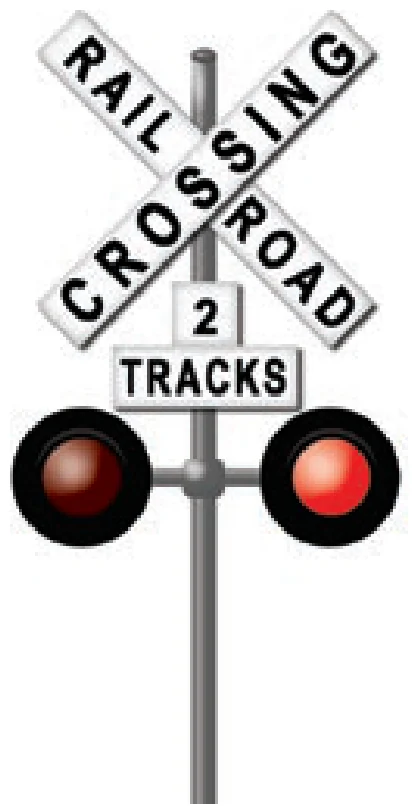
Railroad crossing signs can be round or diamond-shaped, yellow with black symbols, or a white X of black-lettered bars called a crossbuck. A sign below it shows the number of tracks if two or more.

Handbook p. 49 ↗
Railroad crossbuck
Crossbuck with number of tracks and flashing lights

Know the rule

You must yield to all trains. Failing to stop when lights are flashing or a gate is down will get you a citation.

Handbook p. 49 ↗

Know the rule

With two or more tracks, watch for a second train on the other track. Don't enter a crossing until the vehicle ahead has moved far enough for you to clear the tracks.

Handbook p. 49 ↗
Steady green light
Green light and green arrow

Know the rule

Circular green: go straight or turn unless signs or markings forbid it. Turning left on a circular green, you must yield to oncoming vehicles.

Handbook p. 49 ↗

Know the rule

Green arrow: you may make the movement shown. A green left-turn arrow usually means opposing traffic is stopped.

Handbook p. 49 ↗

Know the rule

Steady yellow: the green is ending and red is next. Drive through only if your vehicle clearance is within the intersection. A yellow arrow means the green arrow is ending.

Handbook p. 49 ↗

Know the rule

Steady red: stop and stay stopped until another indication lets you go, unless a green arrow permits your movement. A red arrow means stop and stay stopped for that direction.

Handbook p. 49 ↗

Know the rule

Turn on red: you may turn right on red where two-way streets meet, or left from a one-way street onto another one-way street, after yielding to all traffic and pedestrians, unless a sign forbids it.

Handbook p. 49 ↗
Steady red light
Flashing red

Know the rule

A circular flashing red is the same as a stop sign: stop completely and yield to all traffic and pedestrians. A circular flashing yellow means proceed with caution.

Handbook p. 50 ↗

Know the rule

Signals that are out of order or not needed may be put in flashing mode and then work the same as intersection flashers.

Handbook p. 50 ↗

Put it into practice

You're on a one-way street facing a red light, and the cross street is also one-way to the left. With no NO TURN ON RED sign, you may stop, yield to pedestrians and traffic, then turn left on red.

Check your understanding

Read the question, decide on an answer, then open it to check the explanation. These are Roadwise study questions based on the source handbook.

What should you do if you approach a railroad crossing and the vehicle ahead hasn't cleared the tracks yet?
  1. Enter the crossing immediately behind it
  2. Pull around it into the oncoming lane to cross
  3. Wait until it clears enough space ahead
  4. Drive alongside the vehicle across the tracks

Answer: Wait until it clears enough space ahead

You should not enter a crossing until the vehicle ahead has cleared enough space, or you risk being trapped on the tracks.

Handbook p. 49 ↗
What does a green arrow shown in a left-turn signal usually mean about opposing traffic?
  1. Opposing traffic also has a green light
  2. Opposing traffic is stopped
  3. Opposing traffic must yield only to pedestrians
  4. Opposing traffic can proceed straight only

Answer: Opposing traffic is stopped

A green arrow in a left-turn signal usually means opposing traffic is stopped so the turn can be made safely.

Handbook p. 49 ↗
What must you do when facing a steady circular red traffic light?
  1. Slow down and proceed with caution
  2. Stop only if other traffic is present
  3. Stop and stay stopped until signaled
  4. Proceed if no pedestrians are visible

Answer: Stop and stay stopped until signaled

A steady circular red requires a complete stop, remaining stopped except for a permitted turn on red.

Handbook p. 49 ↗
From a one-way street, when may you legally turn left on a red signal?
  1. Never, left turns on red are always illegal
  2. Only if a police officer directs you to
  3. When turning onto another one-way street, after yielding
  4. When turning onto a two-way street, after yielding

Answer: When turning onto another one-way street, after yielding

A left turn on red is allowed from a one-way street onto another one-way street, after yielding to traffic and pedestrians.

Handbook p. 49 ↗
A circular flashing red light at an intersection is equivalent to what?
  1. A yield sign
  2. A do-not-enter sign
  3. A regular green light
  4. A stop sign

Answer: A stop sign

A circular flashing red functions exactly like a stop sign, requiring a complete stop and yielding.

Handbook p. 50 ↗
At crossings with two or more tracks, you only need to watch for a train on the nearest track.
  1. True
  2. False

Answer: False

With two or more tracks you must be alert for a second train on the other set of tracks.

Handbook p. 49 ↗
Take the lesson checkpoint in the app

More in Signs, Signals, and Markings