roadwise.Open study app

Tennessee driving lesson · Right-of-Way & Required Stops

Emergency vehicles, transit buses & Move Over

A 3-minute lesson from the Tennessee course. Read the rules and examples, follow the handbook page references, and check your understanding before you move on.

Read time
3 minutes
Course unit
Right-of-Way & Required Stops
Checkpoint questions
5
Source pages
68, 69, 86

When sirens sound or you see flashing lights, your job is to clear a path and protect the people working on the roadside. Tennessee law spells out exactly how to pull over and when you must change lanes.

Know the rule

Yield to any police car, fire engine, ambulance or emergency vehicle using a siren, air horn, or red or blue flashing lights: pull parallel and as close as possible to the right edge or curb, stop, and stay until it passes or an officer directs you.

Handbook p. 68 ↗

More emergency-vehicle rules

  • In an intersection? Drive through it first, then pull over
  • Don't pull right where you'd block a side road or driveway
  • At a red light, stay put; if it turns green, wait until the vehicle passes
  • Turn the radio down so you can hear loudspeaker directions
  • More emergency vehicles may follow — proceed with caution
Handbook p. 68 ↗

Know the rule

It's illegal to follow a fire truck or emergency vehicle answering an alarm, to drive within the block where it has stopped, or to drive over an unprotected fire hose without permission.

Handbook p. 68 ↗

Know the rule

Private vehicles may not have blue, or blue-and-red, flashing lights installed or displayed.

Handbook p. 68 ↗

Know the rule

Yield to a transit (metro) bus that has signaled and is pulling back onto the road. Unlike a school bus, you don't have to stop for a transit bus loading passengers and may pass it — carefully.

Handbook p. 68 ↗

Move Over law

On highways with 4+ lanes (2+ each way), move to a lane not next to a stopped emergency, utility, maintenance or tow vehicle with flashing lights; if unsafe, slow down.

Handbook p. 86 ↗

The Move Over law covers stationary:

  • Police and Highway Patrol vehicles
  • Ambulances and fire vehicles
  • Utility vehicles (electric, phone, gas, water) and sanitation trucks
  • Tow trucks and TDOT HELP trucks
  • TDOT maintenance and road contractor vehicles
  • Any vehicle stopped with its emergency flashers on
Handbook p. 86 ↗

Know the rule

Vehicle on the right shoulder? Move left. On the left shoulder? Move right. Only when a lane change is unsafe may you just slow down and stay in your lane.

Handbook p. 86 ↗
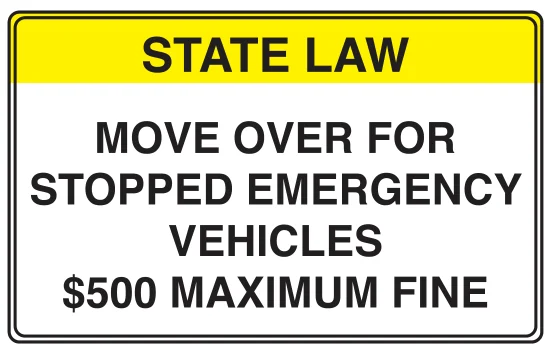
Move over law
Move Over state law sign
6 points

Failing to yield to emergency vehicles, or to move over or slow for vehicles on the roadside

Handbook p. 101 ↗

Put it into practice

On I-24 a tow truck with flashing lights is working on the right shoulder. You're in the right lane. Signal and move one lane left if it's clear. If traffic beside you makes that unsafe, slow down and pass with extra care.

Check your understanding

Read the question, decide on an answer, then open it to check the explanation. These are Roadwise study questions based on the source handbook.

Which action is required when approaching a police car, ambulance, or fire truck using a siren or flashing lights?
  1. Speed up to clear the area quickly
  2. Yield and pull to the right edge, then stop
  3. Stop where you are, even in the intersection
  4. Move into the left lane and keep going

Answer: Yield and pull to the right edge, then stop

You must yield to emergency vehicles and move to a position parallel to and as close as possible to the right curb, then stop.
Handbook p. 68 ↗
If you are already inside an intersection when an emergency vehicle approaches from behind, you should:
  1. Stop where you are and wait
  2. Pull to the right inside the intersection
  3. Clear the intersection, then pull over
  4. Turn onto the cross street at once

Answer: Clear the intersection, then pull over

If already in an intersection, continue through it before pulling over, so you do not block the emergency vehicle's path.

Handbook p. 68 ↗
On a multi-lane highway, if a stationary emergency or utility vehicle has flashing lights on the shoulder, drivers should:
  1. Always stop completely in their lane
  2. Move over into a lane not adjacent to the vehicle, or slow down if unable
  3. Speed up to pass quickly
  4. Only slow down if the vehicle is on the left shoulder

Answer: Move over into a lane not adjacent to the vehicle, or slow down if unable

Tennessee's move-over law requires changing to a lane not adjacent to the stationary vehicle, or reducing speed if changing lanes is unsafe.

Handbook p. 86 ↗
Failure to yield the right-of-way to an emergency vehicle is worth how many points on your driving record?
  1. 3 points
  2. 1 point
  3. 8 points
  4. 6 points

Answer: 6 points

Failing to yield the right-of-way to an emergency vehicle, or failing to move over for one on the roadside, carries 6 points.

Handbook p. 101 ↗
You must yield to a transit (metro) bus that has signaled and is pulling back onto the roadway from a bus stop.
  1. True
  2. False

Answer: True

You must yield the right-of-way to a transit vehicle that has signaled and is re-entering the roadway from a bus stop.

Handbook p. 68 ↗
Take the lesson checkpoint in the app

More in Right-of-Way & Required Stops