roadwise.Open study app

Tennessee driving lesson · Right-of-Way & Required Stops

Right-of-way rules

A 3-minute lesson from the Tennessee course. Read the rules and examples, follow the handbook page references, and check your understanding before you move on.

Read time
3 minutes
Course unit
Right-of-Way & Required Stops
Checkpoint questions
6
Source pages
67, 68

The law doesn't actually give anyone the right-of-way — it only says who must yield. Treat the right-of-way as something you give, not take. If another driver doesn't yield, let them go: avoiding a crash comes first.

Yield to pedestrians:

  • In a marked or unmarked crosswalk, or on your half of the road, or close enough to be in danger
  • Crossing with the light while you turn a corner
  • On the sidewalk as you cross it from a driveway, alley or lot
  • Children playing in the street — slow down near schools, playgrounds, neighborhoods
Handbook p. 67 ↗

Know the rule

It's illegal to drive on a sidewalk except to cross it.

Handbook p. 67 ↗

Know the rule

In a marked school zone with flashers on, stop for a pedestrian in a marked or unmarked crosswalk and stay stopped until they have crossed your roadway.

Handbook p. 67 ↗

Know the rule

For a blind pedestrian with a guide dog or a white (or red-tipped white) cane, or a hearing-impaired person with a dog on a blaze orange leash, stop at least 10 feet away until they're off the road — even outside a crosswalk. Don't honk.

Handbook p. 67 ↗
10 feet

Minimum distance to stop from a blind pedestrian crossing the road

Handbook p. 67 ↗

Yield to other vehicles when:

  • Pulling out from a parked position
  • Entering a main road from a driveway, alley, lot or roadside
  • Entering a roundabout, traffic circle or town square
  • Merging onto a busy highway or interstate
  • A fire vehicle is backing into its station driveway
Handbook p. 67 ↗

Who goes first at intersections

Who goes first at intersections
SituationRule
All-way stopFirst to arrive goes; tie: yield to the right
No signs or signalsYield to a vehicle arriving on your right
T-intersectionRoad that ends yields to both directions
YIELD signSlow or stop for cross traffic
Vehicle already in intersectionYield to it, even on your green
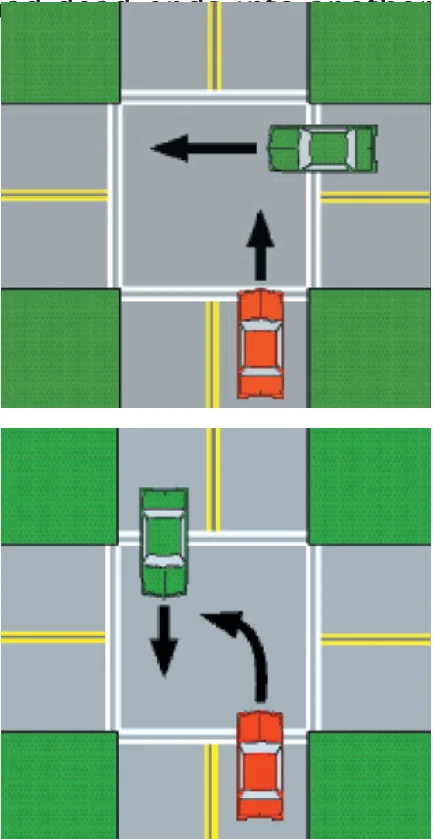
Turning leftYield to oncoming straight/right traffic
Handbook p. 68 ↗

Know the rule

Turning left, you yield to oncoming vehicles — bicycles included — going straight or turning right, unless you have a protected green arrow.

Handbook p. 68 ↗
Right-of-way at intersections
Left turn and vehicle-already-in-intersection situations

Know the rule

If you have the right-of-way and the other driver yields it, go immediately. Don't enter an intersection unless you can get all the way through without stopping.

Handbook p. 68 ↗

Put it into practice

You and another car reach an all-way stop at the same moment; it's on your right. It goes first. If you'd arrived clearly first, you'd go first — but still check that it's actually waiting before you pull out.

Check your understanding

Read the question, decide on an answer, then open it to check the explanation. These are Roadwise study questions based on the source handbook.

At an intersection with no signs or signals, if two vehicles arrive at about the same time, who must yield?
  1. The left driver yields to the right
  2. The driver going straight always yields
  3. The larger vehicle always has the right-of-way
  4. The faster vehicle goes first

Answer: The left driver yields to the right

Where roads cross with no signs or signals, you must yield to any vehicle arriving at the same time on your right.
Handbook p. 67 ↗
At a four-way stop where all vehicles stop, who has the right-of-way?
  1. The first to arrive
  2. The vehicle turning left, always
  3. The largest vehicle present
  4. The vehicle on the busiest road

Answer: The first to arrive

At an all-way stop, the vehicle reaching the intersection first goes first; if simultaneous, yield to the vehicle on the right.

Handbook p. 68 ↗
When turning left at an intersection, you must yield to:
  1. Vehicles waiting at the cross street
  2. Oncoming traffic going straight or right
  3. Pedestrians only, not vehicles
  4. No one, since turning left always has priority

Answer: Oncoming traffic going straight or right

When turning left, you must yield to oncoming vehicles going straight or turning right, unless you have a protected green arrow.

Handbook p. 68 ↗
At a T-intersection where one road dead-ends into a main road, who must yield?
  1. Vehicles on the main road
  2. Whoever is turning left
  3. Traffic on the road that ends
  4. Whoever arrives second

Answer: Traffic on the road that ends

At a T-intersection, vehicles on the ending road must yield to traffic from both directions on the main road.

Handbook p. 68 ↗
When entering a road from a driveway, alley, or parking lot, you must:
  1. Have the right-of-way over all traffic
  2. Only yield to vehicles coming from the left
  3. Only yield if a stop sign is present
  4. Yield to vehicles on the main road

Answer: Yield to vehicles on the main road

When entering a main road from a driveway, alley, or parking lot, you must yield to vehicles already on that road.

Handbook p. 67 ↗
When approaching a blind pedestrian using a white cane or guide dog crossing the roadway, you must:
  1. Stop 10+ feet away until they've crossed
  2. Honk to alert them of your presence
  3. Proceed cautiously without stopping
  4. Only yield if they are in a marked crosswalk

Answer: Stop 10+ feet away until they've crossed

You must stop at least 10 feet away from a blind pedestrian using a white cane or guide dog and not use your horn.

Handbook p. 67 ↗
Take the lesson checkpoint in the app

More in Right-of-Way & Required Stops