roadwise.Open study app

Tennessee driving lesson · Right-of-Way & Required Stops

Stopping at stop signs & signals

A 3-minute lesson from the Tennessee course. Read the rules and examples, follow the handbook page references, and check your understanding before you move on.

Read time
3 minutes
Course unit
Right-of-Way & Required Stops
Checkpoint questions
6
Source pages
63, 64

A legal stop is a complete stop in the right place. Stopping too far forward puts your car in the path of cross traffic or pedestrians; rolling through is illegal and one of the fastest ways to fail your road test.

Know the rule

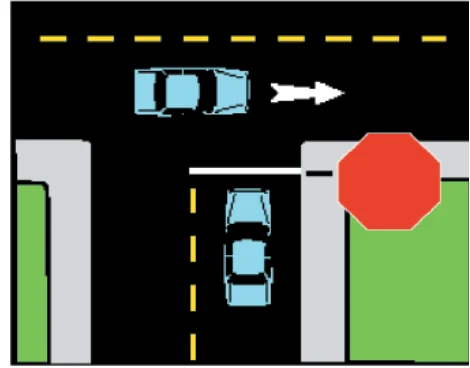
Tennessee law: at a stop sign, stop before the nearest side of the crosswalk or at a marked stop line. If there's neither, stop where you can see traffic on the cross road, nearest that road, before entering the intersection.

Handbook p. 63 ↗

Know the rule

Stop behind the wide white stop line when there is one. With no pavement markings, stop with the front of your car even with the stop sign.

Handbook p. 63 ↗
Stop sign approach lane diagram
Stopping at a stop sign with no stop line

Know the rule

Come to a COMPLETE stop at stop signs and before turning right on red, and go only when traffic is clear — approaching drivers shouldn't have to slow or change lanes for you.

Handbook p. 63 ↗

After you stop

  • If you can't see cross traffic, edge up slowly until you can see both ways
  • With a marked crosswalk, stop before your bumper reaches its nearest line
  • Wait for pedestrians in or about to enter the crosswalk
  • Once it's clear, edge forward to check traffic before crossing
  • At a flashing red light, stop completely just as at a stop sign
  • Stop whenever a flagger or police officer directs you to
Handbook p. 64 ↗

Know the rule

When stopping behind another vehicle, leave a gap: you should see its license plate and/or where its rear tire meets the pavement. When it moves on, pull up to the stop line and stop again.

Handbook p. 64 ↗

Rolling stop

Slowing but not fully stopping at a sign or signal. It's illegal, earns a ticket and fails the road test. You've stopped only when you feel the car lurch forward after all motion has ceased.

Handbook p. 64 ↗

Why rolling stops are dangerous

  • A child or pedestrian may expect you to stop fully
  • A full stop gives you longer to see hazards
  • Two drivers at right angles who both roll almost surely collide
  • Police and insurers hold the driver who didn't stop liable
Handbook p. 64 ↗

Put it into practice

You reach a stop sign where bushes block your view. Stop at the line first, then creep forward slowly until you can see both ways. If a pedestrian steps into the crosswalk while you creep, stop and let them finish.

Check your understanding

Read the question, decide on an answer, then open it to check the explanation. These are Roadwise study questions based on the source handbook.

At a stop sign with no stop line or crosswalk marked, where must you stop?
  1. Exactly 50 feet before the intersection
  2. About 10 feet before the stop sign
  3. Where you can see cross traffic, before entering
  4. Inside the intersection, where you can see best

Answer: Where you can see cross traffic, before entering

With no stop line or crosswalk, you must stop where you have a clear view of approaching traffic before entering the intersection.
Handbook p. 63 ↗
A 'rolling stop,' where a driver slows but never fully stops at a stop sign, is:
  1. Legal if traffic is light
  2. Legal when turning right on red
  3. Allowed if no cars are visible
  4. Dangerous and illegal

Answer: Dangerous and illegal

Rolling stops are dangerous and illegal; a complete stop is required by law at every stop sign.

Handbook p. 64 ↗
If pedestrians are in the crosswalk when you are stopped at an intersection, you must:
  1. Wait until they finish crossing
  2. Proceed once they pass your lane
  3. Edge forward slowly around them
  4. Proceed if you have a green light

Answer: Wait until they finish crossing

If pedestrians are in or about to enter the crosswalk, you must wait for them to cross before proceeding.

Handbook p. 64 ↗
When stopped behind another vehicle at an intersection, a good rule of thumb for a safe gap is to:
  1. Stop about one foot from its bumper
  2. See its rear tires touching the pavement
  3. Stay about five car lengths back
  4. See its roof over your hood

Answer: See its rear tires touching the pavement

You should leave enough of a gap to see the license plate and rear tire of the vehicle ahead, in case it rolls back or stalls.

Handbook p. 64 ↗
A complete stop is considered to have occurred only when:
  1. The car slows to 5 m.p.h.
  2. The driver taps the brake once
  3. You feel the car lurch after all motion stops
  4. The car coasts through at reduced speed

Answer: You feel the car lurch after all motion stops

The handbook says a vehicle has not come to a complete stop until the driver feels the car lurch forward after all motion has ceased.

Handbook p. 64 ↗
Rolling stops are only a minor issue and will not cause you to fail the driving skills test.
  1. True
  2. False

Answer: False

Rolling stops are grounds for both a traffic ticket and failing the road test.

Handbook p. 64 ↗
Take the lesson checkpoint in the app

More in Right-of-Way & Required Stops