A 3-minute lesson from the Tennessee course. Read the rules and examples, follow the handbook page references, and check your understanding before you move on.
Most children hurt around school buses are outside the bus, crossing the road. That's why Tennessee is strict: when a school or church bus shows red lights and its stop arm, traffic stops — from behind and usually from the front, too.
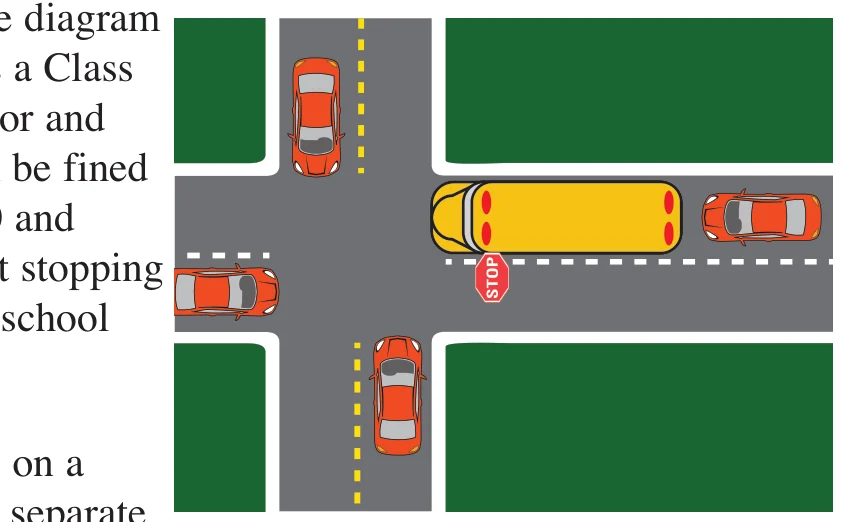
Whether you're meeting it or coming up behind it, stop for a school or church bus with flashing red lights and its stop arm out. Don't move until the red lights go off, the arm is pulled back and the bus begins moving.
You're on a five-lane road (two lanes each way plus a center turn lane). An oncoming school bus stops with red lights flashing. The turn lane isn't a barrier, so you stop too — even though the bus is across the road.
Check your understanding
Read the question, decide on an answer, then open it to check the explanation. These are Roadwise study questions based on the source handbook.
When a school bus has its red stop lights flashing and stop arm extended, meeting traffic must:
Slow down but may proceed carefully
Stop until the arm is withdrawn
Stop only if children are visible
Only stop if directly behind the bus
Answer: Stop until the arm is withdrawn
Any driver meeting a school bus with flashing red lights must stop and remain stopped until the stop arm is withdrawn.
On a divided highway where the roadways are separated by a median or barrier not suitable for vehicular traffic, a driver on the OPPOSITE side of a stopped school bus:
Must always stop regardless of the barrier
Need not stop but should proceed with caution
Must stop only if traveling faster than 45 m.p.h.
Must stop only if children are visible
Answer: Need not stop but should proceed with caution
On a divided highway with a proper median or barrier, the driver need not stop but should proceed with caution.