Nebraska practice test
Nebraska permit practice test.
Get to know the format, try six study questions, and check the explanations before opening a full Roadwise practice test. This course’s simulation is based on the format described below.
- Questions
- 25
- Correct to pass
- 20
- Practice timer
- No timer
- Study question bank
- 683
The format in this course
Nebraska Knowledge (Written) Test
To pass this Roadwise simulation, answer at least 20 of 25 questions correctly. Answers and explanations appear after you finish. Unanswered questions count as incorrect.
This practice format uses one overall passing threshold, without a separately scored sign section.
This Roadwise practice format has no countdown, so you can take the time you need.
The handbook's own 39-question 'Practice Exam' (p.84-85, provided by AAA Nebraska) explicitly states it does not reflect the real test. The actual written knowledge test is 25 questions with a minimum 80% (20 correct) passing score, per DMV examiner policy; there is no separate signs-only section, so the practice test uses one combined score.
Try a few practice questions
Read the question, decide on an answer, then open it to check the explanation. These are Roadwise study questions based on the source handbook.
Which document is NOT accepted as proof of principal address in Nebraska?
- A bank statement issued within 90 days
- A valid Nebraska vehicle registration
- A statement listing only a P.O. Box
- A lease that names the landlord
Answer: A statement listing only a P.O. Box
A P.O. Box cannot be used as proof of principal address.
Handbook p. 18 ↗What is the difference between a license suspension and a revocation?
- Suspension is temporary removal
- They are legally identical in Nebraska
- Suspension is permanent; revocation is temporary
- Revocation only applies to commercial drivers
Answer: Suspension is temporary removal
Suspension is temporary removal of the license; revocation removes the privilege for a set period.
Handbook p. 25 ↗If a traffic signal is completely dark due to a power failure and no officer is directing traffic, treat the intersection as:
- An all-way stop
- A yield-only intersection
- A two-way stop for the side street
- Right-of-way to the busier road
Answer: An all-way stop
A dark signal with no officer present is treated as an all-way stop.
Handbook p. 39 ↗It is unlawful to pass a vehicle within how many feet of an intersection?
- 50 feet
- 100 feet
- 200 feet
- 300 feet
Answer: 100 feet
Passing within 100 feet of an intersection is unlawful.
Handbook p. 61 ↗When you stop for a school bus with its red lights on and STOP arm out, where should you stop?
- Exactly 10 feet from the bus
- A reasonable distance from the bus
- At least 100 feet from the bus
- Right beside the STOP arm
Answer: A reasonable distance from the bus
Stop a reasonable distance from the bus and remain stopped until the driver retracts the stop arm and turns off the red lights.
Handbook p. 78 ↗What does this sign mean?
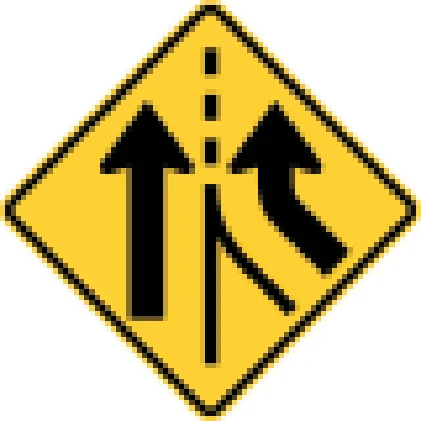
- Horseback riders may cross or use the road ahead.
- Warns that one lane ends and traffic must merge.
- Warns of a series of curves ahead with an advisory speed.
- An additional lane begins ahead without merging.
Answer: An additional lane begins ahead without merging.
Added lane: An additional lane begins ahead without merging. Continue in your lane; no need to merge for the new lane.
Handbook p. 47 ↗What to study next
The practice question pool spans the course. Use the topics below to read the rules behind an answer, then return to practice.
5 lessons
Your License
Documents, testing, classes and renewal
Explore5 lessons
Graduated Driver Licensing
The permit ladder for teen drivers
Explore5 lessons
Suspensions, Revocations & Points
How Nebraska penalizes violations
Explore3 lessons
Alcohol, Drugs & Driving
BAC limits, impairment and getting back on the road
Explore5 lessons
Safety Equipment & Wellness
Belts, air bags, equipment, health and traffic stops
Explore7 lessons
Signals & Signs
Lights, colors, shapes and what they mean
Explore3 lessons
Pavement Markings
What the lines on the road mean
Explore5 lessons
Right-of-Way & Speed
Intersections, roundabouts, emergency vehicles and speed laws
Explore4 lessons
Passing, Turning & Parking
Rules for changing position on the road
Explore2 lessons
Railroad Crossings
Stopping and staying safe around trains
Explore7 lessons
Special Driving Conditions
Interstates, night, weather, distraction and fatigue
Explore6 lessons
Sharing the Road & Crashes
Motorcycles, bikes, pedestrians, buses, trucks and crash duties
Explore