Roadwise States Nebraska Driving lessons Interstate driving Nebraska driving lesson · Special Driving Conditions
Interstate driving A 3-minute lesson from the Nebraska course. Read the rules and examples, follow the handbook page references, and check your understanding before you move on.
Read time 3 minutes
Course unit Special Driving Conditions
Checkpoint questions 6
Source pages 60, 68, 69 In this handbook, "interstate" means any controlled-access, multi-lane highway. Speeds are high, so smooth merging, steady speeds and early planning matter most.
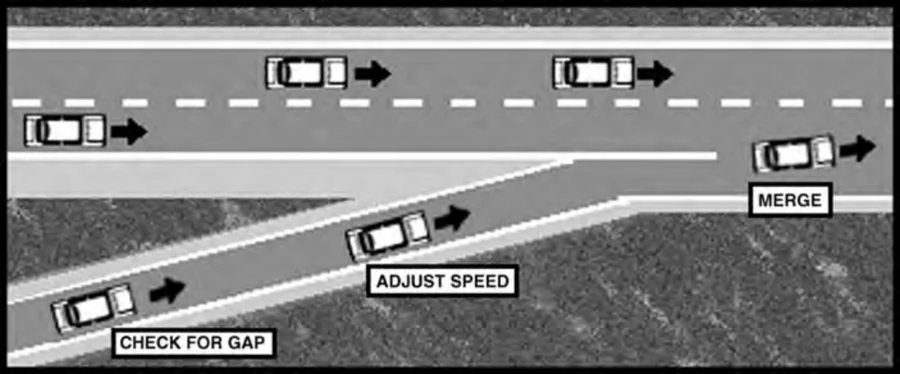
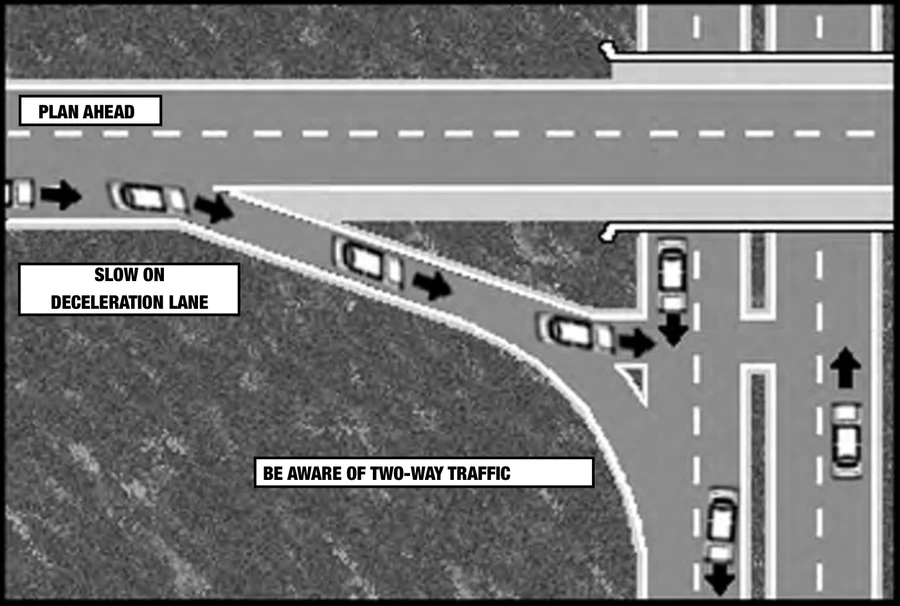
Entering the interstate: check for gap, adjust speed, merge Entering the interstate: Check for a gap in traffic in the nearest lane Notice the solid white line on your left along the ramp When the broken white line begins, adjust speed, signal and merge into a gap when safe Handbook p. 68 ↗ Driving on the interstate: Keep a steady speed with other traffic and obey posted limits Slower traffic keeps right; stay in the right lane unless passing At entrance ramps, if safe, signal and move left to let vehicles enter smoothly Avoid unnecessary lane changes; signal and check blind spots when you do Never back up, use emergency crossovers, or cross the median Handbook p. 68 ↗ Leaving the interstate: plan ahead, slow in the deceleration lane Leaving the interstate: Watch for exit signs and the proper lane for your exit Signal and move into the proper lane a mile or more before the exit Slow down after moving into the deceleration lane Check the advised ramp speed Once off, watch for two-way traffic and check the posted speed limit Handbook p. 68 ↗ Put it into practice
You realize you just passed your exit. Don't stop, back up or use a median crossover. Continue to the next exit and turn around there.
A useful reminder Slow down in the deceleration lane, not on the interstate itself.
Check your understanding Read the question, decide on an answer, then open it to check the explanation. These are Roadwise study questions based on the source handbook.
The minimum speed allowed on the interstate is: 40 MPH 30 MPH 45 MPH 50 MPH Answer: 40 MPH
The interstate minimum speed is 40 mph.
Handbook p. 68 ↗ An 'interstate,' as used in the handbook, refers to: Only highways with the letter 'I' in their number Any controlled-access, multi-lane highway Any highway with a posted speed above 55 MPH Only highways crossing state lines Answer: Any controlled-access, multi-lane highway
An interstate is defined as any controlled-access, multi-lane highway.
Handbook p. 68 ↗ When entering the interstate, you should merge when: You reach the solid white line, regardless of traffic You've traveled the full length of the ramp The broken white line begins and there is a safe gap in traffic Another driver flashes their lights at you Answer: The broken white line begins and there is a safe gap in traffic
Merge once the broken line begins and a safe gap appears.
Handbook p. 68 ↗ If you miss your intended interstate exit, you should: Back up carefully to the exit Use the nearest emergency crossover Stop on the shoulder and wait for a gap Continue to the next exit Answer: Continue to the next exit
Missing an exit means continuing to the next one; backing up is prohibited.
Handbook p. 68 ↗ Crossing the median of an interstate highway is: Allowed in an emergency only Never allowed Allowed if no traffic is visible Allowed at marked crossover points only Answer: Never allowed
Crossing the median is never permitted on the interstate.
Handbook p. 68 ↗ When leaving the interstate, you should move into the proper exit lane: Right at the exit ramp itself A quarter mile before the exit A mile or more before the intended exit Only after you see the deceleration lane begin Answer: A mile or more before the intended exit
Move into the exit lane a mile or more before the exit.
Handbook p. 68 ↗ Previous lesson Stalls, emergencies and train stopping distances Next lesson Night driving More in Special Driving Conditions About the source Roadwise’s Nebraska course uses the driver handbook edition supplied with this study pack. This lesson cites source pages 60, 68, 69. The linked PDF is a third-party mirror of the handbook, rather than a government-hosted page.
Open the handbook source PDF · View the source edition
For current application requirements, fees, appointments, and the format that applies to your age or license type, check Nebraska’s DMV. Roadwise provides study material and does not issue permits or licenses.