A 3-minute lesson from the Nebraska course. Read the rules and examples, follow the handbook page references, and check your understanding before you move on.
Trains can't stop quickly or swerve. Crossings are marked with signs, signals and pavement markings, and you must stop whenever any of them warns of a train.
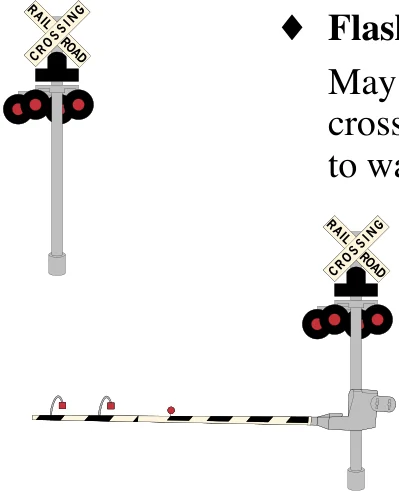
Railroad crossing warnings may include:
A round advance warning sign before the crossing
A crossbuck at the crossing; a number under it means more than one track
A large white X, the letters RR, a no-passing zone and/or a stop line on the pavement
Gates: stop when the lights start to flash, before the gate goes down. Stay stopped until the gates go up and the lights stop flashing. Never drive around the gates; it's dangerous and against the law.
Approach at a constant, controlled speed: fast enough to coast across if the engine stalls, slow enough to stop if necessary. Expect a train on any track at any time.
Red lights start flashing as you approach, and the gate is still up. Stop now, at the stop line or 15 to 50 feet from the nearest rail. Wait until the gates are up and the lights stop, then check for a second train before crossing.
Check your understanding
Read the question, decide on an answer, then open it to check the explanation. These are Roadwise study questions based on the source handbook.
When approaching a railroad crossing, you should drive at a speed that is:
The posted highway speed limit
A constant, controlled speed
10 mph or less at every crossing
Gradually increasing speed
Answer: A constant, controlled speed
Use a constant, controlled speed approaching a crossing.