roadwise.Open study app

Nebraska driving lesson · Right-of-Way & Speed

Right-of-way at intersections

A 3-minute lesson from the Nebraska course. Read the rules and examples, follow the handbook page references, and check your understanding before you move on.

Read time
3 minutes
Course unit
Right-of-Way & Speed
Checkpoint questions
6
Source pages
56, 57, 59, 60

Right-of-way rules decide who goes first when paths cross. They tell you when you must yield. Other drivers may not stop even when you have the right-of-way, so drive defensively.

Know the rule

At an uncontrolled intersection (no signs or signals), when vehicles arrive at about the same time, yield to the vehicle coming from the right.

Handbook p. 56 ↗
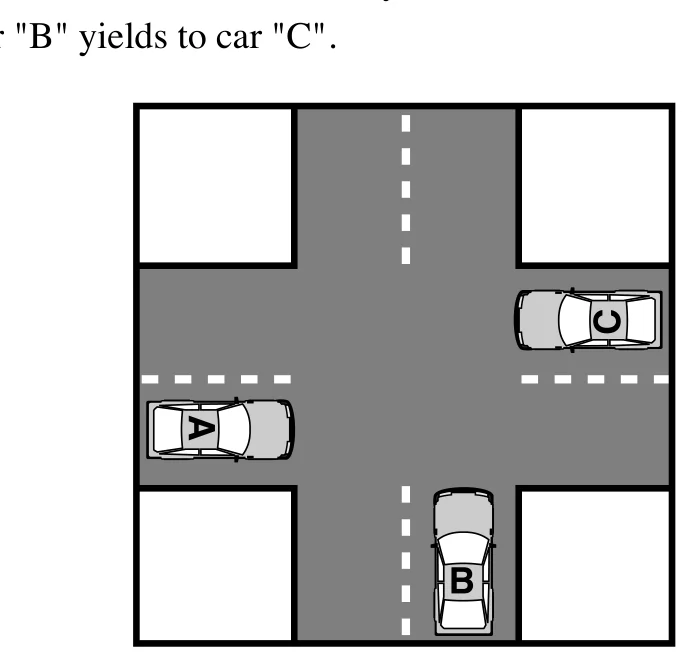
Four-way intersection right-of-way
Uncontrolled intersection with cars A, B and C

In the diagram:

  • Car A, going straight, yields to car B (on its right)
  • If car A turns left, it yields to both B and C
  • Car B yields to car C
Handbook p. 56 ↗

At a Yield sign:

  • Check for cross traffic before reaching the intersection
  • Yield to any cross traffic close enough to cause a conflict
  • When turning onto a street or highway, yield to any vehicle close enough to cause conflict
  • Check for a gap, merge, and adjust your speed
Handbook p. 56 ↗

At a two-way stop:

  • Come to a full stop before entering the intersection
  • Look in all directions for pedestrians and vehicles
  • Wait until all conflicting pedestrians and vehicles have cleared
Handbook p. 56 ↗

Know the rule

At a four-way stop, every driver must stop and then use ordinary care. By courtesy, the driver who stopped first goes first. If in doubt, yield to the driver on your right. Never insist on the right-of-way and risk a collision.

Handbook p. 57 ↗

Know the rule

Leaving an alley, driveway or parking lot: STOP before driving onto the sidewalk or sidewalk area, proceed slowly, and yield to pedestrians and approaching vehicles.

Handbook p. 59 ↗

Know the rule

Always obey a police officer who is directing traffic.

Handbook p. 60 ↗

Put it into practice

You and another driver reach a four-way stop at nearly the same moment, and she's on your right. You can't tell who stopped first, so yield and let her go.

Check your understanding

Read the question, decide on an answer, then open it to check the explanation. These are Roadwise study questions based on the source handbook.

At an uncontrolled intersection with no signs or signals, when vehicles arrive at about the same time, right-of-way goes to:
  1. The vehicle coming from the left
  2. Whichever vehicle is largest
  3. The vehicle on the wider road
  4. The vehicle coming from the right

Answer: The vehicle coming from the right

At an uncontrolled intersection, yield to the vehicle on your right.
Handbook p. 56 ↗
At a 'Yield' sign, before entering the roadway a driver must:
  1. Check for cross traffic and yield to any vehicle close enough to cause conflict
  2. Come to a complete stop regardless of traffic
  3. Proceed immediately if no signal is present
  4. Yield only to vehicles approaching from the right

Answer: Check for cross traffic and yield to any vehicle close enough to cause conflict

Yield signs require checking and yielding to conflicting traffic.

Handbook p. 56 ↗
At a two-way stop intersection, a driver must:
  1. Slow to a rolling stop if the road looks clear
  2. Stop fully
  3. Stop only if another vehicle is visible
  4. Stop only if pedestrians are present

Answer: Stop fully

A two-way stop requires a full stop and checking all directions.

Handbook p. 56 ↗
At a four-way stop, if you're unsure who has the right-of-way, you should:
  1. Proceed first to avoid confusion
  2. Insist on your right-of-way and go
  3. Yield to the driver on your left
  4. Yield to the driver on your right

Answer: Yield to the driver on your right

When in doubt, yield to the driver on your right.

Handbook p. 57 ↗
When leaving an alley or driveway to enter a roadway, a driver must:
  1. Stop before crossing the sidewalk and proceed slowly
  2. Proceed at normal speed if no cars are visible
  3. Only yield to vehicles, not pedestrians
  4. Stop only if a pedestrian is visible

Answer: Stop before crossing the sidewalk and proceed slowly

Drivers must stop before the sidewalk, then proceed slowly and yield.

Handbook p. 59 ↗
If car A is going straight and car B is turning left at an uncontrolled intersection, and both arrive at the same time from opposite directions:
  1. Car A yields to car B in every case
  2. Car B (turning left) yields to car A (going straight)
  3. Whichever car is closer to the center yields
  4. Neither car has to yield

Answer: Car B (turning left) yields to car A (going straight)

A left-turning driver yields to oncoming through traffic.

Handbook p. 56 ↗
Take the lesson checkpoint in the app

More in Right-of-Way & Speed