roadwise.Open study app

Minnesota driving lesson · Sharing the Road

Motorcycles, vulnerable road users and NEVs

A 3-minute lesson from the Minnesota course. Read the rules and examples, follow the handbook page references, and check your understanding before you move on.

Read time
3 minutes
Course unit
Sharing the Road
Checkpoint questions
6
Source pages
4, 52, 53, 54

Motorcycles are small and easy to misjudge, and riders have no protective shell. Minnesota lets motorcyclists split and filter between lanes, and you must not get in their way.

Around motorcycles

  • Their small size makes speed and distance hard to judge
  • Follow at the same or a greater distance than other vehicles — riders may weave
  • Moving in front of one, leave as much space as you would for a car
  • When a motorcycle passes you, keep your lane position and speed
  • Crowding a motorcyclist is illegal — never drive beside one in the same lane
Handbook p. 52 ↗

Lane splitting

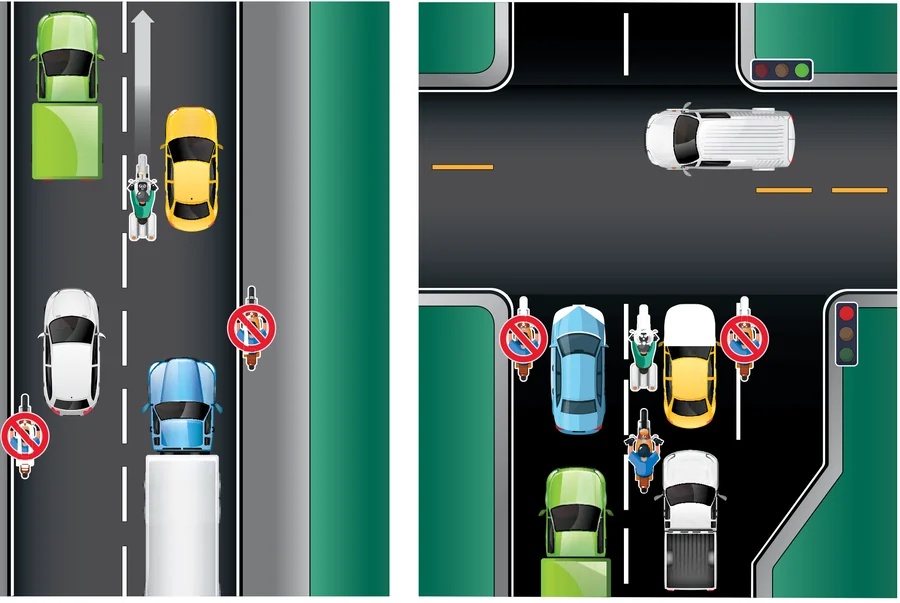
A motorcycle passing in your lane when 2+ lanes go the same way and traffic is moving — at no more than 25 mph and no more than 15 mph faster than traffic.

Handbook p. 53 ↗

Lane filtering

A motorcycle moving through stopped traffic (at a light or jam) with 2+ same-direction lanes, no more than 15 mph faster than traffic.

Handbook p. 53 ↗
Lane splitting and lane filtering (motorcycles)
Lane splitting and lane filtering

Know the rule

Motorcycles may ride or pass between you and the car in the next lane. This is legal, and you may not interfere with their safe movement or try to stop them.

Handbook p. 4 ↗

Know the rule

Crashes at urban intersections are the most common motorcycle-car collisions — often a driver turning left in front of an oncoming motorcycle. Right-of-way laws apply to motorcyclists, and they may use high-occupancy vehicle lanes.

Handbook p. 53 ↗

Vulnerable road users

People on highways, bikeways, sidewalks or trails with less protection than car occupants: riders of two- or three-wheelers, electric mobility devices, horses or scooters, and walkers.

Handbook p. 54 ↗

Know the rule

Share the road safely with vulnerable road users and their passengers; they have no seat belts or airbags. They must also follow all traffic laws.

Handbook p. 54 ↗

Neighborhood electric vehicle (NEV)

An electric vehicle with three or four wheels that can reach 20 to 25 mph. It must be titled and registered with DVS.

Handbook p. 54 ↗

Know the rule

Anyone with a Class D license may drive an NEV, but only on streets with speed limits of 35 mph or less. NEVs can't be used for a road test.

Handbook p. 54 ↗

Put it into practice

Freeway traffic is creeping at 10 mph when a motorcycle rides between your lane and the next at 25 mph. That's legal lane splitting — hold your position and don't drift over to block it.

Check your understanding

Read the question, decide on an answer, then open it to check the explanation. These are Roadwise study questions based on the source handbook.

How should your following distance behind a motorcycle compare to your following distance behind a car?
  1. It can be shorter, since motorcycles are smaller
  2. It doesn't matter at all
  3. It should always be exactly half
  4. It should be the same or greater

Answer: It should be the same or greater

Following distance behind a motorcycle should be the same as, or greater than, that behind a car.
Handbook p. 52 ↗
During lane splitting, a motorcycle may travel no more than how many mph over the speed of surrounding traffic?
  1. 25 mph
  2. 15 mph
  3. 5 mph
  4. 35 mph

Answer: 15 mph

Lane splitting is limited to no more than 15 mph over the speed of traffic in the relevant lanes, and never more than 25 mph itself.

Handbook p. 53 ↗
'Lane filtering' by a motorcycle applies when traffic is:
  1. Moving at highway speed
  2. Moving slowly but not stopped
  3. Stopped
  4. On a one-lane road

Answer: Stopped

Lane filtering lets a motorcycle move through stopped traffic, unlike lane splitting which applies to moving traffic.

Handbook p. 53 ↗
What top speed can a Neighborhood Electric Vehicle (NEV) reach?
  1. Between 20 and 25 mph
  2. Between 35 and 45 mph
  3. Between 10 and 15 mph
  4. Up to 55 mph

Answer: Between 20 and 25 mph

NEVs are electric-powered vehicles that can reach speeds between 20 and 25 mph.

Handbook p. 54 ↗
On what streets may an NEV be legally driven?
  1. Any street, including freeways
  2. Streets posted 35 mph or less
  3. Streets with speed limits over 45 mph only
  4. Only private roads

Answer: Streets posted 35 mph or less

NEVs may only be driven on streets with a posted speed limit of 35 mph or less.

Handbook p. 54 ↗
When lane splitting in moving traffic, what is the fastest a motorcycle may legally travel?
  1. 15 mph
  2. 30 mph
  3. 25 mph
  4. 35 mph

Answer: 25 mph

Lane splitting is allowed at no more than 25 mph and no more than 15 mph over the speed of traffic.

Handbook p. 53 ↗
Take the lesson checkpoint in the app

More in Sharing the Road