roadwise.Open study app

Minnesota driving lesson · Sharing the Road

Sharing the road with trucks and buses

A 4-minute lesson from the Minnesota course. Read the rules and examples, follow the handbook page references, and check your understanding before you move on.

Read time
4 minutes
Course unit
Sharing the Road
Checkpoint questions
5
Source pages
54, 55, 56

Trucks and buses are big, slow to stop and have huge blind spots. Most car-truck crashes come from misjudging a truck's speed or cutting in too close in front of it.

Commercial vehicle

A vehicle or combination over 26,000 pounds used to carry passengers or property. All buses, including school buses, and smaller vehicles with hazmat placards count too.

Handbook p. 54 ↗

Passing a commercial vehicle

  • Passing takes 3 to 5 seconds longer than passing a car
  • Return to the right lane before coming within 100 feet of oncoming traffic
  • If you'll exit or turn soon, stay behind it
  • Uphill: trucks often lose speed, making them easier to pass
  • Downhill: trucks speed up — allow more distance
  • Pass quickly; return only when you see its front in your rearview mirror, and keep your speed
Handbook p. 54 ↗

When a truck passes or meets you

  • Being passed: keep to the far side of your lane and slow slightly — don't speed up
  • Meeting one head-on: stay as far right as possible
  • Wind turbulence pushes vehicles apart, not together
  • Big trucks seem slower than they are — many crashes happen at intersections
Handbook p. 54 ↗

Know the rule

Cutting in close in front of a truck or bus is especially dangerous: you're likely in its blind spot, and it may not be able to slow down in time.

Handbook p. 55 ↗

Stopping distance at 55 mph

Stopping distance at 55 mph
VehicleDistance to stop
Average passenger car130 to 140 feet
Fully loaded tractor-trailerMore than 400 feet
Handbook p. 55 ↗

Following a commercial vehicle

  • Stay back far enough that the driver can see you in the side mirrors
  • At night, always dim your headlights — its big mirrors reflect glare
  • When it merges, be ready to slow down or change lanes; it accelerates slowly
  • Stopped behind it on an upgrade: leave room to roll back and sit left in your lane
Handbook p. 55 ↗

Know the rule

Many trucks make wide right turns and may leave space on the right. Their rear wheels take a shorter path than the front, more so the longer the vehicle. Don't pass on the right if it might turn right.

Handbook p. 55 ↗

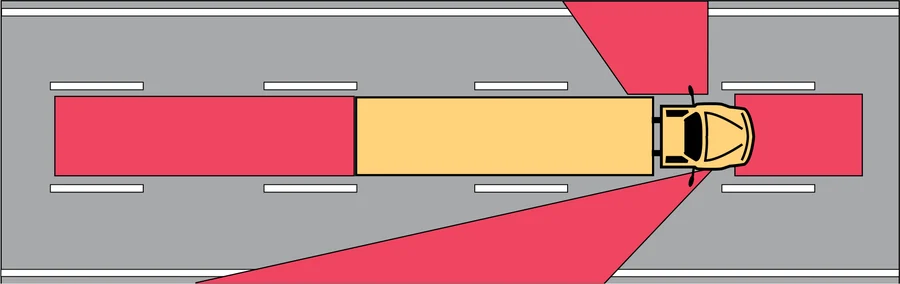
No zones

Blind spots in front, beside and behind a truck. Drivers may not see up to 20 feet in front of the cab, along either side of the trailer, or up to 200 feet behind.

Handbook p. 55 ↗
Commercial vehicle no-zone diagram
Commercial vehicle no zones

Know the rule

Trucks and buses have operating limits and may use speed limiters. Honking, aggressive driving or weaving won't get you there faster and can cause crashes.

Handbook p. 56 ↗

Put it into practice

A truck ahead signals right and swings left to make the turn, leaving a gap at the curb. Don't slip into that gap — its rear wheels will cut in. Wait until the turn is complete.

Check your understanding

Read the question, decide on an answer, then open it to check the explanation. These are Roadwise study questions based on the source handbook.

About how much longer does it take to pass a commercial vehicle compared to a car?
  1. No difference at all
  2. 10 to 15 seconds longer
  3. 3 to 5 seconds longer
  4. About 1 second longer

Answer: 3 to 5 seconds longer

Passing a commercial vehicle takes about three to five seconds longer than passing a car.
Handbook p. 54 ↗
An average passenger car at 55 mph can stop within about how many feet?
  1. 400 feet or more
  2. 50 to 60 feet
  3. 250 to 300 feet
  4. 130 to 140 feet

Answer: 130 to 140 feet

A passenger car traveling 55 mph can typically stop within 130 to 140 feet.

Handbook p. 55 ↗
A fully loaded tractor-trailer at highway speed may need how much distance to stop completely?
  1. More than 400 feet
  2. About 140 feet, same as a car
  3. About 50 feet
  4. About 200 feet

Answer: More than 400 feet

A fully loaded tractor-trailer may need more than 400 feet to stop, far more than a car.

Handbook p. 55 ↗
Truck drivers' blind spots, or 'no zones,' can extend how far behind their trailer?
  1. Up to 20 feet
  2. Up to 200 feet
  3. Up to 50 feet
  4. Up to 500 feet

Answer: Up to 200 feet

A truck's rear 'no zone' blind spot can extend up to 200 feet behind the trailer.

Handbook p. 55 ↗
Commercial vehicles typically need less stopping distance than passenger cars.
  1. True
  2. False

Answer: False

Commercial vehicles, especially loaded tractor-trailers, need significantly more stopping distance than cars.

Handbook p. 55 ↗
Take the lesson checkpoint in the app

More in Sharing the Road