Bicycles are legal vehicles on Minnesota roads with the same rights and responsibilities as other vehicles. Give riders room, check bike lanes before turning, and know what riders may legally do.
Know the rule
You may drive in a bicycle lane only to park (where allowed), to enter or leave the road, or to prepare for a turn. Yield to approaching bicyclists; when the lane is clear, signal and move into it before turning.
Handbook p. 51 ↗Minimum space between your car and a bicyclist you pass
Handbook p. 51 ↗Know the rule
Make sure the bicyclist isn't signaling or making a left turn before you pass. You may cross the center of the road to pass a bicyclist — even in a no-passing zone — when it's safe.
Handbook p. 51 ↗Electric-assist bicycle
A bicycle with an electric motor that helps with pedaling. It follows bicycle rules of the road — unlike a moped, which has a gas engine and different rules.
Handbook p. 51 ↗Bicycle rules
- Ride with the flow of traffic, never against it
- Signal turns and obey all signs, signals and devices
- At stop signs, slow enough to stop; if no vehicle is near, you may go without stopping
- Ride just right of faster traffic; move toward center for hazards, passing or left turns
- Two may ride side by side if they stay in one lane and don't impede traffic
- Wear helmets for safety
- At night use legal lights and reflectors (flashing white front and/or red rear allowed)
- Tires with spikes or other traction features are allowed
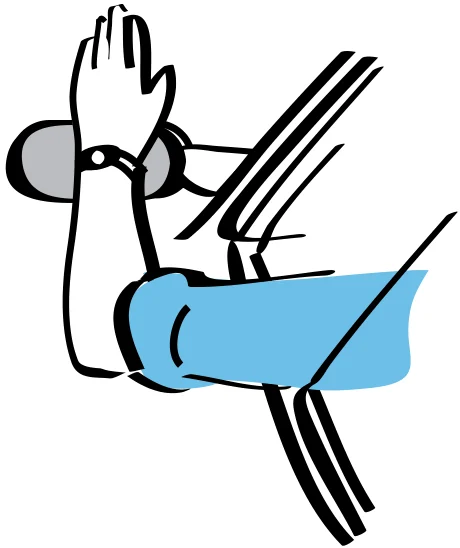
Hand signals (bicyclists and drivers)
| Signal | Arm position |
|---|---|
| Left turn | Left arm straight out |
| Right turn | Left arm out, bent upward (or right arm out) |
| Stop | Left arm out, bent toward the ground |
Bicyclists on sidewalks and crosswalks
- Yield to pedestrians and give an audible signal before passing them
- No riding on sidewalks in a business district unless local authorities allow it
- Local authorities may ban riding on any sidewalk or crosswalk
- On a sidewalk or crosswalk, riders have the same rights and duties as pedestrians
An undetected bicycle may go through a red light after a reasonable time if:
- It has come to a complete stop
- The light has stayed red an unreasonable time, or seems broken or fails to detect it
- No vehicle or person is approaching, or they are far enough away to pose no immediate hazard
Know the rule
This red-light defense covers only entering or crossing on red; it doesn't defend against other civil or criminal actions.
Handbook p. 52 ↗Know the rule
Drivers: watch for bicyclists at intersections, on sidewalks and at alleys and driveways, and be extra careful at night.
Handbook p. 52 ↗Motorized bicycle (moped)
A bicycle defined by a top speed of 30 mph or less. Bicycle rules generally apply, but mopeds are banned from sidewalks, freeways, and pedestrian or bicycle lanes and trails.
Handbook p. 52 ↗Put it into practice
A bicyclist is ahead on a two-lane road with a solid yellow center line, and the oncoming lane is empty. You may cross the center line to give at least 3 feet of space — allowed even in a no-passing zone when safe.