roadwise.Open study app

Massachusetts driving lesson · Right-of-Way, Turns, Lanes & Parking

U-Turns, Three-Point Turns & Backing

A 3-minute lesson from the Massachusetts course. Read the rules and examples, follow the handbook page references, and check your understanding before you move on.

Read time
3 minutes
Course unit
Right-of-Way, Turns, Lanes & Parking
Checkpoint questions
4
Source pages
58, 106, 107

Sometimes you need to reverse direction. A U-turn is quickest where legal and safe; on a narrow street, a three-point turn may be the answer. Both require clear sight lines and patience.

U-turn

A tight left turn that puts you in the opposite direction. Allowed if your path is clear, it's safe, and no NO U-TURN sign is posted.

Handbook p. 106 ↗

Know the rule

Make a U-turn only from the lane closest to the center line, and only with enough room to finish without creating a hazard for oncoming vehicles.

Handbook p. 106 ↗
500 feet

No U-turn at the crest of a hill, near a curve, or anyplace where you or other drivers can't see this far

Handbook p. 106 ↗
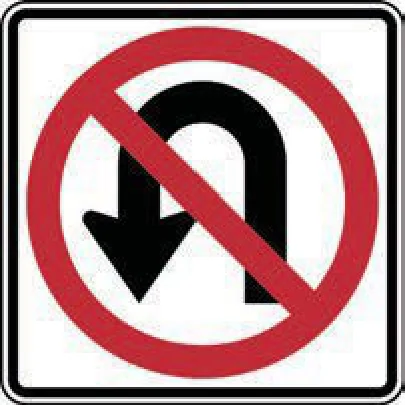
No U-turn
No U-turn sign

Know the rule

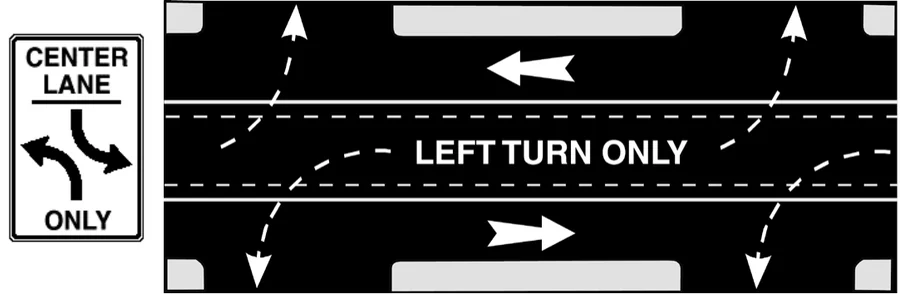
On some two-way roads, a center lane is marked as a common left-turn lane for vehicles in both directions. You may not travel in a center turning lane.

Handbook p. 106 ↗
Two-way left turn lane usage (labeled diagram)
Center left-turn-only lane

Use a three-point turn only when:

  • The street is narrow
  • There is good visibility
  • There are no public driveways to turn into
  • The traffic is light
  • The turn is legal
  • There is no other option
Handbook p. 107 ↗

Three-point turn steps:

  • At the right curb, signal left, check both ways and your blind spot; wait for a 20-30 second gap
  • Move slowly, turning the wheel quickly left; stop about two feet from the far curb
  • Turn the wheel fully right, check traffic, and back up looking over your right shoulder
  • Stop just before the opposite curb
  • Check traffic again, signal left, shift into drive (first gear) and accelerate
Handbook p. 107 ↗

Backing up:

  • Position yourself as close as possible to the right curb
  • Check for traffic in both directions, including your blind spot
  • Shift into reverse and back up looking over your right shoulder, smoothly and within your lane
Handbook p. 107 ↗

Know the rule

Don't rely only on mirrors or sensors when backing: blind spots can hide people. Before getting in, check behind the vehicle for children or animals, and turn your head to look out the window before you back up.

Handbook p. 58 ↗

Put it into practice

On a quiet, narrow street with no driveways, you need to turn around. From the right curb, signal left, wait for a 20-30 second gap in both directions, and then make your three-point turn.

Check your understanding

Read the question, decide on an answer, then open it to check the explanation. These are Roadwise study questions based on the source handbook.

From which lane must you begin a legal U-turn?
  1. The lane next to the center
  2. Any lane you're already in
  3. The rightmost lane only
  4. A dedicated U-turn lane only

Answer: The lane next to the center

A U-turn may only be made from the lane closest to the center line.
Handbook p. 106 ↗
You may not make a U-turn anywhere you or other drivers cannot see how far away?
  1. 200 feet
  2. 500 feet
  3. 300 feet
  4. 1,000 feet

Answer: 500 feet

Do not make a U-turn at the crest of a hill, near a curve, or anyplace where you or other drivers cannot see 500 feet away.

Handbook p. 106 ↗
Before starting a three-point turn, how large a gap in traffic should you wait for?
  1. 5-10 seconds
  2. 10-15 seconds
  3. 45-60 seconds
  4. 20-30 seconds

Answer: 20-30 seconds

Check traffic both ways and wait until you have a 20-30 second gap to complete the turn.

Handbook p. 107 ↗
When backing up, you should look over your right shoulder.
  1. True
  2. False

Answer: True

Shift into reverse and start backing up while looking over your right shoulder.

Handbook p. 107 ↗
Take the lesson checkpoint in the app

More in Right-of-Way, Turns, Lanes & Parking