A 3-minute lesson from the Massachusetts course. Read the rules and examples, follow the handbook page references, and check your understanding before you move on.
Other road users expect you to go straight unless you show otherwise. Signal every move, and turn from and into the proper lane: many motor vehicle crashes are caused by improper turns.
Know the rule
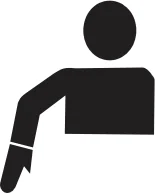
Use signals whenever you stop or make any move in traffic, whatever you drive. If your electronic signals don't work, use the three hand signals through the driver's side window. You must know them to pass the road test.
Before turning, merging, starting from a stop or changing lanes: (1) check your mirrors and the blind spot on that side, (2) signal, (3) make your move. Turn the signal off when you're done. Bicyclists may signal with either arm.
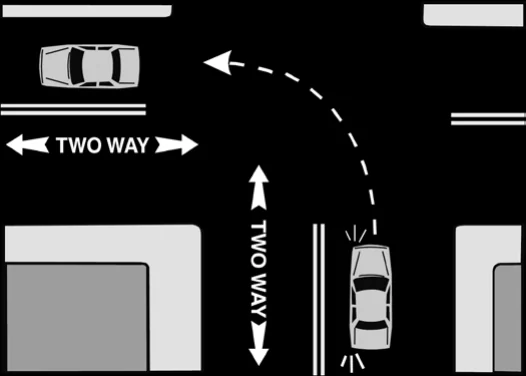
Turn from the lane closest to the lane you want: the far right lane for a right turn, the lane closest to the center for a left turn. Don't swing wide; stay centered in the lanes you leave and enter.
Once you start a turn through an intersection, follow through; don't stop mid-turn and change direction. If you decide not to turn, drive to the next intersection and work your way back.
At a red light, come to a complete stop; then you may turn right, unless NO TURN ON RED is posted, after yielding to pedestrians and vehicles. Left on red is allowed only from a one-way street onto another one-way street, under the same rules.
Halfway through a left turn you realize it's the wrong street. Complete the turn anyway, then continue to the next intersection and work your way back.
Check your understanding
Read the question, decide on an answer, then open it to check the explanation. These are Roadwise study questions based on the source handbook.
On an ordinary road, how far before your turn must you signal?
At least 500 feet
At least 25 feet
At least 100 feet
At least 50 feet
Answer: At least 100 feet
Signal your turn at least 100 feet before making it on an ordinary road.