roadwise.Open study app

Massachusetts driving lesson · Right-of-Way, Turns, Lanes & Parking

Rotaries & Roundabouts

A 3-minute lesson from the Massachusetts course. Read the rules and examples, follow the handbook page references, and check your understanding before you move on.

Read time
3 minutes
Course unit
Right-of-Way, Turns, Lanes & Parking
Checkpoint questions
6
Source pages
109, 110

Rotaries are much more common in Massachusetts than in other parts of the country. Traffic from several roads flows around a central island without a STOP sign or signal, so you must know how to enter, pick a lane and exit.

Know the rule

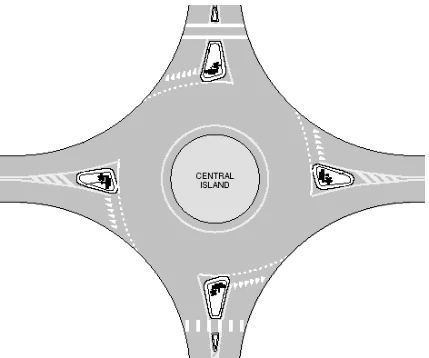
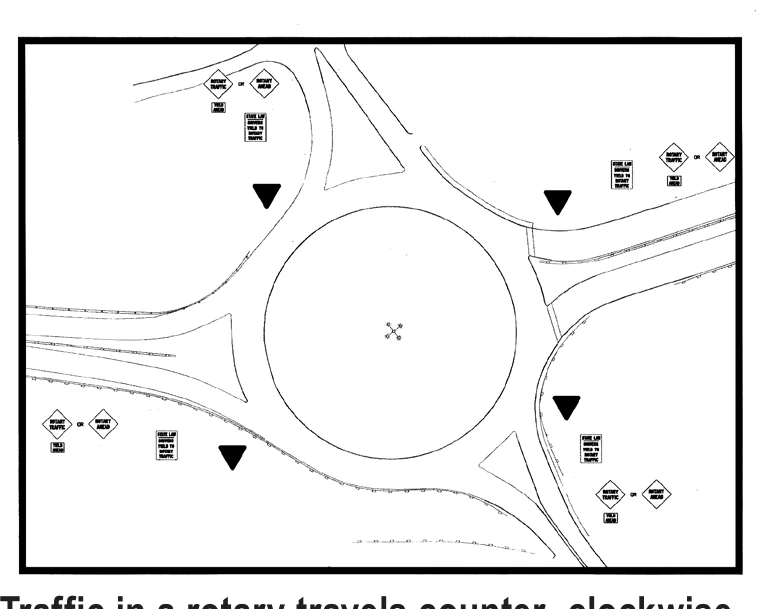
A rotary has YIELD signs at its entrances and a physical barrier (the Central Island) that forces traffic around it. Traffic travels counter-clockwise. Big rotaries are designed for traffic traveling up to 40 miles per hour.

Handbook p. 109 ↗
Rotary (traffic circle) flow diagram
Rotary: yield on entry, traffic travels counter-clockwise

Know the rule

Yield to vehicles already in the rotary (unless signs or police direct otherwise) and to pedestrians. Use your turn signals as at any intersection, and use your right turn signal when you're ready to exit.

Handbook p. 109 ↗

Know the rule

In a single-lane rotary, enter from the right lane of the road you're on and exit onto the right lane of the road you want.

Handbook p. 109 ↗

Multi-lane rotary with no lane signs:

  • Quarter-turn or straight ahead: enter from the right lane, stay in it, exit onto the right lane
  • Three-quarter-turn or U-turn: enter from the left lane, use the middle or inner lane, exit onto the right lane
  • Coming from a single-lane road: stay in the right lane for the entire turn
Handbook p. 109 ↗

Know the rule

In a multi-lane rotary, traffic may be on both sides of you, so don't leave your lane until it's safe. If you miss your exit, don't stop in the rotary: when it's safe, go around again.

Handbook p. 110 ↗

Roundabout

Like a rotary but much smaller, with a smaller central barrier, usually yield lines and crosswalks. Its size requires slowing to 25 mph or less. Choose lanes by the same rules as a rotary.

Handbook p. 110 ↗
Roundabout traffic flow diagram (with crosswalks)
Roundabout

Know the rule

Roundabouts reduce the need to change lanes; look for signs as you approach to find your lane. Their slow speeds make them safe for bicyclists.

Handbook p. 110 ↗

Courtesy crash

A crash caused by drivers trying to be nice: waving someone through stopped traffic, or driving through when waved in. Oncoming traffic keeps the right-of-way no matter who waves.

Handbook p. 110 ↗

Put it into practice

You want to make a U-turn at a two-lane rotary with no lane signs. Enter from the left lane, circle in the inner lane, then signal right and move out to exit onto the right lane when it's safe.

Check your understanding

Read the question, decide on an answer, then open it to check the explanation. These are Roadwise study questions based on the source handbook.

Which direction does traffic travel inside a Massachusetts rotary?
  1. Clockwise
  2. Counter-clockwise
  3. Either direction, driver's choice
  4. It depends on the rotary's size

Answer: Counter-clockwise

Traffic in a rotary always travels counter-clockwise.
Handbook p. 109 ↗
Who has the right-of-way when entering a rotary?
  1. Vehicles entering the rotary
  2. Whoever signals first
  3. Vehicles already inside the rotary
  4. Vehicles on the right side of the entrance

Answer: Vehicles already inside the rotary

You must always yield to vehicles already in the rotary before entering.

Handbook p. 109 ↗
About what speed are large Massachusetts rotaries designed to handle?
  1. Up to 25 mph
  2. Up to 55 mph
  3. Up to 15 mph
  4. Up to 40 mph

Answer: Up to 40 mph

Big rotaries are designed to handle traffic traveling at up to 40 mph.

Handbook p. 109 ↗
Roundabouts generally require drivers to slow to about what speed?
  1. 25 mph or less
  2. 40 mph or less
  3. 15 mph or less
  4. 35 mph or less

Answer: 25 mph or less

Roundabouts require vehicles to reduce speed to about 25 mph or less.

Handbook p. 110 ↗
How should you choose your lane when entering a multi-lane rotary to continue straight ahead?
  1. Enter from the right lane and stay in it
  2. Enter from the left lane and stay in it
  3. Enter from either lane, it doesn't matter
  4. Enter from the center lane only

Answer: Enter from the right lane and stay in it

For a quarter-turn or continuing straight, enter and stay in the right lane.

Handbook p. 109 ↗
You should always come to a complete stop before entering a rotary, even if it's clear.
  1. True
  2. False

Answer: False

A rotary lets you continue through without stopping at a stop sign, as long as you yield to traffic already inside.

Handbook p. 109 ↗
Take the lesson checkpoint in the app

More in Right-of-Way, Turns, Lanes & Parking