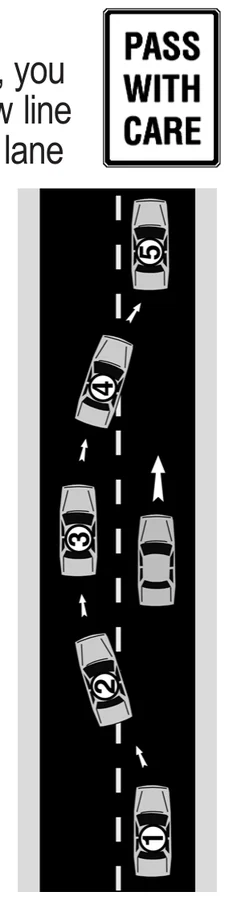
A 3-minute lesson from the Massachusetts course. Read the rules and examples, follow the handbook page references, and check your understanding before you move on.
Passing puts you in space you don't control, sometimes in the oncoming lane. Pass only when it's necessary and safe, and never exceed the speed limit to do it. If you have any doubt, don't pass.
Know the rule
The law requires you to drive on the right side of the road. When passing is allowed, pass on the left; passing on the right is allowed only in certain situations.
On a multiple-lane road with several lanes in one direction, use the middle and left lanes for passing. A broken yellow line on a two-way road lets you cross temporarily into the oncoming lane to pass, if it's safe.
On a two-lane road you're behind a slow car, the line on your side is broken yellow, but a hill limits your view to about 300 feet. Don't pass: you need a clear view of at least 400 feet ahead.
Check your understanding
Read the question, decide on an answer, then open it to check the explanation. These are Roadwise study questions based on the source handbook.
Before crossing a broken yellow line to pass, how far ahead must you be able to see clearly?
At least 200 feet
At least 100 feet
At least 600 feet
At least 400 feet
Answer: At least 400 feet
You must be able to see clearly at least 400 feet ahead before crossing a broken yellow line to pass.