roadwise.Open study app

Massachusetts driving lesson · Right-of-Way, Turns, Lanes & Parking

Parallel Parking & Parking on Hills

A 3-minute lesson from the Massachusetts course. Read the rules and examples, follow the handbook page references, and check your understanding before you move on.

Read time
3 minutes
Course unit
Right-of-Way, Turns, Lanes & Parking
Checkpoint questions
4
Source pages
33, 117, 118

Parallel parking and hill parking are road-test skills and common exam questions. Take it slowly, look where you're going, and set your wheels so a failed brake won't send the car rolling.

Parallel parking steps:

  • Choose a legal space that's long enough for your vehicle
  • Pull alongside the car in front of the space, two or three feet away, bumpers or front seats lined up
  • Look behind you both ways for pedestrians and other traffic
  • Back slowly, turning the wheel all the way toward the curb, with your foot resting lightly on the brake
  • Look directly out the rear window, not in your mirrors
  • When your front passes the parked car's rear bumper, turn the wheel the opposite way and keep backing
  • Straighten your wheels and pull forward, leaving room in front and behind; then shift into park
Handbook p. 117 ↗
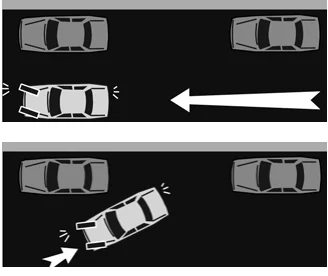
Lane change scenario (composite)
The steps in parallel parking
2–3 feet

Gap between your car and the parked car when you pull alongside to begin parallel parking

Handbook p. 117 ↗

Know the rule

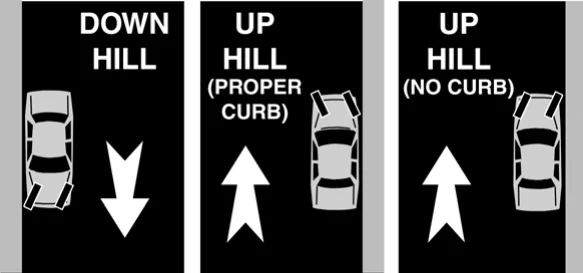
When parking on a hill, always set your parking brake. With an automatic transmission, shift into park; with a manual transmission, leave it in gear. Turn your front wheels so the vehicle won't roll downhill if the brake fails.

Handbook p. 118 ↗

Which way to turn your front wheels

Which way to turn your front wheels
SituationTurn wheels
Downhill against a curbInward, toward the curb
Uphill against a curbOutward, toward the travel lane
No curbInward, toward the edge of the road
Handbook p. 118 ↗
Parking on a hill (downhill/uphill with and without curb)
Wheel positions: downhill, uphill with a curb, uphill with no curb

Know the rule

Parallel parking is one of the skills you must demonstrate on the Class D road test.

Handbook p. 33 ↗

Put it into practice

You park facing uphill on a street with a curb. Turn your front wheels outward, toward the travel lane, set the parking brake, and shift into park (or leave a manual in gear).

Check your understanding

Read the question, decide on an answer, then open it to check the explanation. These are Roadwise study questions based on the source handbook.

When parking downhill against a curb, which way should you turn your front wheels?
  1. Away from the curb, toward traffic
  2. Toward the curb
  3. Straight ahead
  4. It doesn't matter with the brake set

Answer: Toward the curb

Parking downhill against a curb, turn your wheels inward toward the curb.
Handbook p. 118 ↗
When parking uphill against a curb, which way should you turn your front wheels?
  1. Toward the curb
  2. Straight ahead
  3. Away from the curb
  4. Fully to the left regardless of curb

Answer: Away from the curb

Parking uphill against a curb, turn your wheels outward toward the travel lane.

Handbook p. 118 ↗
When parking on a hill where there is no curb, which way should you turn your front wheels?
  1. Toward the travel lane
  2. Toward the edge of the road
  3. Straight ahead
  4. Toward the center line

Answer: Toward the edge of the road

With no curb, turn your wheels inward, toward the edge of the road.

Handbook p. 118 ↗
When you pull up alongside the car in front of a space to parallel park, about how far from it should you be?
  1. 6 to 8 inches
  2. Four or five feet
  3. Two or three feet
  4. One full car width

Answer: Two or three feet

Leave about two or three feet between your vehicle and the parked one before backing in.

Handbook p. 117 ↗
Take the lesson checkpoint in the app

More in Right-of-Way, Turns, Lanes & Parking