roadwise.Open study app

Maryland driving lesson · Signs, Signals & Markings

Pavement markings

A 3-minute lesson from the Maryland course. Read the rules and examples, follow the handbook page references, and check your understanding before you move on.

Read time
3 minutes
Course unit
Signs, Signals & Markings
Checkpoint questions
6
Source pages
24, 25

Pavement markings guide you without making you look away from the road. Color tells direction: yellow separates opposite-direction traffic, white separates same-direction lanes. Solid discourages or forbids crossing; broken permits it.

White lines

White lines
MarkingMeaning
Single broken whiteSame direction; changing lanes permitted
Single solid whiteRight edge; lane changing discouraged
Double solid whiteSame direction; lane changes not allowed
Dotted (white or yellow)Continues lane lines through intersections
Handbook p. 24 ↗

Know the rule

Double solid white lines may also separate general lanes from HOV lanes, or come before obstructions you may pass on either side.

Handbook p. 24 ↗

Yellow lines

Yellow lines
MarkingMeaning
Single broken yellow2-lane, 2-way center line; careful passing
Single solid yellowLeft edge: divided highways, one-way roads, ramps
Double solid yellowOpposite directions; no passing either way
Solid plus broken yellowPass only from the broken-line side
Double broken yellowEdges of reversible lanes
Handbook p. 24 ↗

Know the rule

You may make a left turn across a double solid yellow line, for example into a driveway.

Handbook p. 24 ↗

Know the rule

Solid-plus-broken yellow lines also mark two-way left turn lanes, with solid lines on the outside and broken lines on the inside.

Handbook p. 24 ↗

Divided highway

A road with a guardrail, strip of land, or other barrier between traffic travelling in each direction.

Handbook p. 24 ↗

Word and symbol markings tell you:

  • How to use a lane, and what direction to travel (often with arrows)
  • About lane reductions (e.g., two lanes becoming one)
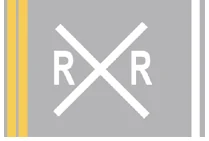
  • 'SCHOOL' and 'RxR': you're approaching a school area or railroad crossing
Handbook p. 25 ↗
Railroad crossing pavement marking
RxR railroad crossing marking

Yield lines

Rows of small triangles across the lane that show where you must yield to other vehicles or pedestrians.

Handbook p. 25 ↗

Know the rule

A stop line is a solid white line showing where to stop for a STOP sign or red signal. Crosswalk lines are solid white lines showing where pedestrians cross.

Handbook p. 25 ↗

Shared-use lane markings (mostly in cities):

  • Alert drivers that bicyclists may be on the road
  • Tell bicyclists where to ride
  • Discourage biking in the wrong direction
Handbook p. 25 ↗

Know the rule

Bike lanes are separated from motor vehicle lanes by solid or broken white lines, and may be marked with signs or bicycle symbols and arrows.

Handbook p. 25 ↗

Put it into practice

On a two-lane road you see a solid yellow line on your side and a broken yellow line on the other. You may not pass, but drivers coming the other way may pass with care. You may still turn left across it into a driveway.

Check your understanding

Read the question, decide on an answer, then open it to check the explanation. These are Roadwise study questions based on the source handbook.

What does a single broken yellow line in the center of a two-lane, two-way road mean?
  1. Passing is never permitted
  2. The road is one-way
  3. It marks the right edge of the road
  4. Careful passing in either direction

Answer: Careful passing in either direction

A single broken yellow center line on a two-lane, two-way road allows careful passing in either direction.

Handbook p. 24 ↗
What does a double solid yellow line mean?
  1. No passing in either direction
  2. Passing is allowed in one direction only
  3. It marks the edge of a bike lane
  4. It only applies to trucks

Answer: No passing in either direction

A double solid yellow line means passing is not allowed in either direction.

Handbook p. 24 ↗
When may you legally cross a double solid yellow line?
  1. To pass a slow vehicle if no traffic is coming
  2. To make a left turn, such as into a driveway
  3. Never, under any circumstance
  4. When the road ahead is straight and clear

Answer: To make a left turn, such as into a driveway

You may cross a double solid yellow line to make a left turn, for example into a driveway.

Handbook p. 24 ↗
On a road with a solid yellow line next to a broken yellow line, who may pass?
  1. Traffic on the broken-line side
  2. Only traffic on the side of the solid line
  3. Traffic in both directions
  4. No traffic may pass

Answer: Traffic on the broken-line side

With a solid-plus-broken yellow line marking, only traffic on the broken-line side may pass; the solid-line side may not.

Handbook p. 24 ↗
What do yield lines look like on the pavement?
  1. A single dashed white line
  2. A double solid yellow line
  3. A row of dots
  4. Rows of small triangles

Answer: Rows of small triangles

Yield lines are rows of small triangles across the lane, showing where a vehicle must yield.

Handbook p. 25 ↗
A single broken white line means crossing from one lane to the other is not permitted.
  1. True
  2. False

Answer: False

A single broken white line separates same-direction lanes where crossing between lanes is permitted.

Handbook p. 24 ↗
Take the lesson checkpoint in the app

More in Signs, Signals & Markings