roadwise.Open study app

Maryland driving lesson · Driving Conditions

Reduced visibility & headlight rules

A 3-minute lesson from the Maryland course. Read the rules and examples, follow the handbook page references, and check your understanding before you move on.

Read time
3 minutes
Course unit
Driving Conditions
Checkpoint questions
6
Source pages
27

When you can't see well, you need to be seen and you need something to steer by. Maryland sets exact rules for when headlights go on and when high beams must come down.

Visibility

Your ability to clearly see everything around you: other vehicles, pedestrians, signs, signals, and pavement markings.

Handbook p. 27 ↗

Most common causes of reduced visibility:

  • Darkness
  • Fog
  • Heavy rain
  • Snow
Handbook p. 27 ↗

In reduced visibility:

  • Use the lines on the edge of the road, or the right side of the road, as a guide
  • Yellow markings should always be on your LEFT, never your right; yellow divides opposite traffic
  • White markings mark the right edge and divide traffic going the same direction
Handbook p. 27 ↗
1,000 feet

Headlights must be on whenever there isn't enough light to clearly see at least this far ahead

Handbook p. 27 ↗

Know the rule

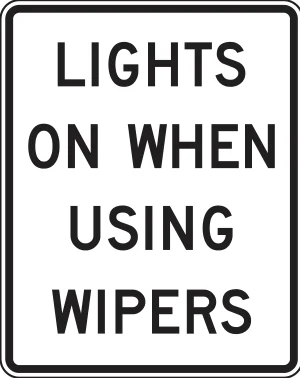
Maryland law requires headlights whenever you use your windshield wipers in inclement (bad) weather.

Handbook p. 27 ↗
Headlights on when using wipers
Lights On When Using Wipers sign

Use low beams when:

  • Driving in normal situations, like at night on a road with streetlights
  • Driving in fog, rain, snow, etc.
  • Entering a tunnel or construction area (not always required by law, but helps others see you)
Handbook p. 27 ↗

Know the rule

Use high beams on roads without streetlights so you can see other vehicles and people.

Handbook p. 27 ↗

When high beams must go to low

When high beams must go to low
SituationSwitch to low beams
Vehicle coming toward youAt least 500 feet before reaching it
Following a vehicleWhen it is 300 feet or less ahead
Handbook p. 27 ↗

Put it into practice

You're on a dark country road with high beams on. A car appears ahead coming toward you. Switch to low beams at least 500 feet before you reach it. Later, closing on a car you're following, dim once you're within 300 feet.

Check your understanding

Read the question, decide on an answer, then open it to check the explanation. These are Roadwise study questions based on the source handbook.

When must you turn on your headlights while driving?
  1. Only after sunset
  2. Only in heavy rain
  3. When you can't see 1,000 feet ahead
  4. Only on roads without streetlights

Answer: When you can't see 1,000 feet ahead

You must turn on your headlights anytime there is not enough light to clearly see at least 1,000 feet ahead.
Handbook p. 27 ↗
Maryland law requires headlights to be on whenever you are using what other feature in bad weather?
  1. Your fog lights
  2. Your rear defroster
  3. Your hazard lights
  4. Your windshield wipers

Answer: Your windshield wipers

Maryland law requires you to turn on your headlights when using your windshield wipers in inclement weather.

Handbook p. 27 ↗
On the left edge of the road, what color are the pavement markings you should expect to see?
  1. Yellow
  2. White
  3. Orange
  4. Blue

Answer: Yellow

Yellow pavement markings mark the left edge of the road and divide opposite-direction traffic; they should never be on your right.

Handbook p. 27 ↗
Reduced visibility is most commonly caused by darkness, fog, heavy rain, and snow.
  1. True
  2. False

Answer: True

The handbook lists darkness, fog, heavy rain, and snow as the most common causes of reduced visibility.

Handbook p. 27 ↗
At least how far before reaching an oncoming vehicle must you switch from high beams to low beams?
  1. 300 feet
  2. 1,000 feet
  3. 100 feet
  4. 500 feet

Answer: 500 feet

You must change to low beams at least 500 feet before reaching oncoming vehicles.

Handbook p. 27 ↗
How close can you be behind another vehicle before you must switch from high beams to low beams?
  1. 300 feet or less
  2. 500 feet or less
  3. 1,000 feet or less
  4. 100 feet or less

Answer: 300 feet or less

You must switch to low beams when following a vehicle that is 300 feet or less in front of you.

Handbook p. 27 ↗
Take the lesson checkpoint in the app

More in Driving Conditions