roadwise.Open study app

Maine driving lesson · Managing Speed, Space and Visibility

Space to the side and behind, and gaps to merge or cross

A 4-minute lesson from the Maine course. Read the rules and examples, follow the handbook page references, and check your understanding before you move on.

Read time
4 minutes
Course unit
Managing Speed, Space and Visibility
Checkpoint questions
5
Source pages
87, 88, 89

You also need room beside you to react to sudden moves, and a big enough gap whenever you merge, cross or enter traffic. When you do those things, it's your job to fit in without making others brake.

Keeping space to the side:

  • Don't drive alongside others on multi-lane roads; pull ahead or drop back
  • Don't crowd the center line; keep right except to pass
  • Make room for vehicles entering multi-lane roads by moving over a lane or slowing
  • At freeway exits, don't drive alongside other cars
  • Keep space from parked cars; people may step out or cars may pull out
  • Give more space to pedestrians, children and bicyclists
  • When a tractor-trailer passes you, move to the right side of your lane
Handbook p. 87 ↗

Know the rule

The driver behind you controls the space behind you more than you do. Help by keeping a steady speed and signaling early before slowing or turning.

Handbook p. 88 ↗

Know the rule

If you're being tailgated and there's a lane to your right, move over. If not, wait until the road ahead is clear, then slow down gradually to encourage the tailgater to pass.

Handbook p. 88 ↗

Know the rule

Split the difference: with parked cars on the right and oncoming cars on the left, steer a middle course between them.

Handbook p. 88 ↗

Know the rule

Take dangers one at a time: with an oncoming car and a bicyclist ahead, slow down, let the car pass, then move left and give the bicyclist plenty of room (three feet).

Handbook p. 88 ↗
Safe passing distance for bicyclists
Wait for the oncoming car, then pass the bicyclist
4 seconds

Gap you need to merge, change lanes or enter a freeway

Handbook p. 89 ↗

Know the rule

Don't squeeze into a gap that's too small. To cross several lanes, change one lane at a time; stopping to wait for all lanes to clear ties up traffic.

Handbook p. 89 ↗

Gaps needed from a full stop

Gaps needed from a full stop
ManeuverCity streetHighway
Cross traffic / get movingAbout ½ blockAbout 1 block
Enter a lane of trafficAbout ⅔ blockAbout 2 blocks
Handbook p. 89 ↗

When crossing traffic:

  • Stop halfway only if a median is large enough to hold your car
  • Make sure no cars or people block your path ahead or to the side
  • Even on a green light, don't start across if cars block your way
  • Don't turn because an approaching car signals; wait until it starts to turn (signals may be left on)
Handbook p. 89 ↗

Put it into practice

You want to turn right onto a highway from a stop sign. A car's coming about one block away. That's enough to cross, but to enter its lane you need about two blocks, so wait for a bigger gap.

Check your understanding

Read the question, decide on an answer, then open it to check the explanation. These are Roadwise study questions based on the source handbook.

What gap do you generally need to safely merge into traffic or change lanes?
  1. A 10-second gap
  2. A 1-second gap
  3. A 2-second gap
  4. A 4-second gap

Answer: A 4-second gap

Anytime you merge with traffic, you need a gap of about four seconds to merge safely.
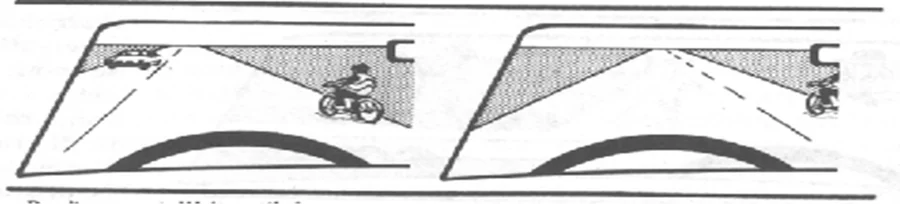
Handbook p. 89 ↗
From a complete stop, about how big a gap do you need to cross traffic on a city street?
  1. About two blocks
  2. About one car length
  3. About a full block
  4. About half a block

Answer: About half a block

From a full stop, you need a gap of about half a block on city streets to get moving.

Handbook p. 89 ↗
From a stop, about how big a gap do you need to turn into a lane of existing traffic on a highway?
  1. About half a block
  2. About a full block
  3. About two blocks
  4. About two-thirds of a block

Answer: About two blocks

To enter a lane of existing traffic you need a gap of about two blocks on the highway (two-thirds of a block in the city).

Handbook p. 89 ↗
What should you do if you notice a driver behind you following too closely and a lane to your right is open?
  1. Speed up to create distance
  2. Brake suddenly to discourage tailgating
  3. Move over to encourage them to pass
  4. Flash your brake lights repeatedly

Answer: Move over to encourage them to pass

If followed too closely and a lane to the right is available, move over to encourage the tailgater to pass.

Handbook p. 88 ↗
Crossing several lanes at once should be done in a single continuous movement rather than one lane at a time.
  1. True
  2. False

Answer: False

If you must cross several lanes, change lanes one at a time rather than trying to cross all at once.

Handbook p. 89 ↗
Take the lesson checkpoint in the app

More in Managing Speed, Space and Visibility