Roadwise States Maine Driving lessons Following distance Maine driving lesson · Managing Speed, Space and Visibility
Following distance A 3-minute lesson from the Maine course. Read the rules and examples, follow the handbook page references, and check your understanding before you move on.
Read time 3 minutes
Course unit Managing Speed, Space and Visibility
Checkpoint questions 6
Source pages 85, 86 The space in front of you is the space you control best. Keep at least four seconds behind the vehicle ahead, and add more whenever conditions or the vehicle ahead call for it.
Space cushion The space you keep between your vehicle and other road users on all sides. The more space, the more time you have to react.
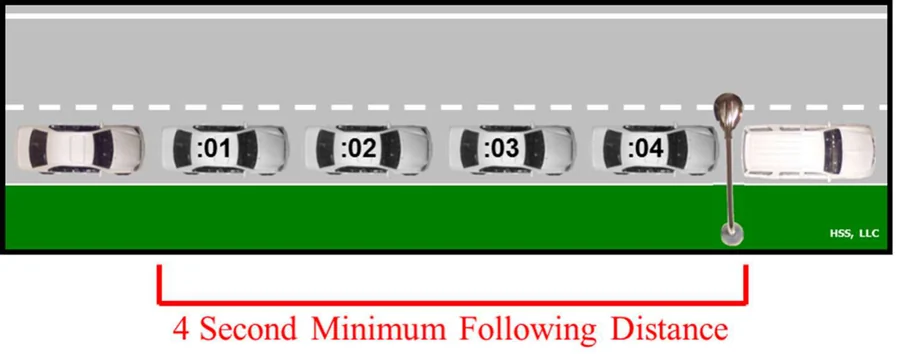
Handbook p. 85 ↗ Checking your following distance: Watch the rear of the vehicle ahead pass a sign, pole or other fixed point Count: "one-thousand-one, one-thousand-two, one-thousand-three, one-thousand-four" If you reach the point before you finish counting four, you're too close Slow down and check again until you're no closer than four seconds Handbook p. 85 ↗ 4 second minimum following distance Increase your following distance: On slick or slippery roads Behind motorcycles or bicycles (falls are likeliest on wet, icy, metal or gravel surfaces) When the driver behind wants to pass: slow a bit to help them Behind large vehicles or vehicles pulling a trailer At night, in fog or in bad weather Behind vehicles that stop at railroad crossings When you're pulling a trailer or carrying a heavy load When speeds are high When stopped on a hill: the vehicle ahead may roll back Handbook p. 86 ↗ Following trucks, tractor-trailers and buses: Stay far enough back that the driver can see you in the mirrors and you can see the road ahead They often make wide turns: don't pass on the right if they may be turning right They gain speed going downhill and lose it climbing; consider this before passing When stopped behind one, especially on a hill, leave space in case it rolls back Handbook p. 86 ↗ Know the rule
School buses and tank trucks carrying flammable liquids must stop at all railroad crossings. Expect the stop and slow down early.
Handbook p. 86 ↗ Put it into practice
It's raining and you're behind a motorcycle. The rider passes a bridge sign and you reach it at "one-thousand-three." That's too close even for dry roads; drop back well beyond four seconds, because a fall is likeliest on wet or metal surfaces.
A useful reminder Four seconds is the minimum, not the goal. Add time for weather, night, bikes, trucks and hills.
Check your understanding Read the question, decide on an answer, then open it to check the explanation. These are Roadwise study questions based on the source handbook.
On slippery roads, you should follow more closely than usual to keep the car ahead from cutting in. True False Answer: False
On slippery roads, you should increase, not decrease, your following distance.
Handbook p. 85 ↗ What is the minimum recommended following distance in good conditions? 4 seconds 6 seconds 8 seconds 2 seconds Answer: 4 seconds
Keep at least 4 seconds between your car and the vehicle in front in good conditions.
Handbook p. 85 ↗ How do you measure your following distance using a fixed point? Use your speedometer reading alone Count seconds from when the car ahead passes it until you reach it Check the gap in your side mirror Estimate distance in car lengths only Answer: Count seconds from when the car ahead passes it until you reach it
Watch when the vehicle ahead passes a fixed point, then count seconds until you reach the same point.
Handbook p. 85 ↗ Why should you increase your following distance when behind a motorcycle or bicycle? Motorcycles brake slower than cars You need extra room to avoid the rider if they fall Riders often stop without signaling Motorcycles have larger blind spots Answer: You need extra room to avoid the rider if they fall
If the cyclist falls, you'll need extra distance to avoid striking the rider.
Handbook p. 85 ↗ Which situation calls for an extra following-distance cushion, beyond the standard 4 seconds? Following a small passenger car Driving on a clear, dry highway Following a vehicle pulling a trailer Driving at low speed in town Answer: Following a vehicle pulling a trailer
You should increase following distance behind vehicles whose rearward view may be blocked, like those pulling trailers.
Handbook p. 86 ↗ You should always leave a larger following-distance cushion when stopped behind a vehicle on a hill. True False Answer: True
You should allow a space cushion when stopped on a hill, since the vehicle ahead may roll back.
Handbook p. 86 ↗ Previous lesson Speed limits and stopping distance Next lesson Space to the side and behind, and gaps to merge or cross More in Managing Speed, Space and Visibility About the source Roadwise’s Maine course uses the driver handbook edition supplied with this study pack. This lesson cites source pages 85, 86. The linked PDF is a third-party mirror of the handbook, rather than a government-hosted page.
Open the handbook source PDF · View the source edition
For current application requirements, fees, appointments, and the format that applies to your age or license type, check Maine’s BMV. Roadwise provides study material and does not issue permits or licenses.