roadwise.Open study app

Maine driving lesson · Managing Speed, Space and Visibility

Looking behind and giving problem drivers room

A 3-minute lesson from the Maine course. Read the rules and examples, follow the handbook page references, and check your understanding before you move on.

Read time
3 minutes
Course unit
Managing Speed, Space and Visibility
Checkpoint questions
4
Source pages
77, 78, 79

Knowing what's behind you is as important as seeing ahead. And some road users are more likely to make a sudden move: learn to spot them and give them extra room.

Every 6 to 8 seconds

How often to check your mirror for traffic behind you

Handbook p. 77 ↗

Know the rule

Check behind when changing lanes, slowing down or stopping, before entering an intersection, and whenever you slow quickly, back up or drive down a long or steep hill.

Handbook p. 77 ↗

Check behind before you slow down when:

  • You slow for something in the road the driver behind can't see (e.g., a stalled car past a corner)
  • You're turning into a side road or driveway, especially one just before a large intersection
  • You're stopping to pull into a parking space
  • You're slowing or stopping for pedestrians
Handbook p. 78 ↗

Drivers who can't see you:

  • Drivers at intersections or driveways whose view is blocked by buildings, trees or cars
  • Drivers backing out of driveways or parking spaces
  • Drivers whose windows are covered with snow or ice
Handbook p. 78 ↗

People who may be distracted:

  • Delivery workers
  • Construction workers
  • Children, who often run into the street without looking
Handbook p. 78 ↗

People who may be confused:

  • Tourists, often at complicated intersections
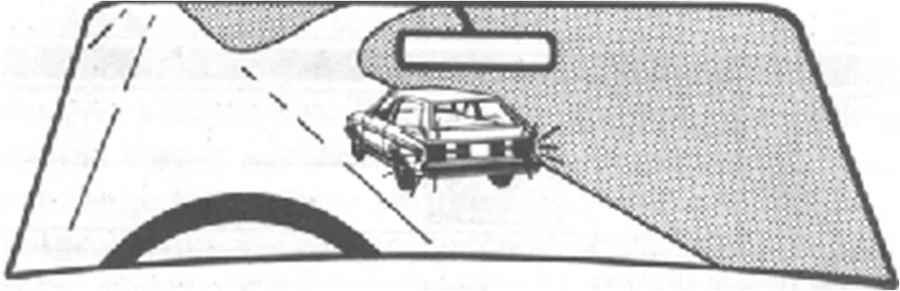
  • Drivers who slow down for no clear reason; a car that brakes in an exit lane may swing back into yours
Handbook p. 79 ↗

Drivers in trouble, and how to help:

  • A driver passing as you approach a curve or oncoming car: slow down and let them back in
  • Forced into your lane by a car, pedestrian, bicyclist, obstruction or narrowing road: slow and move right
Handbook p. 79 ↗

Know the rule

Going up a long or steep hill, check your mirrors: truck and bus drivers often build up speed to make it up the next hill. If you see them early, you can change lanes.

Handbook p. 79 ↗
Anticipating unpredictable driver behavior
A driver who pulled into the exit lane and braked may swing back

Put it into practice

An oncoming car pulls out to pass a truck just as you approach a curve, and it's not going to make it. Slow down and let it get back into its own lane.

Check your understanding

Read the question, decide on an answer, then open it to check the explanation. These are Roadwise study questions based on the source handbook.

About how often should you check your mirrors for traffic behind you?
  1. Only at intersections
  2. Every 30 seconds
  3. Only when changing lanes
  4. Every 6 to 8 seconds

Answer: Every 6 to 8 seconds

Check your mirror often for traffic behind you, about every 6 to 8 seconds.
Handbook p. 77 ↗
You should check behind you whenever you slow down quickly, back up, or drive down a long, steep hill.
  1. True
  2. False

Answer: True

The handbook lists these as situations when you need to look behind you.

Handbook p. 78 ↗
Why check your mirror before slowing to turn into a driveway just before a large intersection?
  1. The driver behind won't expect you to slow there
  2. Traffic behind has the right-of-way there
  3. You must stop fully before any driveway
  4. Brake lights are hard to see there

Answer: The driver behind won't expect you to slow there

When the turn is just before a large intersection, a driver behind won't expect you to slow where you do and may be too close.

Handbook p. 78 ↗
An oncoming driver is passing another car as you approach a curve. What should you do?
  1. Flash your high beams and hold speed
  2. Speed up to clear the curve first
  3. Slow down and let them back in their lane
  4. Move left to give them room

Answer: Slow down and let them back in their lane

Help drivers in trouble: slow down and let a driver who is passing as you approach a curve back into their lane.

Handbook p. 79 ↗
Take the lesson checkpoint in the app

More in Managing Speed, Space and Visibility