roadwise.Open study app

Maine driving lesson · Turns, Lane Changes, Passing and Parking

Roundabouts and changing lanes

A 3-minute lesson from the Maine course. Read the rules and examples, follow the handbook page references, and check your understanding before you move on.

Read time
3 minutes
Course unit
Turns, Lane Changes, Passing and Parking
Checkpoint questions
6
Source pages
62, 63, 64

In a roundabout, everyone travels the same way and the traffic already circling has priority. For any lane change, mirrors alone aren't enough: turn your head to check the blind spot.

Traffic circle / roundabout

A circular intersection, often built where heavily traveled roads meet. Large traffic circles are called rotaries.

Handbook p. 62 ↗

Know the rule

Vehicles approaching a traffic circle or roundabout must yield to vehicles already in it, unless a police officer or traffic control device directs otherwise.

Handbook p. 62 ↗

Know the rule

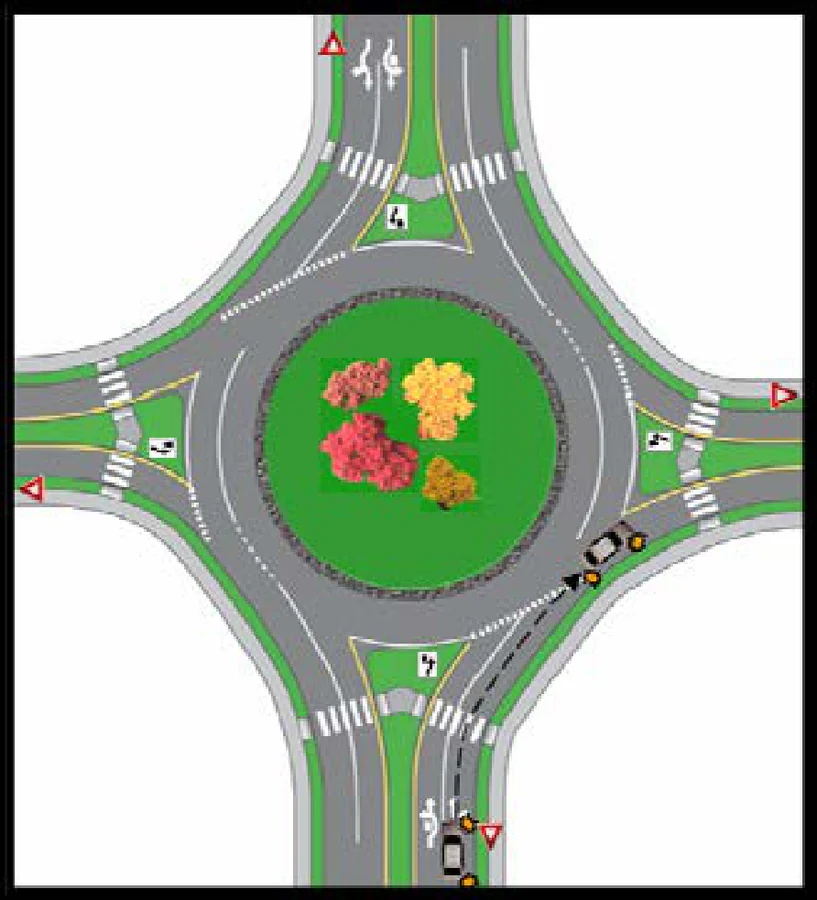
Go to the right around the raised center island (counterclockwise). Raised pavement inside the circle lets trucks get around the small island while cars stay in the outer lane.

Handbook p. 62 ↗

Know the rule

In a rotary, travel counterclockwise at a slow speed, yield to vehicles on your left, and exit with a right turn.

Handbook p. 63 ↗

Know the rule

If you'll leave the rotary within two exits, use the rightmost lane unless markings or signs say otherwise.

Handbook p. 63 ↗

Using traffic circles:

  • Slow down to enter the circle
  • Yield to the traffic in the circle
  • Enter to the right and follow the lane lines
  • Signal your exit
Handbook p. 63 ↗
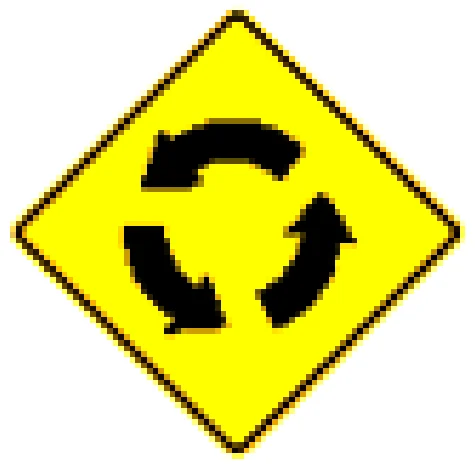
Roundabout ahead
Traffic circle ahead
Roundabout
Moving counterclockwise through a roundabout

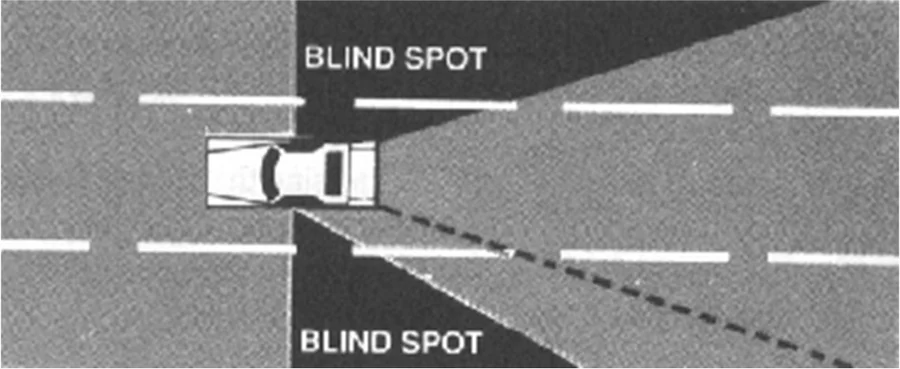
Blind spot

An area around your vehicle that your mirrors don't cover, created by things like headrests and door pillars. You must turn your head to see it.

Handbook p. 63 ↗

Changing lanes:

  • Check your mirrors
  • Check your blind spot by looking over your shoulder toward your move
  • Find a gap, signal, then look again
  • Adjust speed and move into the lane
  • Cancel your turn signal after the lane change
Handbook p. 63 ↗
Blind spot zones
Blind spots beside and behind your car

Changing lanes includes:

  • Moving from one lane to another
  • Entering a freeway or highway from an entrance lane
  • Entering the roadway from the curb or shoulder
Handbook p. 64 ↗

Know the rule

Check behind quickly and check all lanes: someone in another lane may be heading for the same spot. Watch for motorcycles and bicycles; the car you don't see is the most dangerous.

Handbook p. 64 ↗
100 feet

Signal at least this far before a lane change

Handbook p. 64 ↗

Put it into practice

You're in a two-lane rotary and plan to leave at the second exit. Stay in the right lane, yield to cars coming from your left as you enter, and signal before you turn right to exit.

Check your understanding

Read the question, decide on an answer, then open it to check the explanation. These are Roadwise study questions based on the source handbook.

Who has the right-of-way when entering a roundabout?
  1. Whoever signals first
  2. Vehicles already in the circle
  3. The vehicle entering the circle
  4. The vehicle on the right

Answer: Vehicles already in the circle

All vehicles approaching a roundabout must yield to vehicles already in the circle.
Handbook p. 62 ↗
In which direction do you travel around a roundabout in Maine?
  1. Whichever way is shorter
  2. To the left (clockwise)
  3. Either direction is fine
  4. To the right (counterclockwise)

Answer: To the right (counterclockwise)

You enter a roundabout by proceeding to the right around the center island, counterclockwise.

Handbook p. 62 ↗
How do you exit a roundabout?
  1. By making a left turn
  2. By making a right turn
  3. From the inner lane only
  4. By yielding, then turning left

Answer: By making a right turn

Exit from the circle or roundabout is made by making a right turn.

Handbook p. 63 ↗
Before changing lanes, what should you check in addition to your mirrors?
  1. The lane markings ahead
  2. Only the rearview mirror
  3. Your turn signal indicator
  4. Your blind spot, by looking over your shoulder

Answer: Your blind spot, by looking over your shoulder

You must check your blind spot by turning your head, since mirrors alone don't cover it.

Handbook p. 63 ↗
How far before a lane change or turn should you signal, at minimum?
  1. 50 feet
  2. 300 feet
  3. 200 feet
  4. 100 feet

Answer: 100 feet

Always signal what you intend to do at least 100 feet before making a change.

Handbook p. 64 ↗
What causes blind spots around your vehicle?
  1. Headrests and door pillars that block your vision
  2. Tinted glass only
  3. Sun glare on the windshield
  4. Dirty windows only

Answer: Headrests and door pillars that block your vision

Blind spots are areas around your vehicle caused by headrests and door pillars, not covered by mirrors.

Handbook p. 63 ↗
Take the lesson checkpoint in the app

More in Turns, Lane Changes, Passing and Parking