roadwise.Open study app

Maine driving lesson · Turns, Lane Changes, Passing and Parking

Parking rules

A 3-minute lesson from the Maine course. Read the rules and examples, follow the handbook page references, and check your understanding before you move on.

Read time
3 minutes
Course unit
Turns, Lane Changes, Passing and Parking
Checkpoint questions
6
Source pages
69, 70, 71

A parked car shouldn't be a hazard. Park close to the curb, make sure the car can't roll, and know where parking is banned: near hydrants, crosswalks, fire stations and in accessible spaces.

Know the rule

Park parallel to the road except where angle parking lines are painted, and leave at least two feet between your car and vehicles in front and behind.

Handbook p. 69 ↗

Parking properly:

  • Always park in a marked parking area
  • Move as far from driving lanes as possible; pull onto a shoulder as far as you can
  • At a curb, park as close as you can, no more than 18 inches away
  • Set the parking brake and shift to park (first or reverse in a manual car)
Handbook p. 69 ↗

Parking on a hill

Parking on a hill
SituationTurn wheels
DownhillTo the right (toward the curb or road edge)
Uphill without a curbTo the right (off the road)
Uphill with a curbTo the left
Handbook p. 70 ↗

Know the rule

Turn your wheels so that if the car rolls, the curb stops it or, with no curb, the car rolls off the road and not into traffic.

Handbook p. 70 ↗

Know the rule

Get out on the curb side if you can. If you must use the street side, check for traffic, especially bicycles, before opening the door. Turn off the engine, remove the key, and lock the car if it will be out of sight.

Handbook p. 70 ↗

Municipal ordinances may ban parking:

  • In a space reserved for persons with disabilities without a permit or plates ($100 fine)
  • In a loading zone
  • Within 10 feet of a fire hydrant
  • Within 15 feet of a fire station driveway entrance, or directly across from it
  • Within 15 feet of a crosswalk
  • At entrances to schools, churches, theaters, hotels, hospitals or public places during posted hours
Handbook p. 70 ↗

Know the rule

State law prohibits misuse of disability plates and placards ($100 fine).

Handbook p. 70 ↗

Know the rule

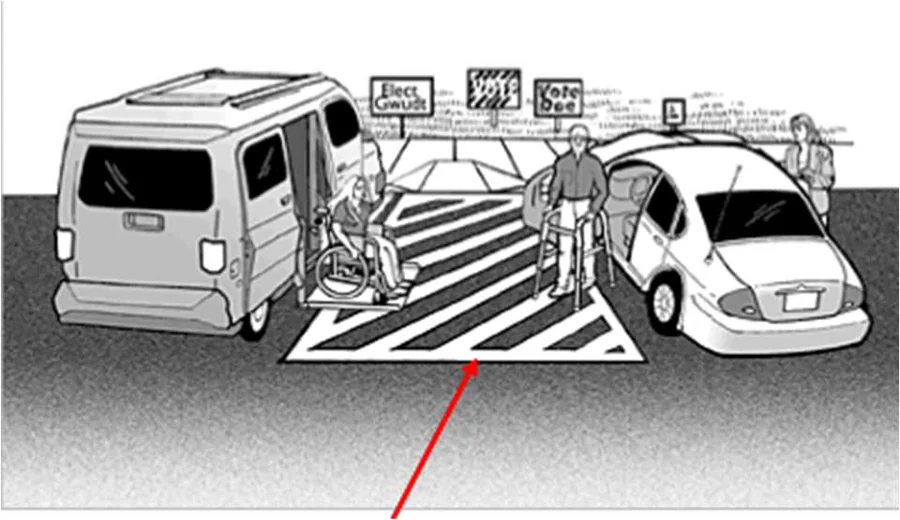
Parking in an access aisle is prohibited. A driver with a disability plate or placard uses the aisle to get in or out, for example with a platform lift or other mobility device. Misusing an access aisle carries a fine of not less than $200.

Handbook p. 70 ↗
Access aisle obstruction
Access aisle beside a disability parking space

Know the rule

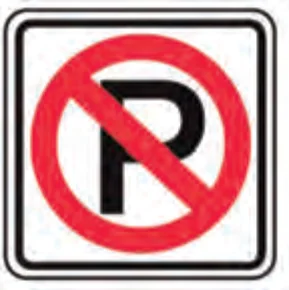
Check for signs or painted curbs that ban or limit parking; some no-parking zones are shown by colored curb markings.

Handbook p. 71 ↗
No parking
No parking

Put it into practice

You park uphill on a street with a curb. Turn your wheels left, away from the curb, so if the car rolls back the front tire catches against it. Set the parking brake and shift to park.

Check your understanding

Read the question, decide on an answer, then open it to check the explanation. These are Roadwise study questions based on the source handbook.

How close to a fire hydrant is it generally prohibited to park?
  1. Within 10 feet
  2. Within 20 feet
  3. Within 5 feet
  4. Within 25 feet

Answer: Within 10 feet

Many municipal ordinances prohibit parking within 10 feet of a fire hydrant.
Handbook p. 70 ↗
How close to a marked crosswalk is it generally prohibited to park?
  1. Within 15 feet
  2. Within 10 feet
  3. Within 5 feet
  4. Within 25 feet

Answer: Within 15 feet

Parking is prohibited within 15 feet of a crosswalk under many local ordinances.

Handbook p. 70 ↗
At most, how far from the curb should your vehicle be when parked?
  1. 6 inches
  2. 48 inches
  3. 18 inches
  4. 36 inches

Answer: 18 inches

If there is a curb, park as close to it as you can, but no more than 18 inches away.

Handbook p. 69 ↗
What is the minimum fine for misusing a disability access aisle?
  1. $50
  2. $200
  3. $500
  4. $100

Answer: $200

Misuse of an access aisle is a traffic infraction subject to a fine of not less than $200.

Handbook p. 70 ↗
When parking downhill without a curb, which direction should you turn your wheels?
  1. To the right
  2. To the left
  3. It does not matter
  4. Straight ahead

Answer: To the right

Turn your wheels to the right when parking downhill, or uphill without a curb.

Handbook p. 70 ↗
How much space should you leave between your parked car and the vehicles in front and behind?
  1. At least 6 inches
  2. At least 2 feet
  3. At least 5 feet
  4. No space is required

Answer: At least 2 feet

Leave at least two feet of space between your car and vehicles parked in front or behind.

Handbook p. 69 ↗
Take the lesson checkpoint in the app

More in Turns, Lane Changes, Passing and Parking