roadwise.Open study app

Maine driving lesson · Turns, Lane Changes, Passing and Parking

Passing and school buses

A 4-minute lesson from the Maine course. Read the rules and examples, follow the handbook page references, and check your understanding before you move on.

Read time
4 minutes
Course unit
Turns, Lane Changes, Passing and Parking
Checkpoint questions
6
Source pages
66, 67, 68, 69

Passing on a two-lane road means borrowing the oncoming lane, and oncoming cars close the gap fast. Know how much room a pass takes, where you must never pass, and when a school bus stops everyone.

Know the rule

To pass on a two-lane road you must use the lane that belongs to oncoming cars. Signal, and pass only when the way is clear.

Handbook p. 66 ↗
10 to 12 seconds

Time needed to pass safely at 50 to 55 mph

Handbook p. 66 ↗

To pass:

  • Check for oncoming traffic
  • Check mirrors and over your shoulder
  • Signal
  • Steer into the passing (left) lane and adjust your speed
  • Wait until you can see the entire passed vehicle in your rearview mirror
  • Signal and check over your shoulder before returning to the right lane
  • Steer back, adjust your speed and cancel your signal
Handbook p. 66 ↗

Know the rule

When being passed, stay in your lane and hold a steady speed. If the passer drops back behind you, you may need to speed up before an oncoming vehicle arrives.

Handbook p. 67 ↗
1,600 feet

About one-third of a mile: room you need to pass safely at highway speed (you and an oncoming car each cover 800+ ft)

Handbook p. 67 ↗

Never pass:

  • When there's an oncoming vehicle too close; oncoming cars seem slower than they are
  • Within one-third of a mile of a hill or curve that blocks your view (treat it like an oncoming car)
  • At intersections, crossroads and shopping center entrances
  • When approaching a railroad crossing or bridge
Handbook p. 67 ↗

You may lose your passing space to:

  • People or bikers near the road
  • A narrow bridge
  • A patch of ice, broken pavement or something on the road
Handbook p. 67 ↗

Know the rule

Don't pull out unless you know you have room to return. Don't count on passing several cars at once, or on other drivers making room for you.

Handbook p. 67 ↗

Know the rule

Maine law requires you to complete a pass before reaching the start of a no passing zone. You may pass where the center line is broken on your side and no oncoming cars are in the passing lane.

Handbook p. 68 ↗

Know the rule

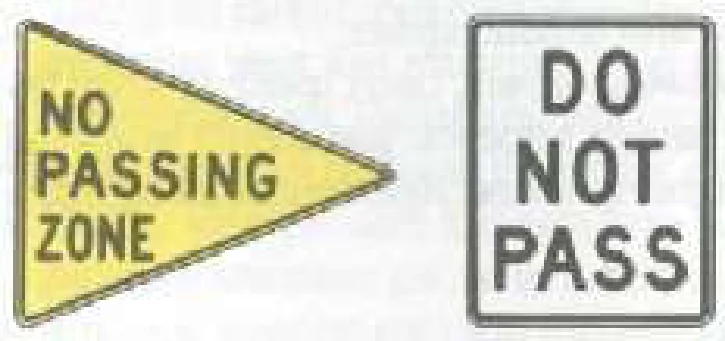
Don't pass where a yellow pennant NO PASSING ZONE sign is on the left of the road or a white rectangular DO NOT PASS sign is on the right.

Handbook p. 68 ↗
No passing zone pennant and Do Not Pass sign
No Passing Zone pennant and Do Not Pass sign

Know the rule

Passing a bicyclist, slow down and leave at least three feet between the right side of your vehicle and the bicycle.

Handbook p. 68 ↗

Know the rule

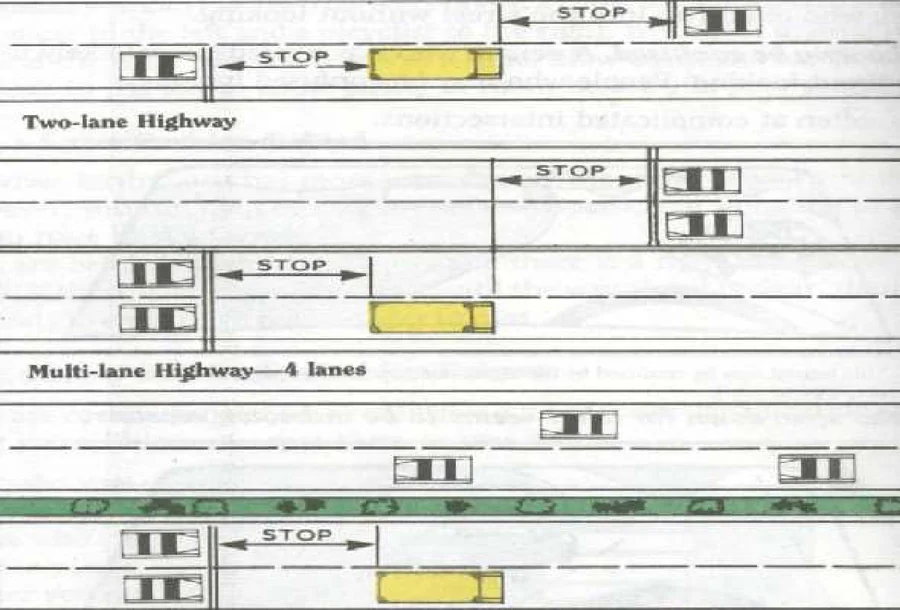
It is illegal to pass a stopped school bus with red lights flashing on school property or any undivided highway or parking area. From either direction, stop in front of or behind the bus and wait until it moves or the driver signals you.

Handbook p. 68 ↗

Know the rule

On a multi-lane divided highway, stop for a school bus with red lights flashing and/or stop arm out. If a solid divider separates you from the bus, you don't have to stop. After the lights stop, go slowly and watch for children.

Handbook p. 69 ↗
School bus stopping rules by road type
When to stop for a school bus on two-lane and multi-lane roads

Put it into practice

On a two-lane road you're behind a slow truck with a hill 1,000 feet ahead. That's inside one-third of a mile, so treat the hill as an oncoming car and don't start the pass.

Check your understanding

Read the question, decide on an answer, then open it to check the explanation. These are Roadwise study questions based on the source handbook.

At highway speeds of 50 to 55 mph, about how many seconds does it take to complete a pass safely?
  1. 20 to 25 seconds
  2. 10 to 12 seconds
  3. 3 to 5 seconds
  4. 30 to 40 seconds

Answer: 10 to 12 seconds

At highway speeds you need from 10 to 12 seconds to complete a pass safely.
Handbook p. 66 ↗
About how much distance do you need to safely complete a pass at highway speed?
  1. About 500 feet
  2. About 3,000 feet
  3. About 1,000 feet
  4. About 1,600 feet (a third of a mile)

Answer: About 1,600 feet (a third of a mile)

You need over 1,600 feet, or about a third of a mile, to pass safely at highway speed.

Handbook p. 67 ↗
How should you treat a hill or curve that blocks your view when deciding to pass?
  1. Pass quickly before reaching it
  2. It only matters at night
  3. Treat it as if an oncoming car is hidden behind it
  4. Ignore it if traffic seems light

Answer: Treat it as if an oncoming car is hidden behind it

Any time your view is blocked by a curve or hill, assume there is an oncoming car just out of sight.

Handbook p. 67 ↗
Maine law requires that you complete a pass before reaching what?
  1. The next marked intersection only
  2. The beginning of a no-passing zone
  3. Any curve found in the road
  4. A bridge, regardless of markings

Answer: The beginning of a no-passing zone

Maine law requires that you complete a pass before you reach the beginning of a no-passing zone.

Handbook p. 68 ↗
Is it legal to pass a stopped school bus with red lights flashing on an undivided highway?
  1. Yes, from the opposite direction only
  2. Yes, if no children are visible
  3. Yes, if you slow down first
  4. No, it is illegal in either direction

Answer: No, it is illegal in either direction

It is illegal to pass a stopped school bus with red lights flashing on an undivided highway.

Handbook p. 68 ↗
What must you do when you approach a stopped school bus with its red lights flashing?
  1. Only stop if you are directly behind it
  2. Stop and wait until the bus resumes motion or the driver signals
  3. Stop only if children are visible
  4. Slow down and proceed carefully

Answer: Stop and wait until the bus resumes motion or the driver signals

You must stop and wait while children board or exit, and not proceed until the bus moves or signals you.

Handbook p. 68 ↗
Take the lesson checkpoint in the app

More in Turns, Lane Changes, Passing and Parking