Maine driving lesson · Right-of-Way, Signals, Signs and Markings
Pavement markings and lane use
A 4-minute lesson from the Maine course. Read the rules and examples, follow the handbook page references, and check your understanding before you move on.
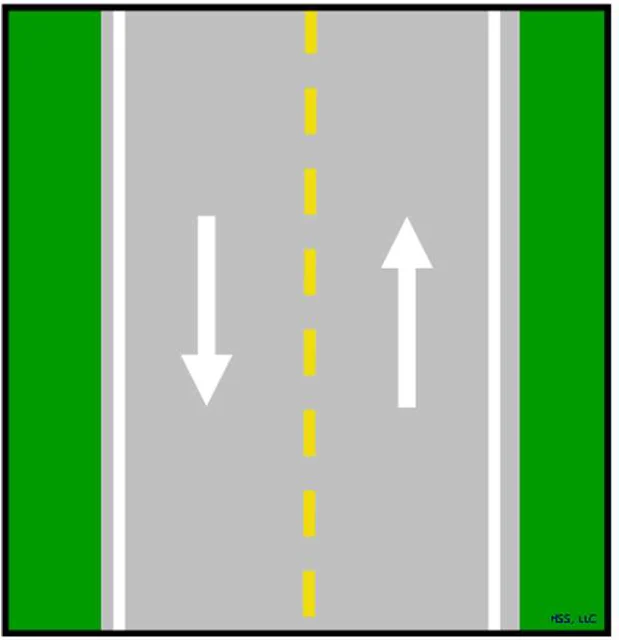
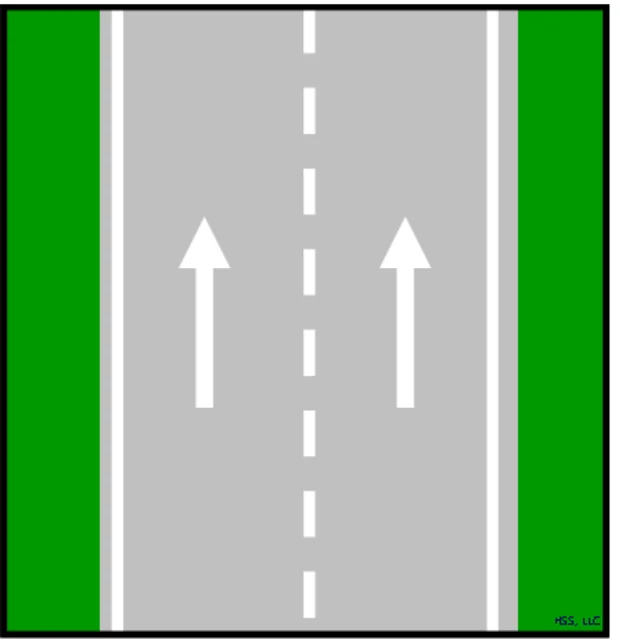
Painted lines tell you who's going which way and when you may change lanes or pass. Yellow separates opposite directions; white separates lanes going the same way.
Know the rule
Pavement markings divide lanes, show where you may pass or change lanes, mark turn lanes and crosswalks, and show where to stop for signs or signals.
Yellow broken center line: two-way road, passing permittedSolid and broken yellow: passing permitted only from the side with the broken lineDouble solid yellow: passing prohibited in both directionsBroken white: one-direction road, passing permitted
Know the rule
Solid white lines separate same-direction lanes with different uses and discourage lane changes. Broken white lines separate same-direction lanes and allow safe lane changes.
With three or more lanes one way, the middle lane is usually smoothest; the left lane is for passing or turning left, the right for slower traffic and vehicles entering or leaving. With two lanes one way, the right lane is generally smoothest.
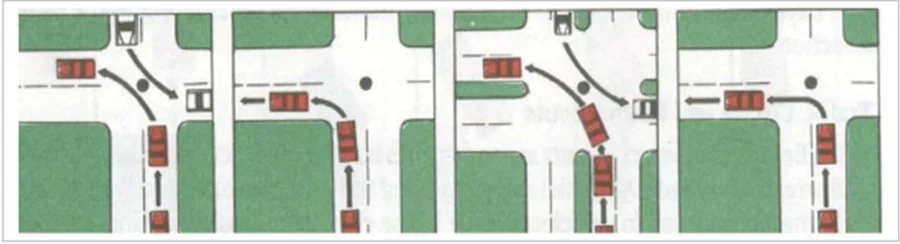
Turn from the lane closest to where you want to go. For a left turn, approach in the lane nearest the center line, pull toward the middle of the intersection with wheels straight, then turn into the leftmost lane going your way.
For a right turn, start from the rightmost lane, stay close to the curb, and turn into the rightmost lane. From a one-way street, set up for a left turn close to the left curb; change lanes only after finishing the turn.
Left turns: two-way to two-way, one-way to one-way, divided to divided, two-way to one-way
Know the rule
If you've started through an intersection or into a turn, follow through. If you made a mistake, go on to the next intersection and work your way back.
You're waiting to turn left across a two-lane road. Keep your wheels pointed straight ahead until the gap comes; if someone rear-ends you, you'll roll forward instead of into oncoming traffic.
Check your understanding
Read the question, decide on an answer, then open it to check the explanation. These are Roadwise study questions based on the source handbook.
What does a solid white line painted between same-direction lanes indicate?
The lane is for turning only
Lane changes are discouraged
Lane changes are required
Traffic moves in opposite directions
Answer: Lane changes are discouraged
Solid white lines separate lanes with different uses and discourage changing lanes.
White lane markings divide traffic moving in opposite directions, while yellow markings divide lanes moving the same direction.
True
False
Answer: False
False. It is the reverse: yellow markings separate traffic moving in opposite directions, and white markings separate lanes moving in the same direction.