roadwise.Open study app

Maine driving lesson · Right-of-Way, Signals, Signs and Markings

Yielding the right-of-way

A 4-minute lesson from the Maine course. Read the rules and examples, follow the handbook page references, and check your understanding before you move on.

Read time
4 minutes
Course unit
Right-of-Way, Signals, Signs and Markings
Checkpoint questions
6
Source pages
48, 49, 50

Right-of-way rules decide who goes first when there are no signs, signals or police. They have the force of law, but a good driver never insists on them: never assume you have the right-of-way.

Know the rule

A driver who has the right-of-way should use it sensibly and never insist on it. Always look at the situation and think about your own safety.

Handbook p. 48 ↗

At intersections:

  • 4-way stop: everyone stops, and the driver who reaches the intersection first goes first
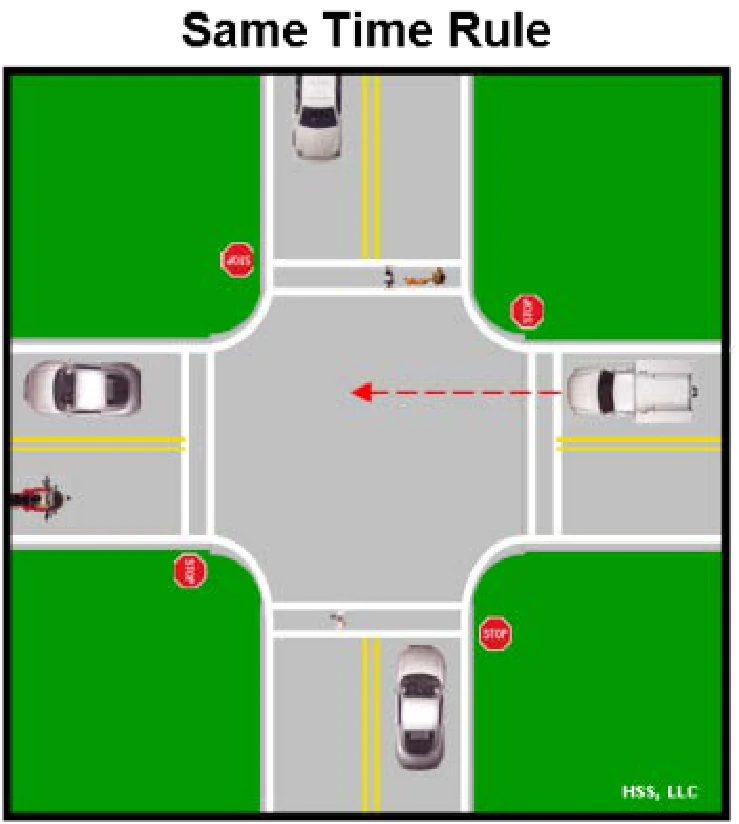
  • 4-way stop, arriving at the same time beside each other: the driver on the right goes
  • Arriving at the same time from opposite directions, one signaling a turn: the car going straight goes
Handbook p. 48 ↗
Four-way stop same-time rule
Same time rule: yield to the driver on your right
Four-way stop same-time rule
First car rule: the first vehicle to arrive goes first

More yielding rules:

  • Uncontrolled intersection, arriving at about the same time: yield to the car on your right
  • Yield to vehicles that have already entered the intersection
  • Entering a traffic circle: the vehicle already in the circle has the right-of-way
  • From a private drive or road: yield to every vehicle and pedestrian on the public way
  • On an entrance ramp: drivers already on the interstate have the right-of-way
  • Starting from a parked position: wait for all moving traffic to pass
  • Never pass a vehicle stopped for pedestrians in a crosswalk
Handbook p. 49 ↗

Know the rule

Emergency vehicles with a siren and flashing light, from any direction: immediately drive to the right side of the road, clear of any intersection, and stop until they pass. Failing to do so is a Class E crime.

Handbook p. 49 ↗

Know the rule

A driver turning left must yield to bicycle and roller ski operators coming from the opposite direction and may not turn unless it can be done safely without interfering with them.

Handbook p. 49 ↗

Yield to pedestrians:

  • In a marked crosswalk when there are no traffic lights or police at the intersection
  • When you're turning a corner and they're crossing with the light
  • When you cross a sidewalk: from a driveway or alley, stop before the sidewalk
  • Always yield to school children crossing a street
Handbook p. 49 ↗

Traffic controls

Traffic signals, signs and road markings, plus directions from law enforcement, highway workers and school crossing guards.

Handbook p. 50 ↗

Know the rule

You may not drive through a parking area to avoid obeying a traffic control device.

Handbook p. 50 ↗

Put it into practice

You and a pickup reach a 4-way stop at the same moment; the pickup is on your right. It goes first. If you had clearly stopped first, you would go first, but only after checking that the pickup driver is actually waiting.

Check your understanding

Read the question, decide on an answer, then open it to check the explanation. These are Roadwise study questions based on the source handbook.

At a 4-way stop, which driver has the right-of-way?
  1. The driver on the left
  2. The one turning left
  3. The one going straight, always
  4. The one who arrives first

Answer: The one who arrives first

The driver reaching the intersection first gets to go first, after all vehicles have stopped.
Handbook p. 48 ↗
If two vehicles reach a 4-way stop at exactly the same time, side by side, who yields?
  1. The driver on the left yields to the driver on the right
  2. The driver turning left goes first
  3. Whichever driver signals first
  4. The driver on the right yields to the driver on the left

Answer: The driver on the left yields to the driver on the right

The driver on your right has the right-of-way if you both arrive at the same time.

Handbook p. 48 ↗
Two cars reach an intersection at the same time from opposite directions; one is signaling a turn. Who has the right-of-way?
  1. The driver going straight
  2. Neither; both must wait for a signal
  3. The driver signaling to turn
  4. Whoever arrived first, regardless of direction

Answer: The driver going straight

The right-of-way belongs to the car going straight when another driver is signaling for a turn.

Handbook p. 48 ↗
What must you do when an emergency vehicle approaches with siren and flashing lights on?
  1. Pull to the right, clear of intersections, and stop
  2. Continue at the same speed
  3. Pull to the left and stop
  4. Speed up to clear the way

Answer: Pull to the right, clear of intersections, and stop

You must drive to the right side of the road, clear of any intersection, and stop until it passes.

Handbook p. 49 ↗
Failing to yield to an emergency vehicle with lights and siren activated is classified as what?
  1. A traffic infraction
  2. A Class D crime
  3. A Class E crime
  4. A Class C crime

Answer: A Class E crime

Failure to yield to an approaching emergency vehicle is a Class E crime.

Handbook p. 49 ↗
It is legal to drive through a parking area to avoid obeying a traffic control device.
  1. True
  2. False

Answer: False

An operator may not drive through a parking area to avoid obeying the requirements of a traffic control device.

Handbook p. 50 ↗
Take the lesson checkpoint in the app

More in Right-of-Way, Signals, Signs and Markings