Maine driving lesson · Right-of-Way, Signals, Signs and Markings
Crosswalks, stop lines and special lanes
A 3-minute lesson from the Maine course. Read the rules and examples, follow the handbook page references, and check your understanding before you move on.
Crosswalks and stop lines show exactly where you must stop and where pedestrians have the right to cross. Special center lanes help with left turns and rush-hour traffic.
Know the rule
At a stop sign or signal, stop behind the stop line or crosswalk. If a stop line comes before the crosswalk, stop at the stop line. If there are no markings, stop before the intersection where you can see approaching traffic.
An area set aside for people to cross the street, often marked with yellow or white lines. Most are at intersections, but some are in the middle of a block.
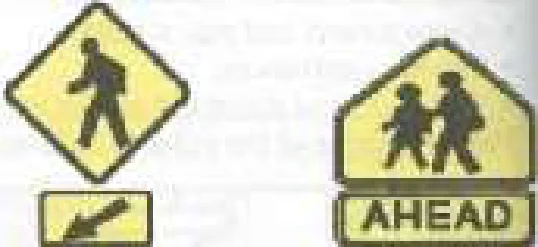
Watch for school zones in the country as well as in town. Stop when a school crossing guard directs you, and always yield to schoolchildren crossing the street.
When turning a corner, watch for people about to cross; your green light may be green for them too. Yield to pedestrians in any crosswalk, marked or unmarked.
A person using a white cane or a guide dog always has the right-of-way. Stop at least 10 feet away until the person is out of danger; failing to yield carries a fine of $50 to $1,000.
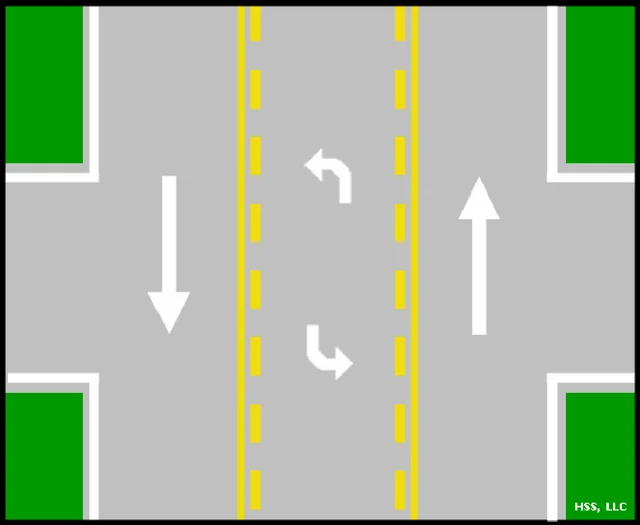
Using a shared center left-turn lane: check mirrors and ahead, signal left, check your left blind spot, steer smoothly into the lane, then turn when traffic is clear.
Reversible lanes carry traffic one way at some times and the other way at others, often during rush hours, and may have double dashed yellow lines. Check the overhead signals before entering: green arrow = use it, red X = don't.
You're turning right on a green light and a man with a white cane steps off the curb. Stop at least 10 feet from him and wait until he's safely out of the road, even though your light is green.
Check your understanding
Read the question, decide on an answer, then open it to check the explanation. These are Roadwise study questions based on the source handbook.
What is the shared center left-turn lane used for?
Passing other slower vehicles
Left turns only, from either direction
Through traffic moving in both directions
Merging from a side street
Answer: Left turns only, from either direction
The shared center lane is only for left-turning vehicles, from either direction; not for through traffic or passing.