Louisiana practice test
Louisiana permit practice test.
Get to know the format, try six study questions, and check the explanations before opening a full Roadwise practice test. This course’s simulation is based on the format described below.
- Questions
- 40
- Correct to pass
- 32
- Practice timer
- No timer
- Study question bank
- 795
The format in this course
Louisiana OMV Knowledge Test
To pass this Roadwise simulation, answer at least 32 of 40 questions correctly. Answers and explanations appear after you finish. Unanswered questions count as incorrect.
This practice format uses one overall passing threshold, without a separately scored sign section.
This Roadwise practice format has no countdown, so you can take the time you need.
The handbook itself (p.13) states the 80% passing threshold but does not give a total question count; the 40-question total and 32-correct passing score come from the official Louisiana OMV website. No section is scored separately, so the practice test uses one combined score.
Try a few practice questions
Read the question, decide on an answer, then open it to check the explanation. These are Roadwise study questions based on the source handbook.
A Class D license covers a single commercial vehicle with a gross vehicle weight rating of:
- Under 10,001 pounds
- 26,001 pounds or more
- 10,001 to less than 26,001 pounds
- 6,001 to 10,000 pounds
Answer: 10,001 to less than 26,001 pounds
Class D covers vehicles from 10,001 up to but not including 26,001 pounds GVWR.
Handbook p. 6 ↗How much more likely are you to survive a crash if you remain inside the vehicle rather than being thrown from it?
- Slightly more likely
- 3 to 4 times more likely
- 10 times more likely
- There is no difference
Answer: 3 to 4 times more likely
Staying inside the vehicle during a crash makes survival 3 to 4 times more likely than being ejected.
Handbook p. 44 ↗Which of the following is illegal when passing?
- Passing on a road with a broken yellow centerline
- Passing when your view is blocked by a hill or curve
- Passing when there is enough distance to see clearly ahead
- Passing a vehicle traveling slower than the flow of traffic
Answer: Passing when your view is blocked by a hill or curve
Passing when your view ahead is obstructed by a hill or curve is explicitly prohibited.
Handbook p. 75 ↗How much extra following distance should you add when driving at night?
- At least 2 additional seconds
- At least 1 additional second
- At least 3 additional seconds
- None, if your high beams are on
Answer: At least 1 additional second
Night driving calls for at least 1 extra second of following distance beyond your normal gap.
Handbook p. 79 ↗How should trailer safety chains be attached?
- With slack, crossed under the trailer tongue
- Pulled tight so they can't move in turns
- Loose enough to drag on the road
- Hooked only to the rear bumper
Answer: With slack, crossed under the trailer tongue
Chains need some slack for sharp turns but shouldn't drag, and should cross under the tongue to catch it if the trailer separates.
Handbook p. 140 ↗What does this sign mean?
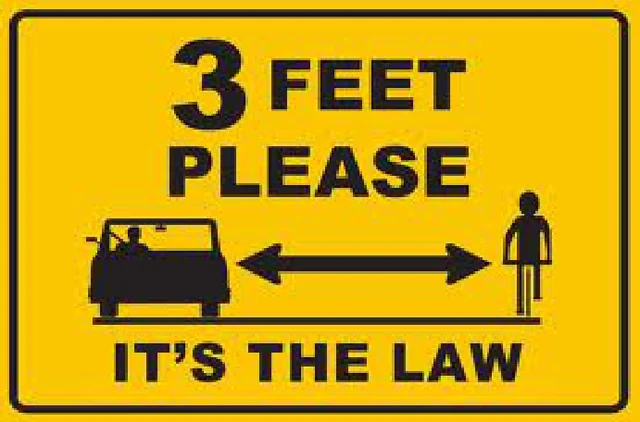
- Marks an obstruction that traffic may pass on either side.
- Instructs drivers to move vehicles out of travel lanes after a minor crash.
- Requires drivers to move over or slow down for stopped emergency vehicles.
- Drivers must leave at least 3 feet of space when passing a cyclist.
Answer: Drivers must leave at least 3 feet of space when passing a cyclist.
3-foot passing law for bicycles: Drivers must leave at least 3 feet of space when passing a cyclist. Leave at least 3 feet of clearance when passing a bicyclist.
Handbook p. 84 ↗What to study next
The practice question pool spans the course. Use the topics below to read the rules behind an answer, then return to practice.
7 lessons
Your License
Documents, the GDL stages, license tests, and keeping your license current
Explore7 lessons
Signs, Signals & Markings
Sign shapes and colors, every sign family, signals, and pavement markings
Explore7 lessons
Vehicle Safety
Crash physics, seat belts, child seats, air bags, vehicle checks, and steering
Explore6 lessons
Space, Speed & Stopping
Defensive driving, scanning, mirrors, stopping distance, following distance, and speed
Explore6 lessons
Intersections & Right-of-Way
Turns, turnarounds, right-of-way, emergency vehicles, roundabouts, and railroad crossings
Explore5 lessons
Passing, Lanes & Parking
Passing, lane use, parking laws, hill parking, and backing
Explore5 lessons
School Buses & Special Laws
School buses, work zones, traffic stops, litter, and other Louisiana laws
Explore6 lessons
Sharing the Road
Pedestrians, bicycles, motorcycles, trucks, rural hazards, and slow vehicles
Explore6 lessons
Night, Weather & Highways
The highway system, night driving, rain, seasons, fog, and interstates
Explore8 lessons
Distraction, Fatigue & Emergencies
Distraction, teen risk, fatigue, road rage, collisions, skids, breakdowns, and floods
Explore5 lessons
Alcohol, Drugs & Offenses
BAC limits, DWI penalties, implied consent, drugs and medicine, and license suspension
Explore2 lessons
Towing & Vehicle Paperwork
Trailers, loads, Class D rules, title, registration, insurance, and inspection
Explore