A 3-minute lesson from the Louisiana course. Read the rules and examples, follow the handbook page references, and check your understanding before you move on.
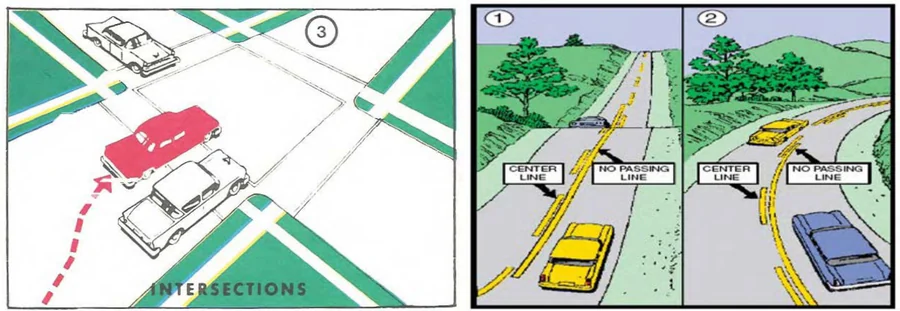
Passing is one of the riskiest moves you'll make, especially on two-lane roads where you borrow the oncoming lane. Pass only when you won't interfere with oncoming traffic or the vehicle you're passing, and get it done quickly.
Know the rule
You must not make another driver slow down or pull over so you can finish your pass. Complete the pass before coming within 100 feet of any vehicle approaching from the opposite direction.
You may pass on the right only where there are two or more lanes moving in your direction. Never pass on the right by driving onto the shoulder, paved or not.
Don't pull up close behind the vehicle you plan to pass, especially a large truck or bus; it blocks your view. Follow at a safe distance until you can see far enough ahead.
If you can actually see an oncoming vehicle getting closer, it's probably less than 25 seconds away. If you see an oncoming vehicle, don't attempt to pass.
On a two-lane road you're stuck behind a slow tractor, 90 feet from a bridge. Even with no oncoming traffic, you can't pass: it's illegal within 100 feet of a bridge. Wait until you're past it and the road ahead is clear.
Check your understanding
Read the question, decide on an answer, then open it to check the explanation. These are Roadwise study questions based on the source handbook.
You should complete a pass before coming within how many feet of a vehicle approaching from the opposite direction?
100 feet
50 feet
200 feet
500 feet
Answer: 100 feet
Passing must be completed with at least 100 feet of clearance before meeting oncoming traffic.