Roadwise States Louisiana Driving lessons Turning rules & signaling Louisiana driving lesson · Intersections & Right-of-Way
Turning rules & signaling A 3-minute lesson from the Louisiana course. Read the rules and examples, follow the handbook page references, and check your understanding before you move on.
Read time 3 minutes
Course unit Intersections & Right-of-Way
Checkpoint questions 6
Source pages 94, 95, 98 Many intersection crashes happen because a driver didn't signal or didn't know who goes first. Plan every turn early: signal, get into the proper lane, slow down, and finish the turn in the correct lane.
Steps for every turn: Prepare for the turn well in advance Scan ahead and around you for vehicles and pedestrians Signal first, then move into the proper lane Slow down before turning and finish in the proper lane Handbook p. 94 ↗ 100 feet Minimum distance to signal and be in the proper lane before turning
Handbook p. 94 ↗ Know the rule
Right turn: don't swing left before turning. Turn from the right-most lane unless lane markings allow more than one lane to turn right.
Handbook p. 94 ↗ Know the rule
Left turn: keep your wheels straight while waiting so a rear-end hit won't shove you into oncoming traffic. Brake before starting the turn, and don't cut the corner in front of traffic approaching from the left.
Handbook p. 94 ↗ Know the rule
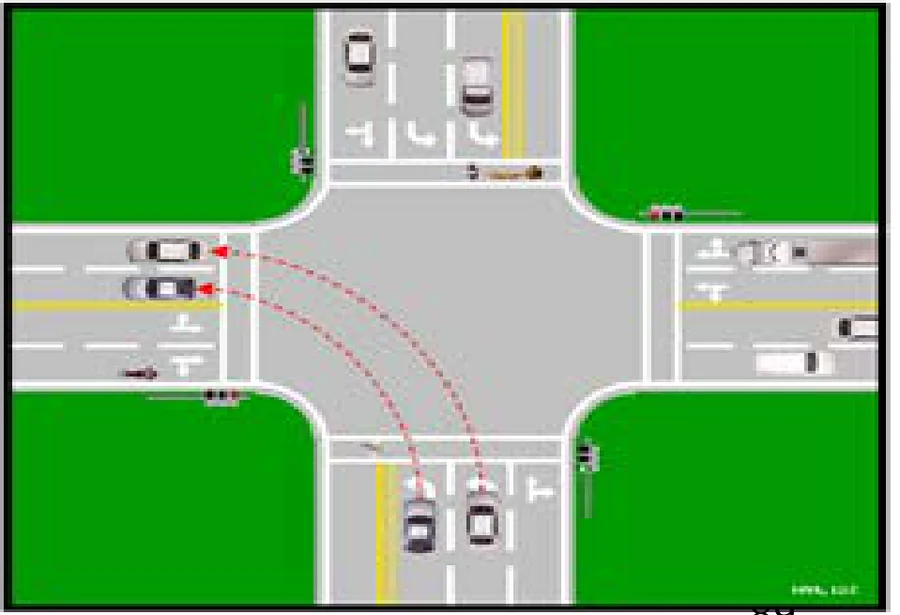
When two drivers facing each other both turn left, each turns to the left of the center of the intersection.
Handbook p. 94 ↗ Two opposing vehicles turning left Know the rule
Where a lane is marked for left turns, you may ONLY turn left from it. More than one lane may be marked left turn only.
Handbook p. 95 ↗ Know the rule
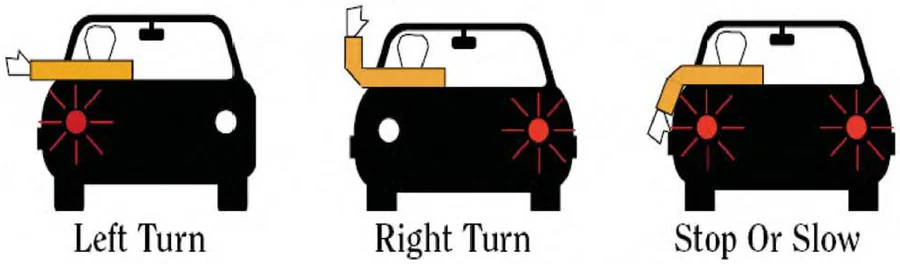
Always signal before you turn, change lanes, slow down or stop. Use your signal lights or your left arm.
Handbook p. 98 ↗ Know the rule
Give a turn signal continuously for at least 100 feet; signal earlier at higher speeds or in heavy traffic.
Handbook p. 98 ↗ Know the rule
Use your left signal when pulling out of a curbside parallel parking space or moving left to pass.
Handbook p. 98 ↗ Know the rule
It's illegal to flash your turn signal on just one side of a parked or disabled vehicle, or to use it to tell another driver to pass you.
Handbook p. 98 ↗ Hand signals: left turn, right turn, stop or slow Put it into practice
You're waiting to turn left while oncoming cars pass. Keep your wheels pointed straight ahead. If someone rear-ends you, you'll roll straight instead of into the oncoming lane. Turn the wheel only when you start the turn.
A useful reminder Signal at least 100 feet before the turn, and keep signaling the whole way.
Check your understanding Read the question, decide on an answer, then open it to check the explanation. These are Roadwise study questions based on the source handbook.
How far before a turn must you signal, at minimum? 100 feet 50 feet 200 feet 300 feet Answer: 100 feet
Louisiana law requires signaling continuously at least 100 feet before turning.
Handbook p. 94 ↗ From which lane should you make a right turn? Any lane, as long as you signal The right-most lane The center lane The left-most lane Answer: The right-most lane
Right turns should be made from the right-most lane, unless markings allow multiple lanes to turn.
Handbook p. 94 ↗ Why should you keep your wheels straight while waiting to make a left turn? It makes the turn faster once traffic clears It shows oncoming drivers you are waiting So you aren't pushed into oncoming traffic It helps you see around the car ahead Answer: So you aren't pushed into oncoming traffic
Straight wheels prevent your car from being shoved into the oncoming lane if rear-ended while waiting.
Handbook p. 94 ↗ What is the correct sequence for making a safe turn? Slow down first, then signal only after starting the turn Prepare, scan, signal, then slow and turn Signal only if other cars are visible Signal and slow, then scan once turning Answer: Prepare, scan, signal, then slow and turn
The handbook lays out this sequence: prepare, scan, signal into position, then slow and complete the turn.
Handbook p. 94 ↗ Two drivers approach an intersection from opposite directions, both signaling a left turn. What should they do? The first to arrive turns; the other waits Each turns right of the intersection's center Each turns left of the intersection's center The driver on the right turns first Answer: Each turns left of the intersection's center
When two vehicles both turn left at the same intersection, each turns to the left of the intersection's center.
Handbook p. 94 ↗ At a four-way intersection, a lane is marked 'left turn only.' What does this require? You may go straight if traffic allows You may turn right if no one is behind you You may turn left or go straight You may only turn left from that lane Answer: You may only turn left from that lane
A marked left-turn-only lane restricts you to turning left; other movements are not allowed from it.
Handbook p. 95 ↗ Previous lesson Speed limits & the general speed law Next lesson Turning around safely More in Intersections & Right-of-Way About the source Roadwise’s Louisiana course uses the driver handbook edition supplied with this study pack. This lesson cites source pages 94, 95, 98. The linked PDF is a third-party mirror of the handbook, rather than a government-hosted page.
Open the handbook source PDF · View the source edition
For current application requirements, fees, appointments, and the format that applies to your age or license type, check Louisiana’s OMV. Roadwise provides study material and does not issue permits or licenses.