roadwise.Open study app

Louisiana driving lesson · Sharing the Road

Pedestrians

A 3-minute lesson from the Louisiana course. Read the rules and examples, follow the handbook page references, and check your understanding before you move on.

Read time
3 minutes
Course unit
Sharing the Road
Checkpoint questions
6
Source pages
80, 81

The moment you step out of your car you're a pedestrian, so know both sides of the rules. As a driver you must yield to pedestrians at all times, even jaywalkers, and slow down whenever people are walking or children are playing near the road.

Pedestrian signals

Pedestrian signals
SignalMeaning
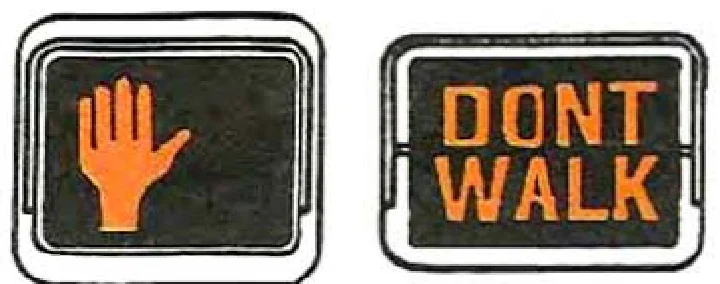
Steady DON'T WALKPedestrians must not enter the roadway
Flashing DON'T WALKDon't start; those already crossing may finish
Steady WALKPedestrians may cross toward the signal
Flashing WALKPossible conflict with vehicles
Handbook p. 80 ↗
Pedestrian don't walk signal (hand and text composite)
Pedestrian signals: hand and DON'T WALK

Pedestrians have the right-of-way:

  • In a marked crosswalk
  • When crossing with a green light or WALK signal
  • Over a vehicle turning right on red
Handbook p. 80 ↗

Know the rule

You must yield to pedestrians at all times. Even when someone is jaywalking, which is illegal, you must stop for them.

Handbook p. 80 ↗

Know the rule

Don't pass a vehicle stopped at a crosswalk, and be ready to stop for pedestrians in marked or unmarked crosswalks.

Handbook p. 80 ↗

Know the rule

Stopping too close to a pedestrian can block the next driver's view of them.

Handbook p. 80 ↗

Know the rule

The faster you drive, the less likely you can stop in time. Most pedestrian crashes happen away from intersections.

Handbook p. 80 ↗

Know the rule

Pedestrians should walk facing traffic, cross at intersections or crosswalks, and look left, right and left again before crossing.

Handbook p. 80 ↗

Know the rule

Pedestrians with a guide dog or a white cane, with or without a red tip, must be given the right-of-way at all times. Take special care when turning corners or backing up.

Handbook p. 81 ↗

Helping a visually impaired pedestrian:

  • Stop no more than 5 feet from the crosswalk; they use your engine's sound as a guide
  • Don't call out directions or honk
  • If the person steps back and pulls in the cane, you should go
  • Don't stop in the middle of the crosswalk or block the sidewalk
  • Look for pedestrians before turning right on red; stop at crosswalks where people wait
Handbook p. 81 ↗

Put it into practice

You're turning right on red when a pedestrian steps into the crosswalk in front of you. Pedestrians have the right-of-way over a vehicle turning right on red, so wait until they've crossed.

Check your understanding

Read the question, decide on an answer, then open it to check the explanation. These are Roadwise study questions based on the source handbook.

The handbook lists when pedestrians have the right of way over vehicles. Which is one of those cases?
  1. When a car is turning right on red
  2. When starting to cross on a flashing DON'T WALK
  3. When crossing between parked cars mid-block
  4. When walking with their back to traffic

Answer: When a car is turning right on red

Pedestrians have the right of way over a vehicle turning right on red.
Handbook p. 80 ↗
Must you yield to a pedestrian who is jaywalking illegally?
  1. No, jaywalkers forfeit the right of way
  2. Yes, you must still stop for them
  3. Only if they are children
  4. Only during daylight hours

Answer: Yes, you must still stop for them

Even illegal jaywalkers must be yielded to — you must stop for any pedestrian in your path.

Handbook p. 80 ↗
Why should you never pass a vehicle that is stopped at a crosswalk?
  1. The stopped car may turn left across you
  2. You may startle the stopped driver
  3. A hidden pedestrian may be crossing
  4. You may block the crosswalk signal

Answer: A hidden pedestrian may be crossing

Passing a stopped vehicle at a crosswalk risks hitting a pedestrian you can't see.

Handbook p. 80 ↗
How close should you stop to a crosswalk when a visually impaired pedestrian using a cane or guide dog is waiting?
  1. At least 20 feet away
  2. At least 15 feet away
  3. At least 10 feet away
  4. No more than 5 feet away

Answer: No more than 5 feet away

Stopping within 5 feet lets the pedestrian use your engine sound as an auditory cue that it's their turn.

Handbook p. 81 ↗
What should you avoid doing when a visually impaired pedestrian is near a crosswalk?
  1. Honking your horn at them
  2. Stopping close enough for them to hear your engine
  3. Waiting patiently for them to cross
  4. Looking before turning right on red

Answer: Honking your horn at them

Honking can startle a visually impaired pedestrian who won't know who or what it's directed at.

Handbook p. 81 ↗
Most pedestrian crashes occur:
  1. At marked crosswalks with working signals
  2. Away from intersections
  3. At intersections with stop signs
  4. At signal-controlled intersections

Answer: Away from intersections

The handbook notes most pedestrian crashes happen away from intersections, where speeds aren't enforced as tightly.

Handbook p. 80 ↗
Take the lesson checkpoint in the app

More in Sharing the Road