Roadwise States Louisiana Driving lessons Large trucks Louisiana driving lesson · Sharing the Road
Large trucks A 4-minute lesson from the Louisiana course. Read the rules and examples, follow the handbook page references, and check your understanding before you move on.
Read time 4 minutes
Course unit Sharing the Road
Checkpoint questions 6
Source pages 86, 87, 88, 89 In a crash with a big truck, you lose. Trucks need far more room to stop, turn and speed up, and they have large blind spots called No-Zones. Give them a wide berth.
290 feet Minimum stopping distance for a loaded tractor-trailer at 55 mph on a clear, dry road
Handbook p. 87 ↗ Know the rule
In car/large-truck crashes, car occupants suffer 78% of the deaths, and in over 70% of fatal crashes police say the car driver contributed.
Handbook p. 87 ↗ Around big trucks: Don't cut in front: that open space is the truck's stopping cushion Don't linger alongside; you may be in the driver's blind spot If you can't see the driver's face in one of the mirrors, the driver can't see you Following and can't see the truck's side mirrors? You're too close Leave room behind a truck stopped on a hill; it will roll back as it starts Avoid the right lane on hills and near weigh stations where trucks re-enter On windy days, pass quickly, stay to the outer edge of your lane, hold the wheel with both hands Handbook p. 87 ↗ The bigger the truck, the: Bigger its blind spots More room it needs to maneuver and turn Longer it takes to stop, to pass, and to accelerate More likely you'll be the loser in a collision Handbook p. 87 ↗ 4-5 seconds Following distance behind a truck in good conditions; longer when conditions are poor
Handbook p. 88 ↗ Know the rule
Following a truck at night, keep your headlights on low beam; high beams reflect off its many mirrors into the driver's eyes.
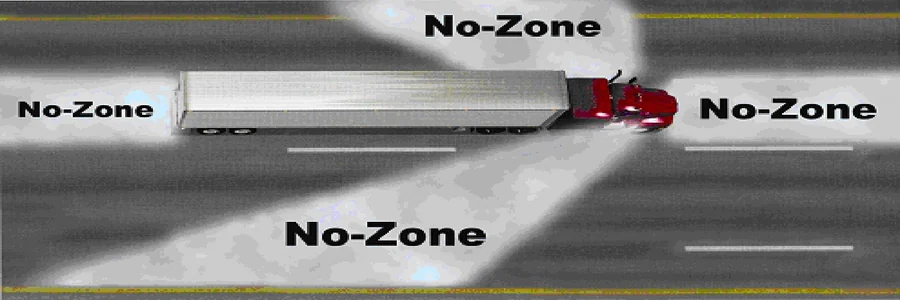
Handbook p. 88 ↗ In rain near trucks: Keep your windshield clean and wipers in good shape Turn on your wipers before an oncoming truck passes you Don't pull out to pass unless you can clearly see ahead Slow down to put more distance between you and the spray Handbook p. 88 ↗ No-Zone The blind spots around the front, back and sides of a large truck where the driver can't see you.
Handbook p. 88 ↗ Truck No-Zones Know the rule
Pass a truck on the left, hold the wheel firmly against air turbulence, and don't pull back in until you see the truck's whole front in your rearview mirror.
Handbook p. 89 ↗ Know the rule
In the right lane, move over to let a truck merge; trucks take much longer to get up to speed.
Handbook p. 89 ↗ Know the rule
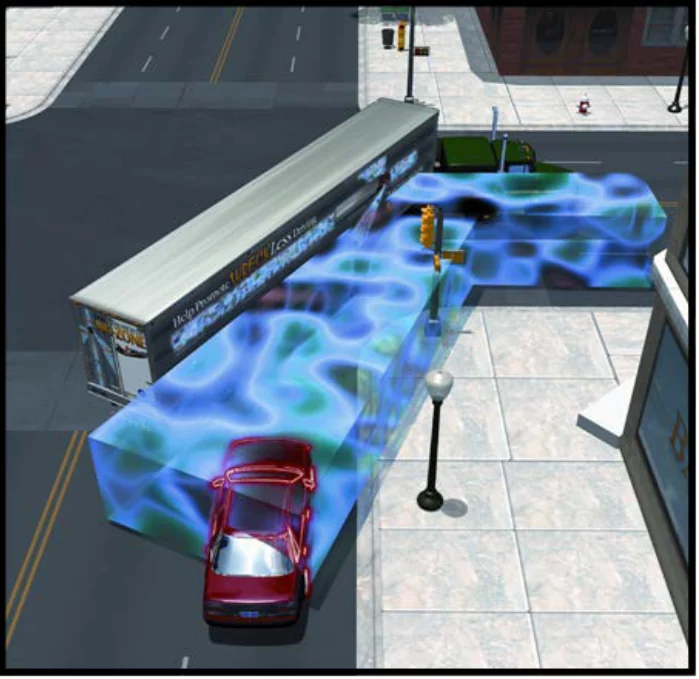
Squeeze play: a truck or bus may swing wide to the left to make a right turn. Don't pull between it and the curb; wait until it completes the turn.
Handbook p. 89 ↗ Squeeze play: don't pull between a turning bus and the curb Put it into practice
A tractor-trailer ahead signals right and drifts left. It's swinging wide to make the turn, not changing lanes. Don't slip into the gap on its right; stay back until the turn is done.
Check your understanding Read the question, decide on an answer, then open it to check the explanation. These are Roadwise study questions based on the source handbook.
About how far does a loaded tractor-trailer need to stop from 55 mph on dry, clear roads? A minimum of 290 feet A minimum of 100 feet A minimum of 50 feet A minimum of 500 feet Answer: A minimum of 290 feet
A properly loaded and maintained tractor-trailer needs about 290 feet minimum to stop from 55 mph.
Handbook p. 87 ↗ How can you tell if a truck driver can see you in their mirrors? If you can see the truck's brake lights If you can see the driver's face in a mirror If your headlights are on If you are directly behind the trailer Answer: If you can see the driver's face in a mirror
This mirror-visibility check tells you whether you're in the truck's blind spot, or 'No-Zone.'
Handbook p. 88 ↗ What following distance is recommended behind a truck in good weather? 1 to 2 seconds 10 to 12 seconds 4 to 5 seconds 20 seconds Answer: 4 to 5 seconds
A 4- to 5-second gap improves visibility and gives you more reaction time behind a truck.
Handbook p. 88 ↗ In crashes between large trucks and cars, what percentage of fatalities are occupants of the cars? 25% 50% 95% 78% Answer: 78%
The handbook cites that car occupants suffer 78% of the fatalities in these crashes.
Handbook p. 87 ↗ Why shouldn't you cut in front of a truck just because you see open space there? It's the truck's cushion for its longer stop Trucks are not allowed to brake suddenly Trucks cannot use their horns there Trucks always have the right-of-way Answer: It's the truck's cushion for its longer stop
Cutting off a truck removes the safety margin it needs given its long stopping distance.
Handbook p. 87 ↗ Why should you avoid lingering alongside a truck instead of passing it? It blocks the truck's turn signals You may be in the truck driver's blind spot It's only dangerous on wet roads Trucks must yield to cars beside them Answer: You may be in the truck driver's blind spot
Staying alongside a truck too long increases the chance you're invisible to the driver in their mirrors.
Handbook p. 87 ↗ Previous lesson Motorcycles Next lesson Rural roads & animals About the source Roadwise’s Louisiana course uses the driver handbook edition supplied with this study pack. This lesson cites source pages 86, 87, 88, 89. The linked PDF is a third-party mirror of the handbook, rather than a government-hosted page.
Open the handbook source PDF · View the source edition
For current application requirements, fees, appointments, and the format that applies to your age or license type, check Louisiana’s OMV. Roadwise provides study material and does not issue permits or licenses.