Kentucky practice test
Kentucky permit practice test.
Get to know the format, try six study questions, and check the explanations before opening a full Roadwise practice test. This course’s simulation is based on the format described below.
- Questions
- 40
- Correct to pass
- 32
- Practice timer
- No timer
- Study question bank
- 611
The format in this course
Kentucky Written Knowledge Test
To pass this Roadwise simulation, answer at least 32 of 40 questions correctly. Answers and explanations appear after you finish. Unanswered questions count as incorrect.
This practice format uses one overall passing threshold, without a separately scored sign section.
This Roadwise practice format has no countdown, so you can take the time you need.
The official KSP page does not publish the exact question count or time limit, only that the Driver Manual is the study source and an 80% score is required. Two independent test-prep sources agree on a 40-question test (32 correct to pass) with no time limit and no separately scored signs section (signs are mixed into the single 40-question test).
Try a few practice questions
Read the question, decide on an answer, then open it to check the explanation. These are Roadwise study questions based on the source handbook.
A Class A commercial license is required for a combination of vehicles with a gross combination weight rating of at least:
- 16,001 pounds
- 26,001 pounds, if the towed vehicle's GVWR exceeds 10,000 pounds
- 33,001 pounds
- 10,000 pounds
Answer: 26,001 pounds, if the towed vehicle's GVWR exceeds 10,000 pounds
Class A covers combinations of 26,001 lbs or more where the towed unit's GVWR is over 10,000 lbs.
Handbook p. 7 ↗How much space should there be between your chest and the steering wheel?
- 20 inches
- 2 inches
- 5 inches
- 10 inches
Answer: 10 inches
The manual recommends 10 inches between your chest and the steering wheel for proper seating.
Handbook p. 34 ↗When making a left turn, you must yield to:
- Only pedestrians, not vehicles
- Oncoming traffic, even right turners
- No one, since you signaled first
- Only oncoming vehicles going straight
Answer: Oncoming traffic, even right turners
You must yield to drivers in the opposing lane when turning left, including vehicles turning right.
Handbook p. 40 ↗If your vehicle does not have ABS and begins to skid while braking, you should:
- Turn the wheel sharply away from the skid
- Pump the brakes gently
- Press the brake pedal as hard as possible
- Take your foot off the brake completely and coast
Answer: Pump the brakes gently
Without ABS, pump the brakes gently rather than slamming them, which would lock the wheels and worsen a skid.
Handbook p. 61 ↗You should dim your high beams when you are within how many feet of an oncoming vehicle?
- 1,000 feet
- 100 feet
- 500 feet
- 200 feet
Answer: 500 feet
Dim your high beams whenever you come within 500 feet of oncoming vehicles.
Handbook p. 73 ↗What does this sign mean?
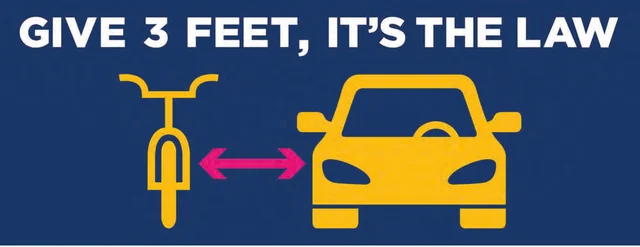
- Provides a phone number for road and weather conditions.
- Gives a phone number and crossing ID to report railroad problems.
- Drivers must leave at least 3 feet when passing a bicyclist.
- Shows nearby services such as food, gas, lodging and a hospital.
Answer: Drivers must leave at least 3 feet when passing a bicyclist.
3-foot passing law (bicycles): Drivers must leave at least 3 feet when passing a bicyclist. Give at least 3 feet of space when passing a cyclist.
Handbook p. 40 ↗What to study next
The practice question pool spans the course. Use the topics below to read the rules behind an answer, then return to practice.
8 lessons
Getting Your License
Classes, GDL phases, testing, transfers, renewals & points
Explore6 lessons
Fit to Drive
Vision, fatigue, distraction, medical review, alcohol & DUI law
Explore5 lessons
Before You Drive
Registration, insurance, vehicle setup, belts, child seats & loads
Explore6 lessons
Vehicle Control & Space
Basic control, speed limits, stopping distance, space & signals
Explore7 lessons
Traffic Control & Signs
Right-of-way, signals, signs, railroad crossings & markings
Explore7 lessons
General Driving Maneuvers
Turns, intersections, buses, parking, lanes & passing
Explore5 lessons
Emergencies & Crashes
Evasive action, skids, collisions & vehicle failures
Explore8 lessons
Sharing the Road
Pedestrians, cyclists, motorcycles, trucks, emergency vehicles & more
Explore5 lessons
Special Situations
Night, funerals, work zones, rural roads, autocycles & trailers
Explore