A 3-minute lesson from the Kentucky course. Read the rules and examples, follow the handbook page references, and check your understanding before you move on.
Right-of-way rules decide who goes first when drivers and pedestrians meet, and in what order to enter an intersection. But the law never hands anyone the right-of-way automatically—you must always read the situation and be ready to yield.
Know the rule
No one should assume he or she automatically has the right of way. Always consider the situation and circumstances at the intersection.
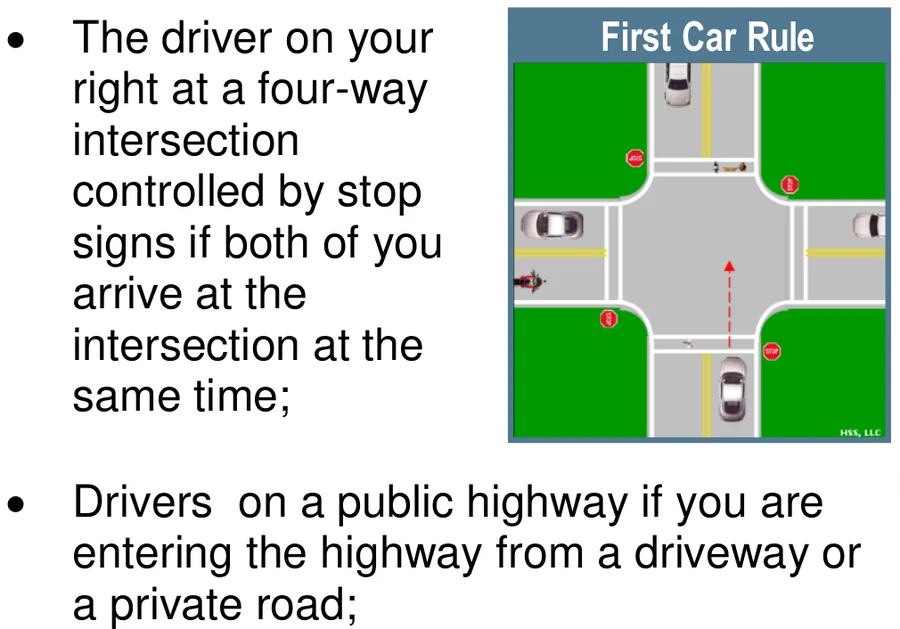
You and a pickup reach a four-way stop at the same moment, and the pickup is on your right. Yield to it. If you had clearly arrived first, you'd go first—after checking that no pedestrians or cyclists are still in the intersection.
Check your understanding
Read the question, decide on an answer, then open it to check the explanation. These are Roadwise study questions based on the source handbook.
At an intersection with no signs or signals, you should generally yield to:
Whoever arrives at or before you
No one; proceed immediately
Whoever is driving the larger vehicle
The driver on your left
Answer: Whoever arrives at or before you
You should yield to the driver who is at or arrives before you at the intersection.