roadwise.Open study app

Kentucky driving lesson · Traffic Control & Signs

Sign shapes, colors & warning signs

A 3-minute lesson from the Kentucky course. Read the rules and examples, follow the handbook page references, and check your understanding before you move on.

Read time
3 minutes
Course unit
Traffic Control & Signs
Checkpoint questions
6
Source pages
41, 42, 46, 47

A sign's shape, color, symbols and words tell you what kind of message it carries—often before you can read it. Warning signs alert you to possible danger or a special situation ahead so you can slow down and be ready to stop.

Standard sign shapes

Standard sign shapes
ShapeUsed for
Horizontal rectangleGenerally guide signs
Equilateral triangleUsed only for yield signs
Vertical rectangleGenerally regulatory signs
DiamondExisting or possible hazards on the roadway
PentagonSchool signs
RoundRailroad and advance warning
Handbook p. 47 ↗

Standard colors

Standard colors
ColorMeaning
RedStop or forbidden
GreenMovement permitted, directional guidance
YellowGeneral warning
Handbook p. 46 ↗

Know the rule

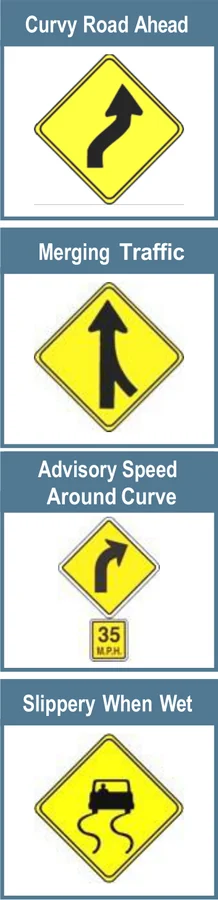
Warning signs are usually yellow with black lettering or symbols and diamond shaped. Some—such as school zone, school crossing and pedestrian crossing signs—may be fluorescent yellow.

Handbook p. 41 ↗
Warning signs grid (intersections/curves/crossings) composite
Warning signs: cross road, side road, T-intersection, right curve, divided highway, added lane, signal and stop ahead, crossings
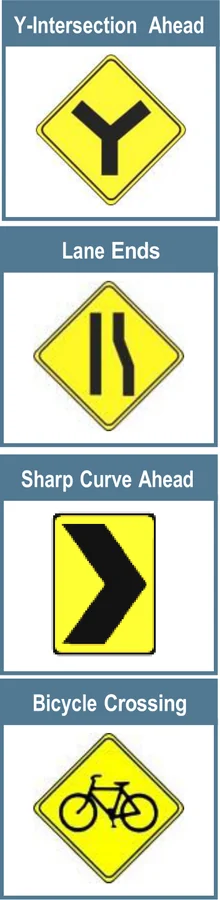
Curve and merge warning signs composite (vertical)
Curvy road, merging traffic, advisory speed around curve, slippery when wet
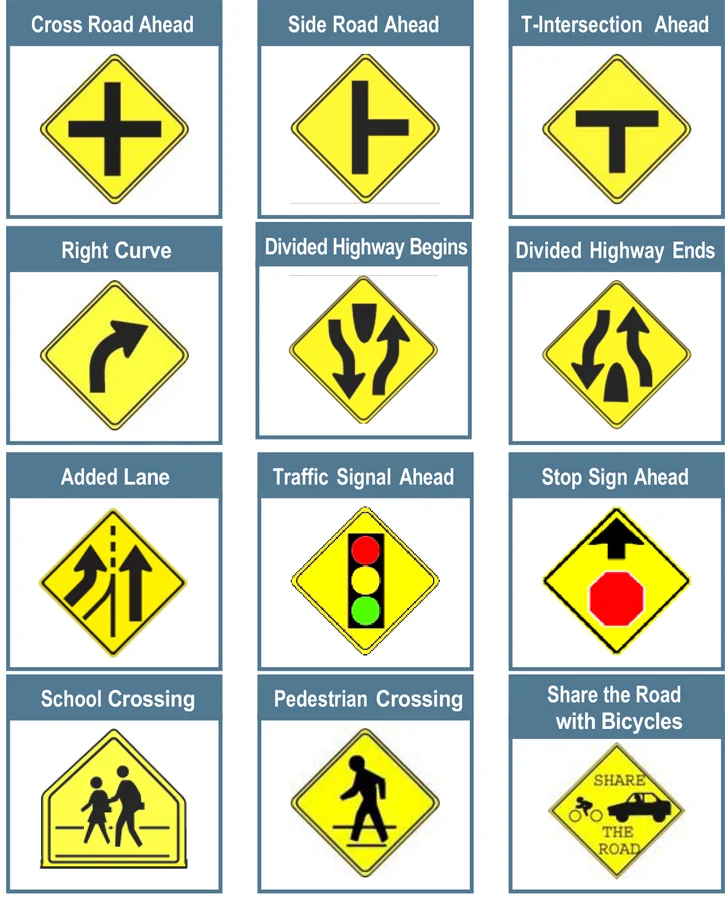
Intersection and curve warning signs composite (vertical)
Y-intersection, lane ends, sharp curve ahead, bicycle crossing

More warning signs in the handbook:

  • Divided Highway (begins) and Divided Highway Ends
  • Lane Ends, Merging Traffic, Traffic Pass on Both Sides, Two Way Traffic
  • Right Turn, Curve Right, Reverse Turn, Reverse Curve, Winding Road
  • Low Clearance (shows the height), Hill, Slippery When Wet
  • No Passing Zone
  • Cross Road, Side Road, Railroad Crossing
  • School, School Crossing, Pedestrian Crossing, Bike Crossing, Cattle Crossing
  • Pavement Ends, Soft Shoulder, Narrow Bridge
Handbook p. 47 ↗

Put it into practice

You see a yellow diamond with a bent arrow and a small yellow plate showing 35 beneath it. That's a curve warning with an advisory speed around the curve—slow down before you enter it.

Check your understanding

Read the question, decide on an answer, then open it to check the explanation. These are Roadwise study questions based on the source handbook.

Warning signs in Kentucky are typically what shape and color?
  1. Orange diamonds with black symbols
  2. Yellow diamonds with black symbols
  3. Green rectangles with white letters
  4. Red octagons with white letters

Answer: Yellow diamonds with black symbols

Warning signs are usually yellow with black lettering or symbols and are diamond shaped.
Handbook p. 41 ↗
Some warning signs, like school zone or pedestrian crossing signs, may be fluorescent yellow instead of standard yellow.
  1. True
  2. False

Answer: True

Some warning signs, such as school zone and pedestrian crossing signs, may be fluorescent yellow.

Handbook p. 41 ↗
A round sign shape is generally used for:
  1. Guide signs
  2. Railroad and advance warning signs
  3. School zone signs
  4. Regulatory stop signs

Answer: Railroad and advance warning signs

Round signs are generally used for railroad crossings and advance warning of hazards.

Handbook p. 47 ↗
An equilateral triangle sign shape is used only for:
  1. Guide signs
  2. Stop signs
  3. Yield signs
  4. Warning signs generally

Answer: Yield signs

The equilateral triangle shape is used only for yield signs.

Handbook p. 47 ↗
A pentagon-shaped sign is generally used for:
  1. Regulatory speed limits
  2. Railroad crossings
  3. Guide information
  4. School signs

Answer: School signs

The pentagon shape is generally reserved for school-related signs.

Handbook p. 47 ↗
A diamond-shaped sign generally warns of:
  1. Parking restrictions
  2. Existing or possible hazards
  3. Guide information for tourists
  4. Regulatory speed limits

Answer: Existing or possible hazards

Diamond-shaped signs generally warn of existing or possible hazards ahead.

Handbook p. 47 ↗
Take the lesson checkpoint in the app

More in Traffic Control & Signs