Roadwise States Kentucky Driving lessons Night driving Kentucky driving lesson · Special Situations
Night driving A 3-minute lesson from the Kentucky course. Read the rules and examples, follow the handbook page references, and check your understanding before you move on.
Read time 3 minutes
Course unit Special Situations
Checkpoint questions 6
Source pages 73 Night driving is harder and more hazardous than daytime driving because you can see only as far as your headlights reach. Use your lights well, keep your eyes moving, and give yourself more time and space.
Know the rule
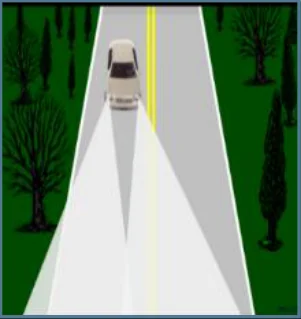
Use your high beams whenever there are no oncoming vehicles—high beams let you see twice as far as low beams.
Handbook p. 73 ↗ High beams light the road far ahead when no one is coming Use low beams: When following another vehicle In fog, rain or snow—high-beam light causes glare that makes it harder to see Some vehicles have fog lights you can use in fog, snow or rain Handbook p. 73 ↗ Night driving habits: If an oncoming driver keeps high beams on, look toward the right side of the road Avoid looking directly into oncoming headlights Search beyond your headlight beams for dark shapes on the road Glance left and right to find the pavement edge and spot hazards from the sides Don't wear sunglasses or colored lenses at night or on overcast days Handbook p. 73 ↗ Know the rule
Add at least one extra second of following distance at night, and at least two extra seconds on unfamiliar roads at night.
Handbook p. 73 ↗ Know the rule
Best rule: turn on your headlights whenever you have trouble seeing other vehicles. If you can't see them, they probably can't see you.
Handbook p. 73 ↗ Put it into practice
On a dark two-lane road with your high beams on, headlights appear over a hill ahead. Dim to low beams before the car is within 500 feet, and look toward the right edge of the road until it passes.
A useful reminder Dim at 500 feet for oncoming traffic, 300 feet when following.
Check your understanding Read the question, decide on an answer, then open it to check the explanation. These are Roadwise study questions based on the source handbook.
High beam headlights let you see how much farther than low beams? Twice as far Three times as far Half as far The same distance Answer: Twice as far
High beams let you see twice as far as low beams, so use them whenever there is no oncoming traffic.
Handbook p. 73 ↗ You should dim your high beams when you are within how many feet of an oncoming vehicle? 1,000 feet 100 feet 500 feet 200 feet Answer: 500 feet
Dim your high beams whenever you come within 500 feet of oncoming vehicles.
Handbook p. 73 ↗ You should dim your high beams when you are within how many feet of a vehicle you are following? 200 feet 300 feet 100 feet 500 feet Answer: 300 feet
Dim your headlights within 300 feet of any vehicle you are following.
Handbook p. 73 ↗ When an oncoming vehicle's high beams are blinding you at night, you should: Look directly at their headlights Speed up to pass them quickly Flash your high beams repeatedly at them Look toward the right side of the road Answer: Look toward the right side of the road
Look toward the right side of the road to avoid being distracted or momentarily blinded by oncoming high beams.
Handbook p. 73 ↗ For night driving, the manual recommends increasing your following distance by at least: Ten additional seconds One additional second No change is needed at night Half an additional second Answer: One additional second
Increase your following distance by at least one additional second for night driving conditions.
Handbook p. 73 ↗ On an unfamiliar roadway at night, the manual recommends adding how many extra seconds of following distance? Exactly one extra second No additional seconds At least two additional seconds Ten extra seconds Answer: At least two additional seconds
Add at least two additional seconds of following distance on unfamiliar roadways at night.
Handbook p. 73 ↗ Previous lesson Slow-moving vehicles, horses & ATVs Next lesson Funeral processions More in Special Situations About the source Roadwise’s Kentucky course uses the driver handbook edition supplied with this study pack. This lesson cites source pages 73. The linked PDF is a third-party mirror of the handbook, rather than a government-hosted page.
Open the handbook source PDF · View the source edition
For current application requirements, fees, appointments, and the format that applies to your age or license type, check Kentucky’s KYTC. Roadwise provides study material and does not issue permits or licenses.