Roadwise States Kentucky Driving lessons Towing a trailer Kentucky driving lesson · Special Situations
Towing a trailer A 3-minute lesson from the Kentucky course. Read the rules and examples, follow the handbook page references, and check your understanding before you move on.
Read time 3 minutes
Course unit Special Situations
Checkpoint questions 6
Source pages 75, 76 Driver error contributes to the large majority of crashes involving vehicle-trailer combinations. You can't change the vehicle to fit your habits—you must change your driving to fit the vehicle: slower pace, more space, more planning.
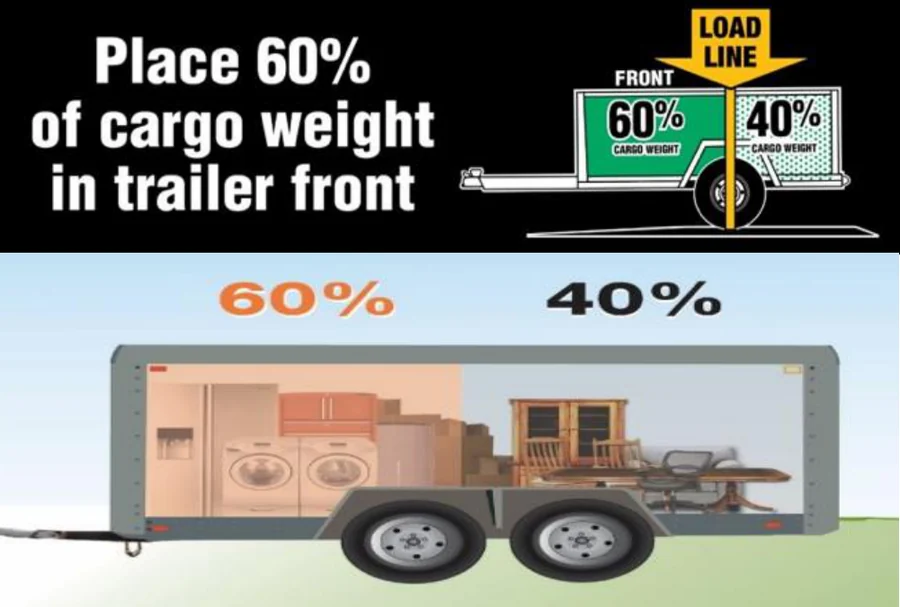
60% / 40% Cargo weight split: 60% in the front of the trailer (nearest the tow vehicle), 40% in the back
Handbook p. 75 ↗ Know the rule
Load trailers heavier in front to reduce sway. Failing to do so is a leading cause of vehicle-trailer mishaps.
Handbook p. 75 ↗ Place 60% of cargo weight in the trailer front If the trailer sways or whips: Steer straight and reduce speed gradually Don't apply the brakes, and never speed up Stop as soon as you can get completely off the road Check that the load is heavier in front; reload if needed Keep heavy items on the floor and tie down partial loads Handbook p. 76 ↗ 55 mph Maximum recommended speed for most vehicle-trailer combinations
Handbook p. 76 ↗ Driving with a trailer: Drive more slowly; never exceed the posted limit, and slow more when conditions worsen Slow down BEFORE starting down a grade Leave extra following distance—even more in rain, snow or fog Allow more distance to pass, especially on hills or curves Give the trailer extra room on turns—it doesn't follow directly behind the car Handbook p. 76 ↗ Know the rule
Backing a trailer: go slowly with your hand at the bottom of the wheel. Move your hand left to move the trailer left, right to move it right. If it starts to jackknife, STOP, pull ahead to straighten out, then start again.
Handbook p. 76 ↗ 'Pro' tips: Unsure how to hook up, load or drive with a trailer? Ask a trailer professional Before driving and at each fuel stop, recheck hitch, coupler, safety chains, lights and tire pressures Hear an unusual noise? Stop at a safe place off the road and check Don't drive 'straight through' on long trips—plan rests so you drive rested in daylight Handbook p. 76 ↗ Safe trailering checklist: Load heavier in front; load secure Hitch tight; chains attached Lights working; tire pressures OK Reduce speed; think ahead Stop often for rest; inspect often Wear your seat belt Handbook p. 76 ↗ Put it into practice
On the interstate your camper trailer starts to fishtail. Keep the wheel straight and ease off the gas so speed drops gradually—no brakes, no acceleration. Then pull completely off the road and check that the load is heavier in front.
A useful reminder Backing a trailer: hand at the bottom of the wheel, moved the way you want the trailer to go.
Check your understanding Read the question, decide on an answer, then open it to check the explanation. These are Roadwise study questions based on the source handbook.
When loading a trailer, what percentage of cargo weight should go in the front, nearest the towing vehicle? 50 percent 40 percent 75 percent 60 percent Answer: 60 percent
Sixty percent of the cargo weight should go in the front of the trailer and 40 percent in the back.
Handbook p. 75 ↗ If a trailer begins to sway or whip while driving, you should: Apply the brakes hard immediately Turn sharply to correct the sway Steer straight and reduce speed gradually, without braking Increase speed to stabilize it Answer: Steer straight and reduce speed gradually, without braking
Steer straight and reduce speed gradually if a trailer sways; do not apply the brakes, which can worsen the sway.
Handbook p. 76 ↗ The maximum recommended speed for most vehicle-trailer combinations is: 65 mph 55 mph 45 mph 70 mph Answer: 55 mph
The maximum recommended speed for most vehicle-trailer combinations is 55 mph.
Handbook p. 76 ↗ When backing up a trailer, to move the trailer to the left you should move your hand (placed at the bottom of the wheel): Straight down Straight up To the right To the left Answer: To the left
With your hand at the bottom of the wheel, move it left to steer the trailer left, and right to steer it right.
Handbook p. 76 ↗ If a trailer begins to jackknife while backing up, you should: Apply the trailer brakes only Continue backing while steering hard Stop and pull ahead to straighten out, then start again Speed up to straighten it Answer: Stop and pull ahead to straighten out, then start again
If the trailer starts to jackknife, stop, pull forward to straighten it, then begin backing again.
Handbook p. 76 ↗ Before driving with a trailer and at each fuel stop, you should: Only check the fuel gauge Check the hitch once before the entire trip only Walk around and recheck the hitch, chains, lights, and tire pressures Inspect only the tow vehicle, not the trailer Answer: Walk around and recheck the hitch, chains, lights, and tire pressures
Walk around the vehicle-trailer combination at each stop to recheck the hitch, chains, lights, and tire pressures.
Handbook p. 76 ↗ Previous lesson Rural roads & autocycles More in Special Situations About the source Roadwise’s Kentucky course uses the driver handbook edition supplied with this study pack. This lesson cites source pages 75, 76. The linked PDF is a third-party mirror of the handbook, rather than a government-hosted page.
Open the handbook source PDF · View the source edition
For current application requirements, fees, appointments, and the format that applies to your age or license type, check Kentucky’s KYTC. Roadwise provides study material and does not issue permits or licenses.