Kansas practice test
Kansas permit practice test.
Get to know the format, try six study questions, and check the explanations before opening a full Roadwise practice test. This course’s simulation is based on the format described below.
- Questions
- 25
- Correct to pass
- 20
- Practice timer
- No timer
- Study question bank
- 643
The format in this course
Kansas Driver's License Knowledge Test
To pass this Roadwise simulation, answer at least 20 of 25 questions correctly. Answers and explanations appear after you finish. Unanswered questions count as incorrect.
This practice format uses one overall passing threshold, without a separately scored sign section.
This Roadwise practice format has no countdown, so you can take the time you need.
The test is not timed (handbook p.94: 'The test is not timed, but generally takes 15 to 20 minutes to finish'). It covers traffic laws and road sign identification together as one combined score; the handbook does not describe a separately scored signs section, so the practice test uses one combined score. The exam may be taken at a driver's license office or online at ks.knowtodrive.com.
Try a few practice questions
Read the question, decide on an answer, then open it to check the explanation. These are Roadwise study questions based on the source handbook.
A Commercial Class A, B or C license used for interstate driving requires a minimum age of:
- 18 years old
- 19 years old
- 21 years old
- 25 years old
Answer: 21 years old
Interstate commercial driving requires drivers to be 21 or older; intrastate commercial driving only requires 18.
Handbook p. 9 ↗If you can meet the 20/40 vision standard only with glasses or contacts, what happens to your Kansas license?
- You may drive only in daylight
- It is restricted to corrective lenses
- You must retest your vision every year
- You cannot be licensed until age 18
Answer: It is restricted to corrective lenses
If corrective lenses are needed to meet the standard, the license is restricted to "corrective lenses" and you must wear them while driving.
Handbook p. 20 ↗A driver controlled by a yield sign needs to stop:
- Every time, just like at a stop sign
- Only when needed to avoid interfering with traffic
- Never; a yield sign only requires slowing
- Only when a pedestrian is in the crosswalk
Answer: Only when needed to avoid interfering with traffic
Cars controlled by a yield sign need stop only when necessary to avoid interfering with traffic, including pedestrians, that has the right-of-way.
Handbook p. 18 ↗If your vehicle has ABS and you need to stop quickly, you should:
- Ease off when the pedal pushes back
- Steer first, then brake afterward
- Pump the brake pedal repeatedly
- Press the brake pedal hard and keep pressing
Answer: Press the brake pedal hard and keep pressing
With ABS, press firmly and hold the brake pedal down; the ABS will manage wheel lock-up, and you should not let up even if you feel it pushing back.
Handbook p. 73 ↗Why do open bridge gratings and steel bridges require reduced speed?
- They have lower posted speed limits
- They are slippery only when wet
- They are narrower than the connecting road
- Traction for braking and steering is reduced
Answer: Traction for braking and steering is reduced
Open grating and steel bridge surfaces reduce tire traction, so slowing down and keeping a firm grip on the wheel is important.
Handbook p. 90 ↗What does this sign mean?
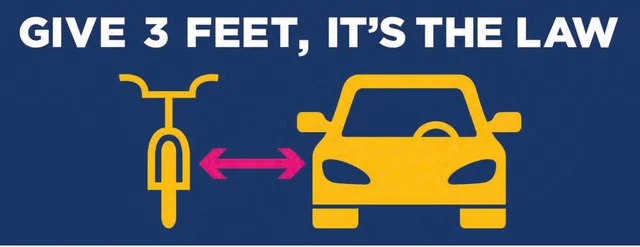
- Provides a phone number to report a problem at this railroad crossing.
- Drivers must leave at least 3 feet when passing a bicyclist.
- Provides a phone number for road and weather conditions.
- Shows gas, food, and lodging services available at the next right.
Answer: Drivers must leave at least 3 feet when passing a bicyclist.
3-foot passing law (bicycles): Drivers must leave at least 3 feet when passing a bicyclist. Give at least 3 feet of space when passing a cyclist.
Handbook p. 18 ↗What to study next
The practice question pool spans the course. Use the topics below to read the rules behind an answer, then return to practice.
8 lessons
Getting Your License
License types, permits, GDL limits, tests, renewal and suspension
Explore5 lessons
Kansas Rules of the Road: Speed & Basic Laws
Speed limits, seatbelts, signaling, passing, stops and phones
Explore6 lessons
Fit to Drive
Vision, fatigue, distraction, alcohol and drugs, and vehicle setup and control
Explore8 lessons
Signs, Signals & Pavement Markings
Signal meanings, sign shapes and colors, railroad crossings and lane markings
Explore7 lessons
Right-of-Way, Turning & Parking
Who yields, lane use, turnabouts, roundabouts, school buses and parking
Explore8 lessons
Visual Search, Speed & Space Management
Scanning, stopping distances, conditions, space cushions and communicating
Explore4 lessons
Avoiding Collisions & Emergencies
Braking and steering to avoid crashes, skids, rollovers, breakdowns and visibility
Explore6 lessons
Sharing the Road
Pedestrians, cyclists, motorcycles, emergency vehicles, trucks and slow vehicles
Explore4 lessons
Special Driving Situations
Rural roads, night, floods, work zones, animals, trips and severe weather
Explore