roadwise.Open study app

Kansas driving lesson · Right-of-Way, Turning & Parking

Right-of-way rules

A 4-minute lesson from the Kansas course. Read the rules and examples, follow the handbook page references, and check your understanding before you move on.

Read time
4 minutes
Course unit
Right-of-Way, Turning & Parking
Checkpoint questions
6
Source pages
18, 33, 34

Right-of-way rules decide who waits when vehicles or pedestrians meet with no sign or signal to sort it out. The law only says who must yield; it never gives anyone the right-of-way. You get it only when someone yields it to you.

Know the rule

Regardless of the circumstances, you must do everything you can to avoid striking a pedestrian, property or another vehicle.

Handbook p. 33 ↗

Pedestrians:

  • Always yield to pedestrians, even if they're jaywalking or crossing where they shouldn't
  • Yield to pedestrians when crossing a sidewalk to enter or leave a driveway, alley or parking lot
  • Never drive on a sidewalk except to cross it, such as at a driveway
  • Always yield to pedestrians with a guide dog or white cane, and don't use your horn near them
Handbook p. 33 ↗

At intersections:

  • Yield to a vehicle that has already entered the intersection from a different road
  • Arriving at about the same time from different roads: the driver on the left yields to the right
  • No signs or signals (uncontrolled): yield to vehicles in the intersection and those from your right
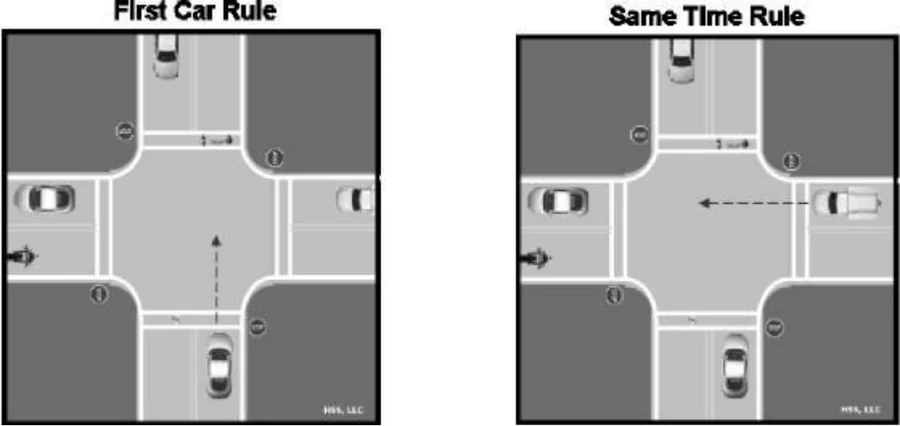
  • 4-way stop: the first to arrive goes first; arriving together, the vehicle on the right goes first
  • Turning left: yield to oncoming vehicles going straight or turning right
  • At a stop sign on a through street: stop completely, go when you won't interfere with traffic
Handbook p. 33 ↗
4-way stop right-of-way rules (First Car / Same Time)
4-way stop: first car rule and same time rule

Know the rule

When entering a road from a driveway, alley, private drive, side road or roadside, yield to vehicles already on the main road.

Handbook p. 34 ↗

Know the rule

In a business or residential district, a driver coming out of an alley, driveway or building must stop before the sidewalk or sidewalk area, then yield.

Handbook p. 18 ↗

Know the rule

Emergency vehicles showing a red light or sounding a siren or bell have the right-of-way. Immediately drive to the right and stop until they pass. Never follow them.

Handbook p. 18 ↗

Know the rule

Approaching a stopped emergency vehicle with flashing lights on a road with two or more lanes each way, move to a lane not next to it. If you can't, slow down and proceed with caution.

Handbook p. 18 ↗

Know the rule

Yield to construction vehicles and workers actually working on the road, and move to a lane not next to working construction vehicles (K.S.A. 8-1531).

Handbook p. 18 ↗

Know the rule

Don't enter an intersection, crosswalk or railroad crossing unless there's room on the other side for your vehicle, even on a green light (K.S.A. 8-1584).

Handbook p. 18 ↗

Put it into practice

You and another car reach a 4-way stop at the same moment; the other car is on your right. Let it go first. If you had clearly arrived first, you'd go first.

Check your understanding

Read the question, decide on an answer, then open it to check the explanation. These are Roadwise study questions based on the source handbook.

A driver controlled by a yield sign needs to stop:
  1. Every time, just like at a stop sign
  2. Only when needed to avoid interfering with traffic
  3. Never; a yield sign only requires slowing
  4. Only when a pedestrian is in the crosswalk

Answer: Only when needed to avoid interfering with traffic

Cars controlled by a yield sign need stop only when necessary to avoid interfering with traffic, including pedestrians, that has the right-of-way.

Handbook p. 18 ↗
At a 4-way stop, if more than one vehicle arrives at the same time, who goes first?
  1. The largest vehicle
  2. The vehicle on the right
  3. The vehicle going straight
  4. The vehicle on the left

Answer: The vehicle on the right

When vehicles arrive simultaneously at a 4-way stop, the vehicle on the right has the right-of-way.

Handbook p. 33 ↗
At a 4-way stop where vehicles arrive at different times, who should be given the right-of-way?
  1. The driver turning left
  2. The driver going straight
  3. The driver who reached the intersection first
  4. The driver on the right, regardless of arrival order

Answer: The driver who reached the intersection first

The general rule at a 4-way stop is that the first vehicle to arrive gets the right-of-way; the right-hand rule only applies when vehicles arrive together.
Handbook p. 33 ↗
When must you yield to a pedestrian who is jaywalking outside a crosswalk?
  1. Always, even when they are jaywalking
  2. Only if they have a WALK signal
  3. Never, since jaywalking is illegal
  4. Only if they are in a marked crosswalk

Answer: Always, even when they are jaywalking

Kansas requires drivers to yield to pedestrians even if they are crossing illegally outside a crosswalk.

Handbook p. 33 ↗
A driver turning left at an intersection must yield to:
  1. No one, if they have a green light
  2. Pedestrians only, not vehicles
  3. Only oncoming vehicles turning left
  4. Oncoming vehicles going straight or turning right

Answer: Oncoming vehicles going straight or turning right

Left-turning drivers must yield to oncoming traffic going straight or turning right, even with a green light, unless the intersection is clear.

Handbook p. 33 ↗
At an uncontrolled intersection in a residential area with no signs or signals, you must yield to:
  1. Only vehicles coming from the left
  2. Vehicles already in the intersection and those coming from the right
  3. Whichever vehicle is moving fastest
  4. The first vehicle to arrive, from any direction

Answer: Vehicles already in the intersection and those coming from the right

At an uncontrolled intersection, yield to vehicles already in the intersection and to those approaching from your right.

Handbook p. 33 ↗
Take the lesson checkpoint in the app

More in Right-of-Way, Turning & Parking