A 3-minute lesson from the Kansas course. Read the rules and examples, follow the handbook page references, and check your understanding before you move on.
Some lanes have special jobs: a shared center lane for left turns from both directions, reversible lanes that change direction with rush hour, and lanes reserved for buses, bikes or carpools.
Know the rule
In a shared center left-turn lane, the solid yellow outer lines mean you can't use the center lane for passing. The broken inner lines mean traffic from either direction may use it only to turn left.
A lane that carries traffic one direction at some times and the opposite direction at others. It may have double dashed yellow lines, and overhead signals show its use.
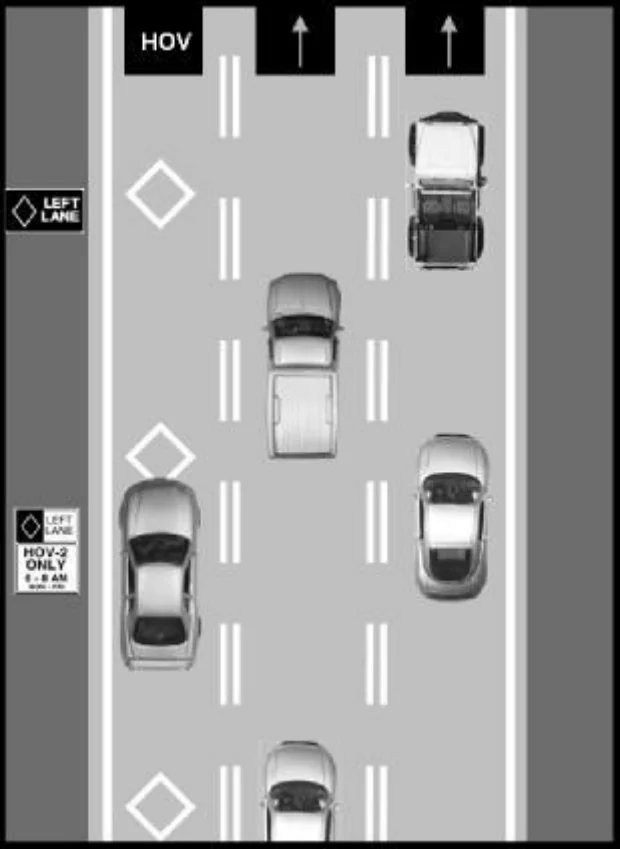
You're alone in your car on a road with a lane marked by white diamonds and an 'HOV 3' sign. You can't use it: that lane requires at least three people in the vehicle during the posted days and hours.
Check your understanding
Read the question, decide on an answer, then open it to check the explanation. These are Roadwise study questions based on the source handbook.
In a shared center left-turn lane, broken yellow lines on both sides mean:
The lane is reserved for buses
Only for left turns from either direction
The lane is for passing
The lane changes direction by time of day
Answer: Only for left turns from either direction
The shared center left-turn lane, marked with broken yellow lines on both sides, is only for left turns from either direction, never for passing or through travel.