A 4-minute lesson from the Kansas course. Read the rules and examples, follow the handbook page references, and check your understanding before you move on.
Trains can't swerve and need more than a mile to stop, so the whole job of avoiding a crash at a crossing is yours. Learn the signs and signals, and never let traffic trap you on the tracks.
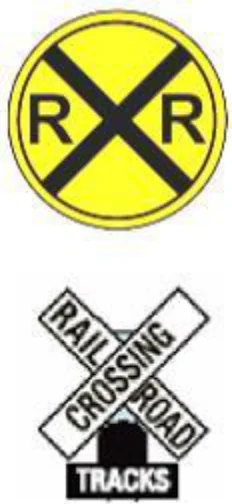
Round yellow RR advance warning sign and white crossbuck with number of tracks
Know the rule
A round yellow sign with an 'X' and black 'RR' letters stands before a crossing. Slow down, look and listen for a train, and be prepared to stop.
The white X-shaped 'Railroad Crossing' sign (crossbuck) is at the crossing itself. Wait for any approaching train, and stay behind the stop line until the crossing is clear.
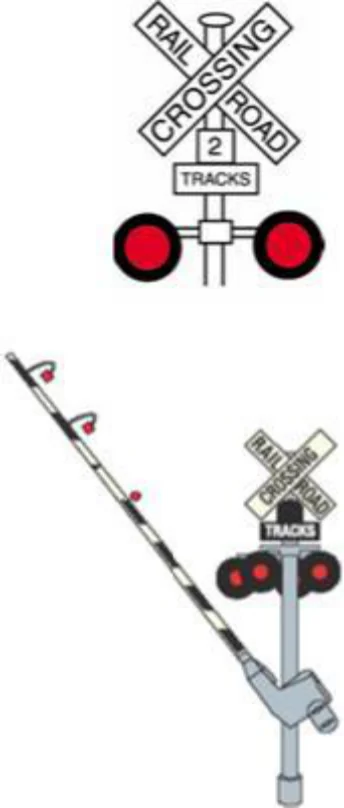
When side-by-side lights flash alternately, stop before the stop line or gate. Don't go around a lowered gate until it lifts and the lights stop, and don't cross until any bell or horn stops.
If you stall on the tracks, get everyone out and far away, running toward the direction the train is coming from so flying debris won't hit you. Then call local law enforcement.
Traffic ahead is backed up just past a crossing and there's room for your car only on the tracks. Stay behind the stop line and wait until you can clear the crossing completely.
Check your understanding
Read the question, decide on an answer, then open it to check the explanation. These are Roadwise study questions based on the source handbook.
The white, X-shaped 'crossbuck' sign at a railroad crossing means you must:
Proceed if you don't see a train within one mile
Always come to a complete stop, even with no train present
Yield to any approaching train or railroad vehicle
Sound your horn before crossing
Answer: Yield to any approaching train or railroad vehicle
The crossbuck sign at the crossing itself means you must yield to and wait for any approaching train or railroad vehicle.
The handbook states a 100-car freight train traveling 55 mph needs roughly how much distance to stop once emergency braking begins?
More than a mile
About 100 feet
About a quarter mile
About 500 feet
Answer: More than a mile
A loaded freight train at 55 mph needs more than a mile (about 18 football fields) to stop, which is why you should never assume a train can stop for you.
If your vehicle stalls on railroad tracks with a train approaching, you should get everyone out and run:
In the direction from which the train is approaching
Along the road, back the way you came
Across the tracks, as far away as possible
In the same direction the train is traveling
Answer: In the direction from which the train is approaching
Running toward the oncoming train's direction (away from the point of impact) reduces the risk of being hit by flying debris, unlike running in the train's direction of travel.
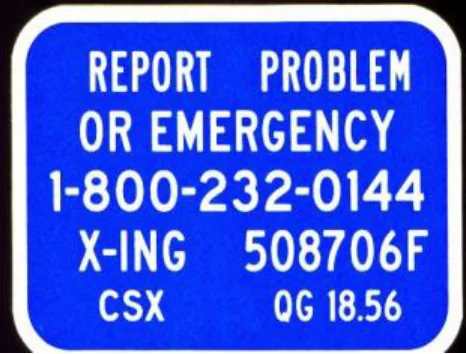
The Emergency Notification System (ENS) sign at a rail crossing is provided for:
Providing directions to the nearest hospital
Reporting unsafe conditions to a railroad dispatcher
Alerting drivers to upcoming speed limit changes
Displaying the current train schedule
Answer: Reporting unsafe conditions to a railroad dispatcher
The blue ENS sign gives a phone number to report malfunctioning signals, blocked crossings, trespassers, or other unsafe conditions directly to a railroad dispatcher.