roadwise.Open study app

Kansas driving lesson · Signs, Signals & Pavement Markings

Pavement markings and crosswalks

A 3-minute lesson from the Kansas course. Read the rules and examples, follow the handbook page references, and check your understanding before you move on.

Read time
3 minutes
Course unit
Signs, Signals & Pavement Markings
Checkpoint questions
6
Source pages
43, 44

Painted lines tell you who's beside you and whether you can cross into another lane. The key: yellow lines separate traffic going opposite ways, white lines separate traffic going the same way.

Know the rule

Lines separating traffic moving in opposite directions are yellow.

Handbook p. 43 ↗

Yellow centerlines

Yellow centerlines
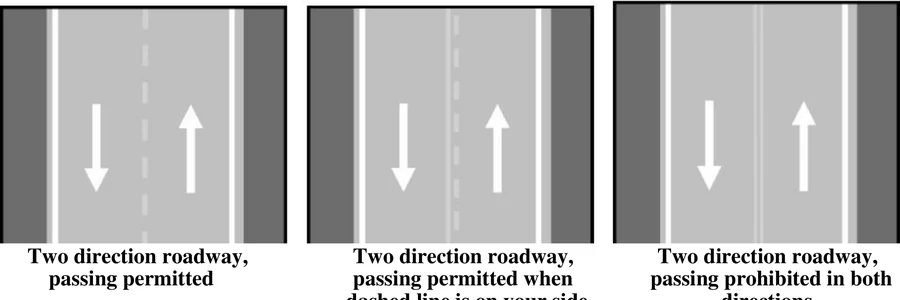
MarkingMeaning
Dashed yellowYou may pass if a safe gap is available
Solid + dashed, solid on your sideDo not pass
Solid + dashed, dashed on your sideYou may pass if a safe gap is available
Two solid yellowNeither side may pass
Handbook p. 43 ↗

Know the rule

You may cross a solid yellow line to make a turn when there are gaps in traffic. When passing is permitted, pass only if the lane you enter is clear, and only when necessary.

Handbook p. 43 ↗
Passing permitted/prohibited on two-direction roadway (composite)
Two-direction roadways: passing permitted, permitted from the dashed side, prohibited both ways

Know the rule

Multiple lanes going the same direction are separated by white lines. A dashed white line may be crossed to change lanes when a safe gap exists; a solid white line means stay in your lane unless a special situation requires a change.

Handbook p. 43 ↗

Know the rule

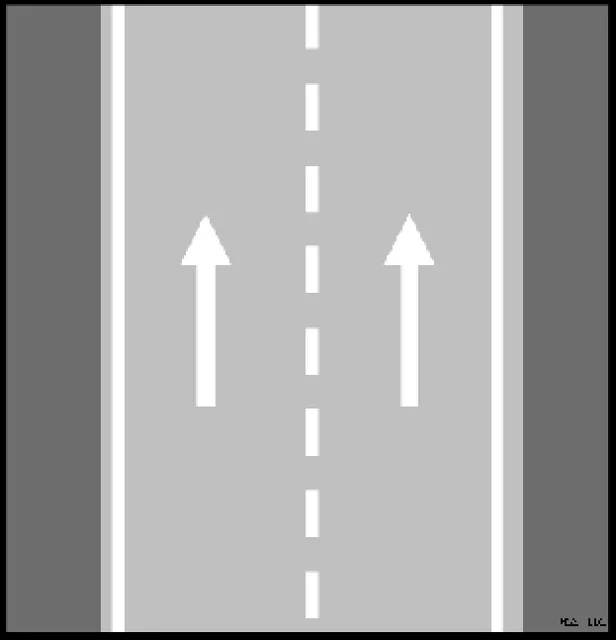
Solid white lines also mark the right edge of the road and parking spaces, designate turn lanes and prevent lane changes near intersections. White arrows show traffic direction and which turns each lane may make.

Handbook p. 43 ↗
One-way road lane markings (parallel arrows)
One-direction roadway, lane changes permitted

Know the rule

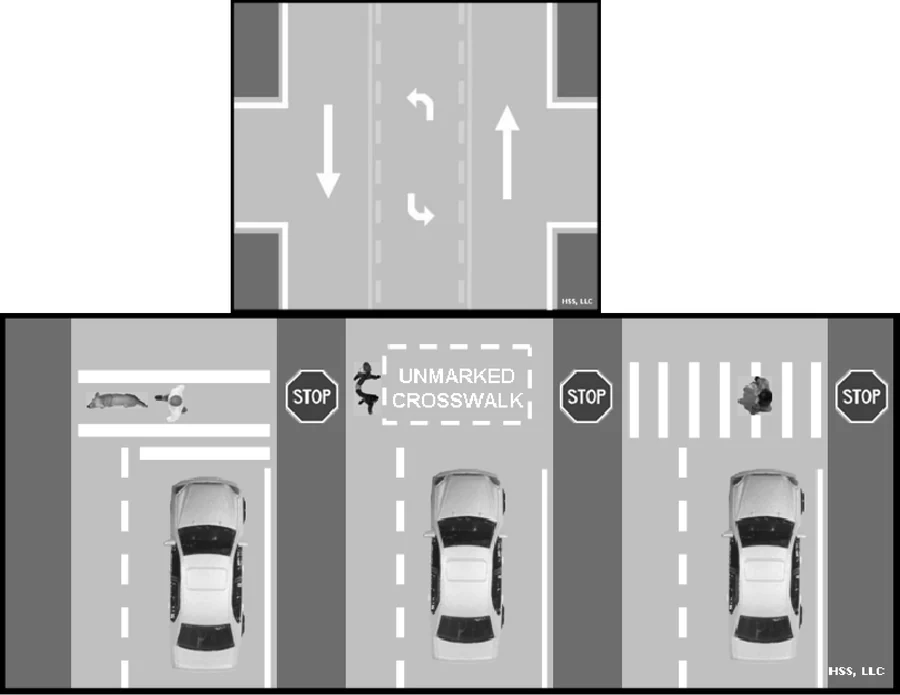
When a sign or signal requires you to stop, stop behind the stop line, crosswalk or sign. If there's a stop line before the crosswalk, obey the stop line first; with no crosswalk visible, stop before entering the intersection.

Handbook p. 44 ↗

Know the rule

You must yield to pedestrians entering or in a crosswalk. Not all crosswalks are marked, so watch for pedestrians at every intersection.

Handbook p. 44 ↗

Know the rule

Leaving a driveway, alley or building area (gas station, store, restaurant), stop as you would for a stop sign, behind the sidewalk, and yield to all pedestrians and traffic.

Handbook p. 44 ↗
Unmarked crosswalk at intersection
Common crosswalk markings, including an unmarked crosswalk

Put it into practice

You're on a two-lane road with a solid line and a dashed line in the center. The dashed line is on your side, so you may pass when there's a safe gap. The oncoming driver, facing the solid line, may not.

Check your understanding

Read the question, decide on an answer, then open it to check the explanation. These are Roadwise study questions based on the source handbook.

Lines separating traffic moving in opposite directions are what color?
  1. Yellow
  2. Blue
  3. White
  4. Orange

Answer: Yellow

Yellow lines separate opposing traffic flows; white lines separate same-direction lanes.
Handbook p. 43 ↗
A dashed yellow line on your side of the centerline means:
  1. Passing is not allowed from your side
  2. You may cross it only to make a turn
  3. You may pass if there is a safe gap in traffic
  4. Only oncoming traffic may pass

Answer: You may pass if there is a safe gap in traffic

A dashed yellow line on your side permits passing when a safe gap is available.

Handbook p. 43 ↗
Multiple lanes of travel in the same direction are separated by lines of what color?
  1. Blue
  2. Orange
  3. Yellow
  4. White

Answer: White

White lane markings separate lanes traveling the same direction; yellow separates opposing traffic.

Handbook p. 43 ↗
A solid white line between lanes generally means:
  1. You may change lanes at any time
  2. Stay in your lane except for special situations
  3. It marks a bike lane
  4. It only applies to trucks, buses, and other large vehicles

Answer: Stay in your lane except for special situations

A solid white line means you should stay in your lane except when a special situation, like an obstruction, requires changing.

Handbook p. 43 ↗
When may you cross a solid yellow centerline?
  1. To pass a slow vehicle when clear
  2. Never, for any reason
  3. To make a turn when there is a gap
  4. Only on roads under 40 mph

Answer: To make a turn when there is a gap

Page 43: you may cross a solid yellow line to turn when gaps in traffic flow exist, but not to pass.

Handbook p. 43 ↗
A dashed white line between same-direction lanes means you may cross it to change lanes when safe.
  1. True
  2. False

Answer: True

Dashed white lines allow lane changes when there is a safe gap in traffic.

Handbook p. 43 ↗
Take the lesson checkpoint in the app

More in Signs, Signals & Pavement Markings