roadwise.Open study app

Kansas driving lesson · Signs, Signals & Pavement Markings

Traffic signals

A 3-minute lesson from the Kansas course. Read the rules and examples, follow the handbook page references, and check your understanding before you move on.

Read time
3 minutes
Course unit
Signs, Signals & Pavement Markings
Checkpoint questions
6
Source pages
34, 35

Traffic signals tell you when and where to stop and go. Each color means something different when it's steady, flashing or shown as an arrow, and a green light never means the way is guaranteed clear.

Know the rule

Traffic control devices include signals, signs and pavement markings. You must also obey directions from law enforcement, highway personnel and school crossing guards.

Handbook p. 34 ↗

Know the rule

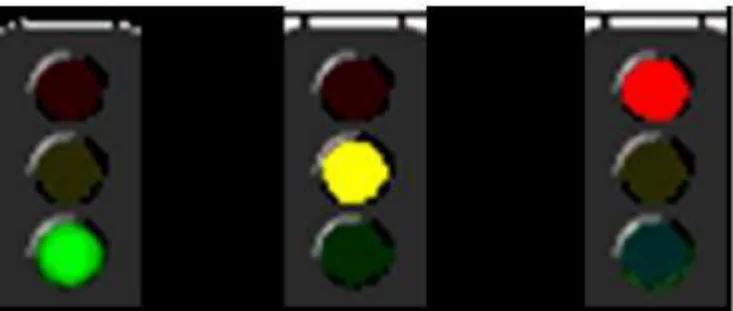
Signal lights are red, yellow and green from top to bottom. On horizontal signals, used in some metro areas, red is on the left, yellow in the middle and green on the right.

Handbook p. 34 ↗
Traffic signal states (red/yellow/green) composite
Vertical signals: green, yellow and red
Traffic signal states (horizontal arrangement)
Horizontal signals: red on the left, green on the right

What each signal means

What each signal means
SignalMeaning
Steady greenGo if clear; yield to emergency vehicles and others
Green arrowTurn that way if clear; others should yield to you
Steady yellowAbout to turn red; stop if traffic behind allows
Flashing yellowSlow down and proceed with caution
Yellow arrowGreen arrow ending; prepare to stop and yield
Steady redStop before the intersection; wait for green
Flashing redSame as a stop sign: full stop, look, yield
Red arrowStop; don't go that way until green arrow/light
Handbook p. 34 ↗

Know the rule

If you're already in the intersection when the light turns yellow, you may continue safely through.

Handbook p. 34 ↗

Know the rule

When your light turns green, let crossing traffic clear the intersection first. Turning left on a steady green, you may turn only when clear, yielding to oncoming traffic and pedestrians.

Handbook p. 34 ↗

Know the rule

On a green arrow, watch for drivers turning right on red from the other side of the intersection, and for pedestrians.

Handbook p. 34 ↗

Know the rule

Right on red is allowed after a full stop and checking for traffic and pedestrians, unless a sign prohibits it.

Handbook p. 34 ↗

Know the rule

Some left turns on red may be permitted from a one-way street onto another one-way street, or from a two-way street onto a one-way street.

Handbook p. 34 ↗

Know the rule

A small, very bright blinking light in the middle of a red light alerts you to the red light and that you must stop.

Handbook p. 34 ↗

Put it into practice

You're first in line at a red light and want to turn right. There's no NO TURN ON RED sign. Stop fully behind the stop line, check for cross traffic and pedestrians, then turn when it's clear.

Check your understanding

Read the question, decide on an answer, then open it to check the explanation. These are Roadwise study questions based on the source handbook.

When turning left on a steady green light, you may turn:
  1. Only if a green arrow is also displayed
  2. Immediately, since green always means go
  3. Only when clear, yielding to oncoming traffic
  4. Only after all oncoming traffic has a red light showing

Answer: Only when clear, yielding to oncoming traffic

A steady green permits a left turn, but only when it is clear and after yielding to oncoming traffic and pedestrians.

Handbook p. 34 ↗
A steady yellow traffic light means you should:
  1. Stop only if a pedestrian is present
  2. Speed up to clear the intersection
  3. Treat it exactly the same as a flashing yellow light
  4. Slow down and stop if you can do so safely

Answer: Slow down and stop if you can do so safely

Steady yellow warns that the light is about to turn red; you should slow and stop if traffic behind allows, unless already in the intersection.

Handbook p. 34 ↗
A flashing yellow traffic light means:
  1. Yield only to pedestrians, not vehicles
  2. Slow down and proceed with caution
  3. The signal is malfunctioning and should be ignored
  4. Stop completely, then proceed

Answer: Slow down and proceed with caution

A flashing yellow means slow down and proceed with caution, being ready to stop for entering traffic.

Handbook p. 34 ↗
A flashing red traffic light should be treated the same as:
  1. A do-not-enter sign
  2. A yield sign
  3. A stop sign
  4. A steady green light

Answer: A stop sign

At a flashing red light you must stop completely, look both ways, and yield right-of-way, exactly as you would at a stop sign.

Handbook p. 35 ↗
A red arrow means you:
  1. May turn after a full stop, just like a plain red light
  2. May proceed with caution
  3. Should treat it as a yield sign
  4. Stop, and wait for the arrow or light to change

Answer: Stop, and wait for the arrow or light to change

A red arrow requires a stop, and you may not proceed in that direction until the arrow or light changes.

Handbook p. 35 ↗
When turning right on a steady red light where no sign prohibits it, you must first:
  1. Yield only to vehicles, not pedestrians
  2. Stop, then check for traffic and pedestrians
  3. Slow down without stopping
  4. Wait for a green arrow only

Answer: Stop, then check for traffic and pedestrians

A right turn on red requires a complete stop, followed by checking for traffic and pedestrians before turning.

Handbook p. 34 ↗
Take the lesson checkpoint in the app

More in Signs, Signals & Pavement Markings