roadwise.Open study app

Kansas driving lesson · Right-of-Way, Turning & Parking

Lane use and turning

A 3-minute lesson from the Kansas course. Read the rules and examples, follow the handbook page references, and check your understanding before you move on.

Read time
3 minutes
Course unit
Right-of-Way, Turning & Parking
Checkpoint questions
4
Source pages
45, 46, 47

Where no signs or markings say which lane to use, general rules take over: keep right except to pass, never back up in a travel lane, and turn from and into the lane closest to where you're going.

Know the rule

It is illegal and unsafe to back up in any travel lane except to parallel park. If you miss a turn or exit, go on to where it's safe to turn around.

Handbook p. 45 ↗

Know the rule

Don't stop in travel lanes or on the shoulder for any reason (confusion, breakdown, letting out a passenger). Keep moving until you can safely pull off into a parking area.

Handbook p. 45 ↗

Know the rule

With two or more lanes in your direction, stay in the right lane except to pass. With three or more, use the center lane, especially when lots of traffic is entering or exiting.

Handbook p. 46 ↗

Know the rule

Never drive on the shoulder unless law enforcement tells you to or local regulations allow it. Never pass on the shoulder, paved or not.

Handbook p. 46 ↗

Know the rule

On multi-lane roads the left-most lane is for passing slower vehicles. A driver you pass on the right may not see you and could change lanes suddenly.

Handbook p. 46 ↗

Turning step by step:

  • Search all corners for traffic controls, pedestrians and vehicles, and signal
  • Get into the lane closest to the direction you want to go
  • Recheck traffic in all directions and look through the turn as far as possible
  • Turn smoothly into the closest lane going your way, crossing the fewest lanes
  • Accelerate smoothly, make sure your signal cancels, and check traffic behind
  • If not already in the right lane after turning, move right when safe
Handbook p. 46 ↗

Know the rule

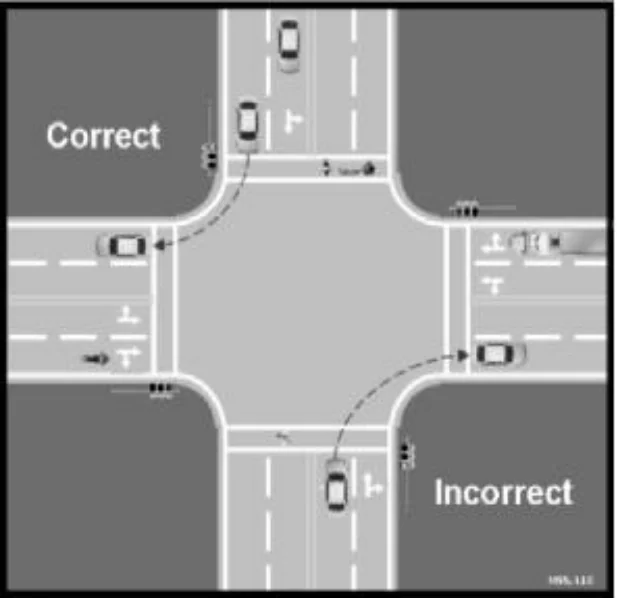
Right turns: don't swing wide to the left first; a driver behind may think you're turning left and try to pass on your right. Turn from the right-most lane unless markings allow more lanes.

Handbook p. 46 ↗
Correct vs incorrect turning path at intersection
Right turn: correct tight turn versus incorrect wide swing

Know the rule

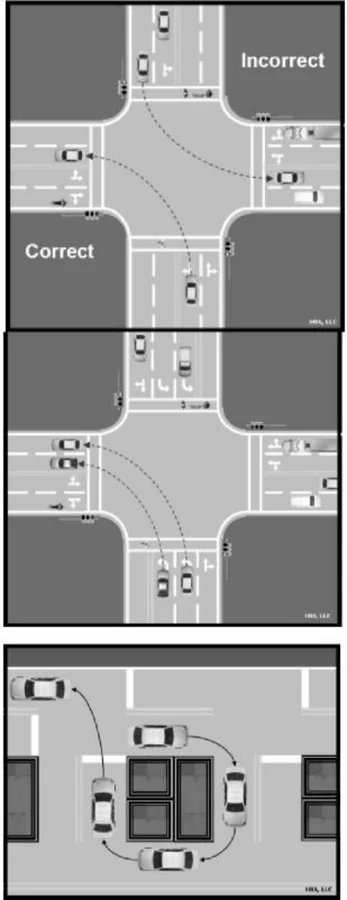
Left turns: on green, pull into the intersection ready to turn. Don't cut the corner in front of traffic from the left, leave room for oncoming left-turners, and turn from the left-most lane unless markings allow more.

Handbook p. 47 ↗
Correct vs incorrect intersection paths (composite)
Left turns: correct and incorrect paths, and dual turn lanes

Know the rule

Multiple turn lanes: at least one block before, enter the lane you'll turn from after checking mirrors and blind spots, then steer into the matching lane on the new street.
Handbook p. 47 ↗

Put it into practice

You miss your exit on the highway. Don't stop or back up on the shoulder. Continue to the next exit and turn around there.

Check your understanding

Read the question, decide on an answer, then open it to check the explanation. These are Roadwise study questions based on the source handbook.

When turning right, from which lane should you generally begin and end your turn?
  1. The right-most lane
  2. Any lane with the least traffic
  3. The left-most lane
  4. The center lane

Answer: The right-most lane

Right turns should be made from the right-most lane to avoid swinging wide and to reduce confusion for drivers behind you.

Handbook p. 46 ↗
It is legal to back up in a travel lane if you missed your turn or exit.
  1. True
  2. False

Answer: False

Backing up in a travel lane is illegal and unsafe; you should continue to a safe place to turn around instead.

Handbook p. 45 ↗
On a road with three or more lanes going your direction, which lane does the handbook suggest when a lot of traffic is entering and exiting?
  1. The right lane
  2. The left lane
  3. The center lane
  4. Whichever lane has the least traffic

Answer: The center lane

Page 46: on a road with three or more lanes in the same direction, use the center lane, especially when many vehicles are entering or exiting.

Handbook p. 46 ↗
On multi-lane roads, the left-most lane is intended to be used for:
  1. Passing slower vehicles
  2. Trucks and buses
  3. Vehicles preparing to exit
  4. Slow-moving vehicles

Answer: Passing slower vehicles

Page 46: on multi-lane roads, the left-most lane is intended for passing slower vehicles.

Handbook p. 46 ↗
Take the lesson checkpoint in the app

More in Right-of-Way, Turning & Parking