roadwise.Open study app

Kansas driving lesson · Right-of-Way, Turning & Parking

Turnabouts and U-turns

A 4-minute lesson from the Kansas course. Read the rules and examples, follow the handbook page references, and check your understanding before you move on.

Read time
4 minutes
Course unit
Right-of-Way, Turning & Parking
Checkpoint questions
6
Source pages
47, 48, 49

When you're headed the wrong way, pick the safest way to turn around. Going around the block is best; driveways come next; the three-point turnabout is the last resort.

Know the rule

The safest way to change direction is to turn right and go around the block, avoiding most left turns across traffic. On the interstate, go to the next exit and turn around.

Handbook p. 47 ↗

Know the rule

It is illegal to cross the median strip or use crossover areas reserved for emergency vehicles.

Handbook p. 47 ↗

Know the rule

A two-point turnabout uses a street, alley or driveway when you can't go around the block. Backing into the driveway is safest because you can see traffic better leaving it. Use it only on a two-lane road.

Handbook p. 48 ↗

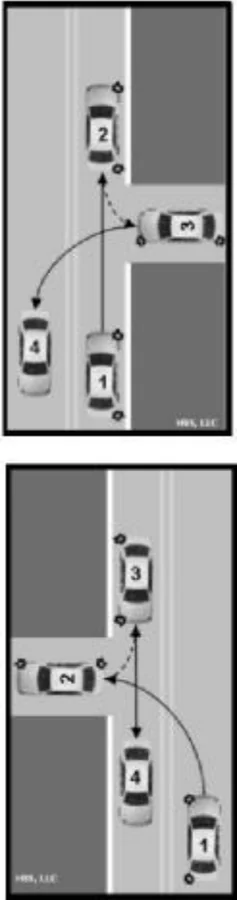
Reverse two-point turnabout:

  • Signal right, stop, and check traffic to the sides and rear
  • Back until your rear bumper reaches the near edge of the driveway
  • While backing slowly, steer rapidly all the way right
  • As the vehicle centers in the driveway, straighten the wheels and stop
  • Shift to drive, check both ways, signal and turn left into the proper lane
Handbook p. 48 ↗

Forward two-point turnabout:

  • Check mirrors and signal left; move close to the center of the road
  • Turn into the driveway or alley as near the right side as possible
  • Stop when the rear clears the curb or driveway edge
  • Check all directions, signal right and shift to reverse
  • Back slowly, turning the wheel quickly all the way right
  • As you center in the nearest lane: straighten, stop, shift to drive, cancel signal, go
Handbook p. 48 ↗
Lane change / turn path diagram (composite)
Reverse and forward two-point turnabouts

Know the rule

The three-point turnabout is the most difficult and dangerous way to turn around. Use it only when the road is too narrow for a U-turn and you can't go around the block, and only on a two-lane road.

Handbook p. 48 ↗

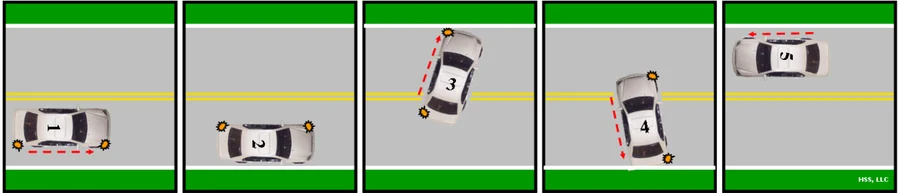
Three-point turnabout:

  • Check mirrors, signal right and stop on the right side of the road
  • Signal left, check traffic and your left blind spot; turn hard left across and stop
  • Shift to reverse, check traffic and both blind spots; turn hard right back across and stop
  • Shift to drive, signal left, check; turn hard left into the right lane going the new way
Handbook p. 48 ↗
U-turn maneuver steps
Three-point turnabout sequence

Know the rule

U-turns need a wide street or a vehicle that turns in a small space and aren't legal everywhere. Move far right, wait for a large gap both ways, turn sharply left, and watch for vehicles turning right into your path.

Handbook p. 49 ↗

Put it into practice

You're lost on a two-lane residential street and need to go the other way. First choice: turn right and go around the block. If that's not possible, back into a driveway (reverse two-point turnabout) rather than backing out onto the street.

Check your understanding

Read the question, decide on an answer, then open it to check the explanation. These are Roadwise study questions based on the source handbook.

What is the safest way to change direction if you're headed the wrong way, according to the handbook?
  1. Make a quick U-turn wherever convenient
  2. Turn right and go around the block
  3. Use a median crossover to turn around
  4. Back up in the roadway

Answer: Turn right and go around the block

Turning right and going around the block avoids most left turns across oncoming traffic and is the safest option.

Handbook p. 47 ↗
In a two-point turnabout, the safest method to reverse direction using a driveway is to:
  1. Pull forward into the driveway, then back out
  2. Make a three-point turn in the street
  3. Back the vehicle into the driveway
  4. Make a U-turn at the driveway entrance

Answer: Back the vehicle into the driveway

Backing into the driveway lets you see oncoming traffic better when you pull back out, making it the safer two-point turnabout method.

Handbook p. 48 ↗
A three-point turnabout should only be used when:
  1. There is heavy traffic in both directions
  2. You are on a multi-lane highway
  3. The road is wide and traffic is light
  4. The road is too narrow for a U-turn and no block is nearby

Answer: The road is too narrow for a U-turn and no block is nearby

This maneuver is reserved for narrow two-lane roads where a U-turn isn't possible and driving around the block isn't an option, since it's the most difficult and dangerous turn.
Handbook p. 48 ↗
It is illegal to cross the median strip or use crossover areas on a divided highway because:
  1. Those areas are reserved for emergency vehicles
  2. They are reserved for bicyclists
  3. They are reserved for trucks and buses
  4. They are reserved for highway maintenance

Answer: Those areas are reserved for emergency vehicles

Crossover areas on divided highways and interstates are reserved for emergency vehicle use, so crossing the median there is illegal for other drivers.

Handbook p. 47 ↗
During a forward two-point turnabout, after turning into a driveway or alley, what should you check before backing out?
  1. Only your left side
  2. Only your rearview mirror
  3. Only the traffic to your right
  4. Traffic in all directions before reversing

Answer: Traffic in all directions before reversing

Before backing out during a forward two-point turnabout, you must check traffic in all directions again before shifting to reverse.

Handbook p. 48 ↗
The three-point turnabout is described as the most difficult and dangerous way to change direction.
  1. True
  2. False

Answer: True

The handbook specifically calls the three-point turnabout the most difficult and dangerous turnabout method.

Handbook p. 48 ↗
Take the lesson checkpoint in the app

More in Right-of-Way, Turning & Parking