Roadwise States Kansas Driving lessons Where you can't park Kansas driving lesson · Right-of-Way, Turning & Parking
Where you can't park A 3-minute lesson from the Kansas course. Read the rules and examples, follow the handbook page references, and check your understanding before you move on.
Read time 3 minutes
Course unit Right-of-Way, Turning & Parking
Checkpoint questions 6
Source pages 19, 52, 54, 55 You're responsible for making sure your parked vehicle isn't a hazard. Kansas law lists places you can never park, and many come with exact distances that show up on the test.
Know the rule
A parked vehicle must be far enough from any travel lane to avoid interfering with traffic, and visible to vehicles approaching from either direction.
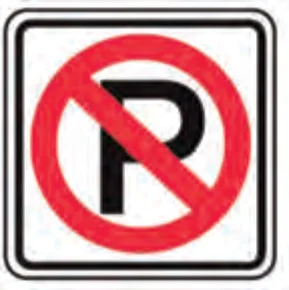
Handbook p. 52 ↗ Never park: Within an intersection Within a pedestrian crosswalk at an intersection In front of a driveway On a bridge or elevated structure, or in a tunnel In 'No Parking' zones marked by official signs Double ('two-deep') along the curb or side of the street On narrow streets or roads where parking would interfere with traffic On a sidewalk Alongside or opposite a street excavation or obstruction if it would block traffic In spaces identified as handicapped parking Handbook p. 19 ↗ Also do not park: In a construction area if your vehicle will block traffic Within 30 ft. of a yield sign Blocking an alley, private road or curb lowered for sidewalk access On an overpass or underpass On the opposite side of the street, against the flow of traffic In a handicapped space unless you have a handicap license plate, tag or sticker On the roadway next to a parked vehicle Wherever a sign says you cannot park Handbook p. 54 ↗ No Parking sign Know the rule
Check for signs that prohibit or limit parking; some restrictions are shown by colored curb markings.
Handbook p. 54 ↗ Put it into practice
You find an open spot 25 feet before a stop sign. You can't take it: parking is banned within 30 feet approaching a stop sign, traffic signal or flashing beacon.
A useful reminder Parking numbers in order: 12 inches, 15 feet, 20 feet, 30 feet, 50 feet, 75 feet.
Check your understanding Read the question, decide on an answer, then open it to check the explanation. These are Roadwise study questions based on the source handbook.
How close to a fire hydrant is parking prohibited? Within 50 feet Within 25 feet Within 15 feet Within 5 feet Answer: Within 15 feet
Parking is prohibited within 15 feet of a fire hydrant.
Handbook p. 19 ↗ How far from a highway-railroad grade crossing is parking prohibited? Within 50 feet of the nearest rail Within 100 feet Within 15 feet Within 20 feet of the crossing Answer: Within 50 feet of the nearest rail
Parking within 50 feet of the nearest rail at a railroad crossing is prohibited.
Handbook p. 19 ↗ Within how many feet of a traffic control signal, stop sign, or flashing beacon is parking prohibited? 10 feet 50 feet 75 feet 30 feet Answer: 30 feet
Parking is prohibited within 30 feet approaching a traffic control signal, stop sign, or flashing beacon.
Handbook p. 19 ↗ Parking is prohibited within how many feet of a fire station driveway on the same side of the street? 20 feet 10 feet 50 feet 75 feet Answer: 20 feet
You may not park within 20 feet of a fire station driveway on the same side; the limit is 75 feet on the opposite side.
Handbook p. 19 ↗ On the side of the street opposite a fire station driveway, parking is prohibited within how many feet? 50 feet 20 feet 75 feet 30 feet Answer: 75 feet
The opposite-side restriction near a fire station driveway is 75 feet, larger than the 20-foot same-side restriction.
Handbook p. 19 ↗ What does a blue painted curb typically indicate? Short stops only A handicap parking restriction A fire zone A loading zone Answer: A handicap parking restriction
Blue curb markings indicate handicap parking restrictions; other colors indicate different restrictions such as loading zones or fire lanes.
Handbook p. 55 ↗ Previous lesson School bus stopping law Next lesson Turnabouts and U-turns More in Right-of-Way, Turning & Parking About the source Roadwise’s Kansas course uses the driver handbook edition supplied with this study pack. This lesson cites source pages 19, 52, 54, 55. The linked PDF is a third-party mirror of the handbook, rather than a government-hosted page.
Open the handbook source PDF · View the source edition
For current application requirements, fees, appointments, and the format that applies to your age or license type, check Kansas’s DMV. Roadwise provides study material and does not issue permits or licenses.