Safe drivers know what's happening all around the car. Look far down the road so problems show up early, check the sides at every intersection, and glance behind before you slow down or move over.
How far ahead to look
| Where | Look at least |
|---|---|
| In the city | Two blocks or two traffic signals |
| In an urban area | Three blocks or three traffic signals |
| On the highway | A quarter of a mile |
Visual lead
An area 20 to 30 seconds ahead of the front of your vehicle. Searching it lets you spot changes in your path in time to stop or steer around them.
Handbook p. 56 ↗Measuring how far ahead you're looking:
- Pick a stationary object, like a sign or telephone pole, as far ahead as you can see
- Count 'one-thousand-one, one-thousand-two…' until you reach it
- The count is how many seconds ahead you were looking
Know the rule
A traffic light that has been green for a long time may turn red before you get there; start slowing and be ready to stop.
Handbook p. 56 ↗Reacting and stopping on dry pavement
| Speed | React and stop | You must see ahead |
|---|---|---|
| 60 mph | About 4 to 5 seconds or 359 feet | At least 400 feet, or you're too fast |
| 30 mph | About 2 to 3 seconds or 123 feet | At least 150 feet |
Know the rule
Before entering an intersection, look front, left and right. If stopped, look left, right and left again. Don't rely on signals or signs; keep searching even when cross traffic has a red light, especially just after your light turns green.
Handbook p. 57 ↗Know the rule
If your view of a cross street is blocked, edge forward slowly until you can see. Crossing drivers will see your front end first and can slow or warn you.
Handbook p. 57 ↗Know the rule
Look to the sides near shopping centers, parking lots, construction areas, busy sidewalks, playgrounds and schoolyards. Before turning, search for a safe gap, oncoming turners and pedestrians.
Handbook p. 57 ↗Know the rule
Approach a highway-railroad crossing by slowing at the round warning sign and looking each direction before the tracks.
Handbook p. 57 ↗Check behind you (more often in heavy traffic) before:
- Changing lanes
- Slowing down, especially quickly or where others don't expect it, like driveways
- Entering traffic from the side of a street
- Driving down a long or steep hill, watching for fast trucks and buses
Changing lanes:
- Keep a safe following distance and check rearview and side mirrors
- Check your blind spots by turning your head to look over your shoulder
- Look several times briefly, since traffic ahead could stop while you look away
- Find a 4 to 5 second gap, signal, look again, adjust speed and steer in
- Cancel your turn signal
Blind spots
Areas around your vehicle you cannot see with your mirrors. Check them by turning your head and looking over your shoulder; be sure no one is near your rear corners.
Handbook p. 58 ↗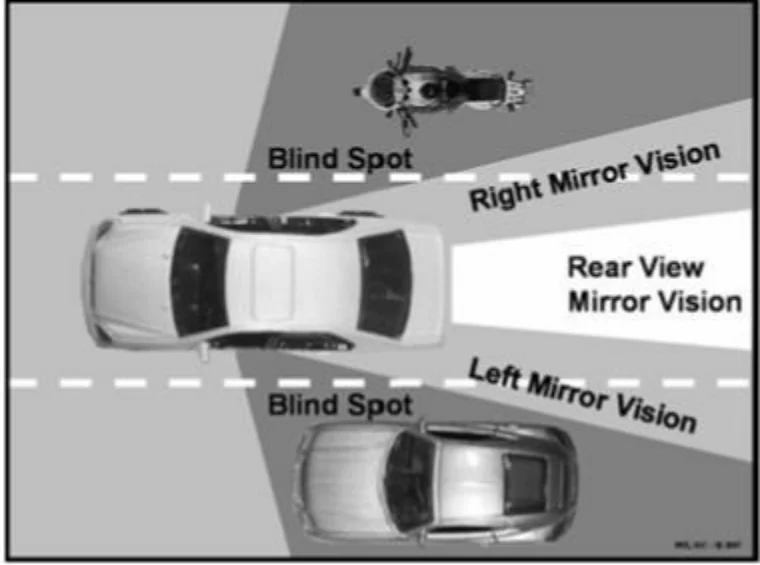
Put it into practice
You're doing 60 mph at night and can only see about 300 feet ahead. The handbook's rule: at 60 mph you need to see at least 400 feet, so you're driving too fast for your visibility. Slow down.