roadwise.Open study app

Kansas driving lesson · Visual Search, Speed & Space Management

Space to merge, cross and pass

A 4-minute lesson from the Kansas course. Read the rules and examples, follow the handbook page references, and check your understanding before you move on.

Read time
4 minutes
Course unit
Visual Search, Speed & Space Management
Checkpoint questions
6
Source pages
64, 65, 66

Merging, crossing and passing all require a big enough gap in time. Learn the gap sizes and how long each move takes, and never count on other drivers to make room for you.

4 to 6 seconds

Gap to choose for merging, changing lanes or entering a roadway

Handbook p. 64 ↗

Know the rule

Move into the middle of the gap so both you and the car behind can adjust to a 3-second following interval. Don't take a smaller gap; it can quickly get smaller.

Handbook p. 64 ↗

Know the rule

If you need to cross several lanes, change lanes one at a time.

Handbook p. 64 ↗
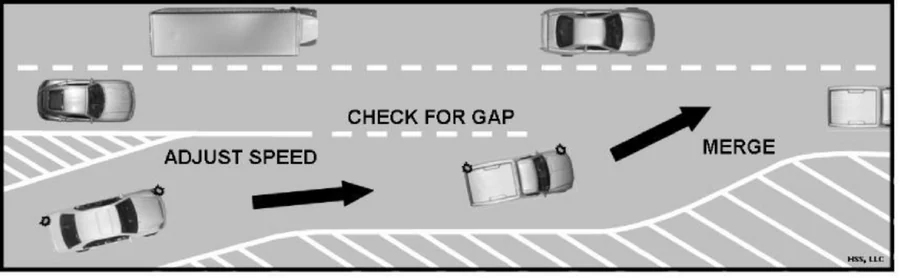
Merging onto a highway
Adjust speed, check for a gap, merge

Time needed from a stop

Time needed from a stop
MoveTime
Go straight across an intersection3 to 5 seconds
Right turn and get up to speed12 to 15 seconds
Left turn and get up to speed15 to 18 seconds
Handbook p. 65 ↗

Know the rule

Even on green, don't start across if vehicles block your way; if the light turns red while you're caught inside, you're illegally blocking traffic.

Handbook p. 65 ↗

Know the rule

Don't pull out just because an approaching vehicle's turn signal is on. Wait until it actually starts to turn; trucks' and motorcycles' signals may not self-cancel.

Handbook p. 65 ↗

To pass safely:

  • Check for oncoming traffic, vehicles entering from side streets or driveways, and traffic slowing ahead
  • Check mirrors and over your shoulder, then signal
  • Start from at least two seconds behind the vehicle you're passing
  • Don't drift toward the vehicle you're passing
  • Keep going until its complete front is visible in your rearview mirror, signal, and return
Handbook p. 65 ↗

Know the rule

When being passed, keep right: move to the right side of your lane and hold a constant speed.

Handbook p. 66 ↗

Know the rule

Pass only one vehicle at a time; a pass can take 20 to 30 seconds. If you can see an oncoming vehicle, don't try to pass. One more than 25 seconds away seems to be standing still.

Handbook p. 66 ↗
1/3 of a mile

At 55–60 mph you must see this far (about 20 to 25 seconds) ahead to pass; don't start within 1/3 mile of a hill or curve

Handbook p. 66 ↗

Don't pass, or expect to lose your passing space, when there are:

  • Intersections, shopping center entrances, parking lot entrances or alleys (passing there is illegal/dangerous)
  • People or bicyclists near the road
  • A narrow bridge or anything else that narrows the lane
  • A patch of ice, a pothole or something on the road
  • Not enough room to return to your lane
  • A railroad grade crossing within the 20 to 25 second area ahead
Handbook p. 66 ↗

Put it into practice

On a two-lane highway at 55 mph, you want to pass a truck, but a hill crest is about a quarter mile ahead. That's inside 1/3 of a mile, so treat the hill like an oncoming car and wait.

Check your understanding

Read the question, decide on an answer, then open it to check the explanation. These are Roadwise study questions based on the source handbook.

What size gap in traffic should you look for when merging or changing lanes?
  1. 20 to 30 seconds
  2. 1 to 2 seconds
  3. 4 to 6 seconds
  4. 10 to 15 seconds

Answer: 4 to 6 seconds

The handbook recommends a 4-to-6 second gap for merging, entering a roadway, or changing lanes.

Handbook p. 64 ↗
An oncoming vehicle that appears to be more than how many seconds away generally looks like it's standing still?
  1. 5 seconds
  2. 10 seconds
  3. 60 seconds
  4. 25 seconds

Answer: 25 seconds

Oncoming vehicles more than 25 seconds away can appear to be standing still, which is why judging their speed is difficult and risky when deciding to pass.
Handbook p. 66 ↗
Before passing near a hill or curve, you should treat it as an oncoming vehicle if you are within:
  1. 1/3 of a mile
  2. 1 mile
  3. 100 feet
  4. 1/10 of a mile

Answer: 1/3 of a mile

You should not begin passing within 1/3 of a mile of a hill or curve that blocks your view, treating it as if an oncoming vehicle were there.

Handbook p. 66 ↗
When crossing an intersection after a stop, a vehicle going straight can typically clear it in about:
  1. 1 second
  2. 20 to 25 seconds
  3. 3 to 5 seconds
  4. 10 to 12 seconds

Answer: 3 to 5 seconds

Going straight through an intersection after stopping normally takes about 3 to 5 seconds under normal circumstances.

Handbook p. 65 ↗
Completing a left turn and accelerating to speed from a stop typically takes about:
  1. 30 to 40 seconds
  2. 3 to 5 seconds
  3. 15 to 18 seconds
  4. 1 to 2 seconds

Answer: 15 to 18 seconds

A left turn takes longer than a right turn to complete and reach speed — about 15 to 18 seconds, compared to 12 to 15 for a right turn.

Handbook p. 65 ↗
When passing another vehicle, you should pass from about how far behind it before pulling out?
  1. About 10 feet behind
  2. At least two seconds behind
  3. About one car length behind
  4. About one second behind

Answer: At least two seconds behind

Pass from at least two seconds behind the vehicle you intend to pass, to avoid striking its rear as you move into the passing lane.

Handbook p. 65 ↗
Take the lesson checkpoint in the app

More in Visual Search, Speed & Space Management