Roadwise States Iowa Driving lessons Lane markings and lane use Iowa driving lesson · Signs, Signals & Markings
Lane markings and lane use A 4-minute lesson from the Iowa course. Read the rules and examples, follow the handbook page references, and check your understanding before you move on.
Read time 4 minutes
Course unit Signs, Signals & Markings
Checkpoint questions 6
Source pages 15, 16 Pavement markings direct traffic just like signs, alone or together with signs and signals. The first code to learn: white lines separate traffic moving the same direction; yellow lines separate traffic moving in opposite directions.
Know the rule
On two-way roads with a solid yellow line beside a dashed yellow line, you may not pass from the solid-line side. Vehicles on the dashed-line side may pass when safe.
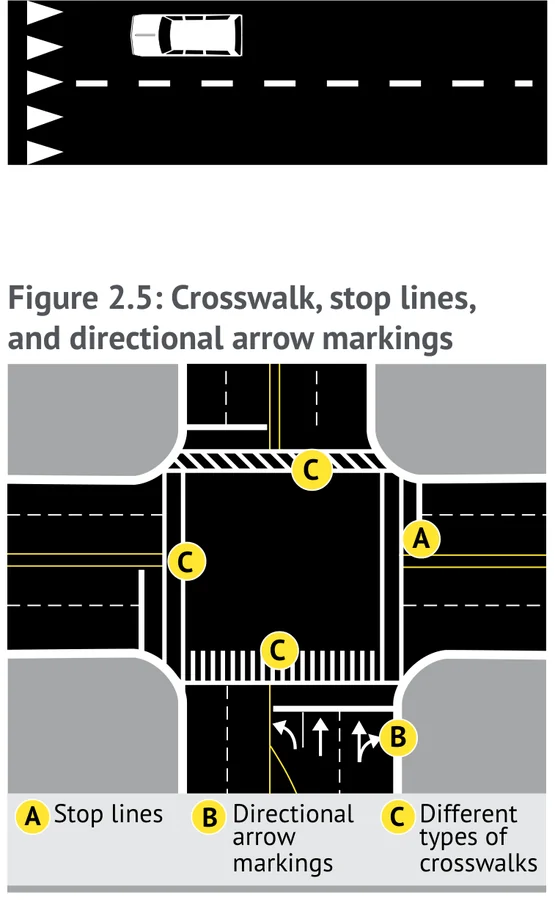
Handbook p. 15 ↗ Yield line A row of solid white triangles pointing toward approaching vehicles, marking where to yield for Yield, Yield Here to Pedestrians, or Yield Here to Pedestrians and Bicycles signs.
Handbook p. 15 ↗ Know the rule
When a sign or signal requires you to stop, stop before the stop line—or before the crosswalk if there is one.
Handbook p. 15 ↗ Know the rule
Yield to anyone in or about to enter a crosswalk. Not all crosswalks are marked, so watch for pedestrians at intersections without them.
Handbook p. 15 ↗ Know the rule
Directional arrow markings, when present, show the movements allowed or required from that lane.
Handbook p. 15 ↗ Stop lines (A), directional arrows (B), and crosswalks (C) Know the rule
Reversible lanes carry traffic one way at some times and the other way at others, usually marked by double-dashed yellow lines. Check signs or overhead lights before using them.
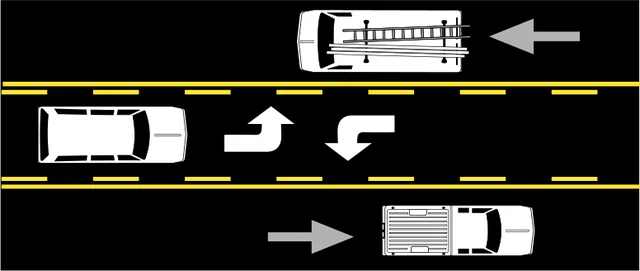
Handbook p. 15 ↗ Shared left-turn lane Center lane for left turns from either direction, marked on each side by solid and dashed yellow lines. You may enter and stop in it to turn left, but never use it to pass.
Handbook p. 16 ↗ Shared left-turn lane Reserved lane Lane for special vehicles, marked by signs and often a white diamond—e.g., HOV lanes for vehicles carrying two or more people. Don't use it unless you drive that type of vehicle.
Handbook p. 16 ↗ General lane use: With 2+ lanes in your direction, the left lane is generally used for passing With 3+ lanes, stay in the right or center lane except to pass; use center with heavy entering traffic Never drive on the shoulder unless a traffic control device or official tells you to Never pass on the shoulder, paved or not—other drivers may pull off without looking Handbook p. 16 ↗ Know the rule
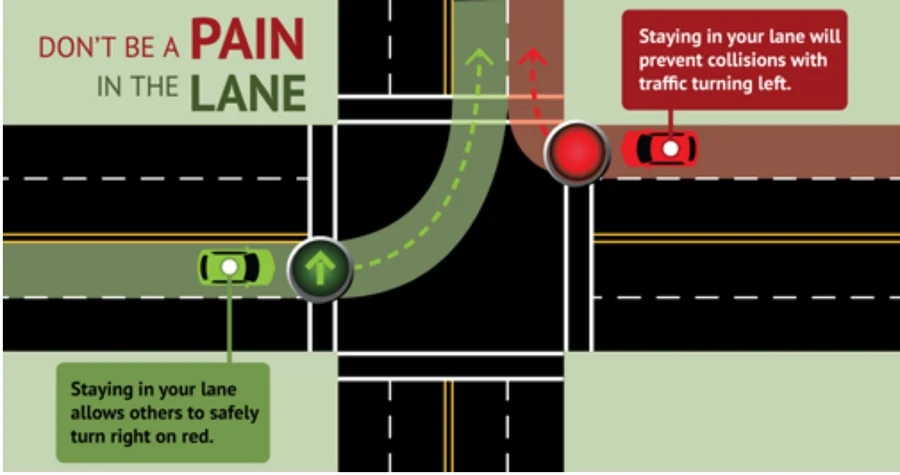
Without signs or markings, turn from the lane closest to the direction you want to go and into the lane closest to the one you came from. Change lanes only after completing the turn.
Handbook p. 16 ↗ Stay in your lane and turn into the lane closest to the one you came from Put it into practice
At rush hour the signal over your lane changes to a steady yellow X. The lane's direction is changing—signal and move out of it as soon as it's safe.
Check your understanding Read the question, decide on an answer, then open it to check the explanation. These are Roadwise study questions based on the source handbook.
On a two-way road, you see a solid yellow line on your side paired with a dashed yellow line on the other. What does this mean? Both sides may pass when safe Only the dashed-line side may pass when safe Neither side may ever pass Only the solid-line side may pass Answer: Only the dashed-line side may pass when safe
Passing is not allowed on the solid-yellow side; the vehicle on the dashed-line side may pass when safe.
Handbook p. 15 ↗ What does a steady yellow X displayed over a reversible lane mean? You may freely enter and use the lane The lane is permanently closed The lane's use is changing The lane is for turning only Answer: The lane's use is changing
A steady yellow X means the lane's use is changing, and you should move out of it as soon as safely possible.
Handbook p. 15 ↗ What is a shared left-turn lane used for? Passing slower vehicles Parking temporarily High-occupancy vehicles only Left turns from either direction Answer: Left turns from either direction
Shared left-turn lanes are reserved for vehicles making left turns from either direction, and cannot be used for passing.
Handbook p. 16 ↗ On a road with three or more lanes in the same direction, where should you generally drive except to pass? In the far-left lane, since it's fastest In whichever lane has the least traffic In the right or center lane In the left lane when traffic is light Answer: In the right or center lane
On a road with three or more lanes, stay in the right or center lane except to pass.
Handbook p. 16 ↗ When may you legally drive on the shoulder of the road? Anytime traffic is moving slowly Anytime it is paved When passing a car turning left Only when directed by a traffic device or official Answer: Only when directed by a traffic device or official
You should never drive on the shoulder unless instructed to by a traffic control device or an official.
Handbook p. 16 ↗ In a reversible lane, what does a flashing yellow X mean, compared to a steady yellow X? It's for turning only They mean exactly the same thing The lane is closed, unlike the steady X You may use it to pass Answer: It's for turning only
A flashing yellow X means the lane is only for turning; a steady yellow X means its use is changing and you should exit it.
Handbook p. 15 ↗ Previous lesson Work zones Next lesson Pedestrians, bike lanes, and crosswalk beacons More in Signs, Signals & Markings About the source Roadwise’s Iowa course uses the driver handbook edition supplied with this study pack. This lesson cites source pages 15, 16. The linked PDF is a third-party mirror of the handbook, rather than a government-hosted page.
Open the handbook source PDF · View the source edition
For current application requirements, fees, appointments, and the format that applies to your age or license type, check Iowa’s DOT. Roadwise provides study material and does not issue permits or licenses.